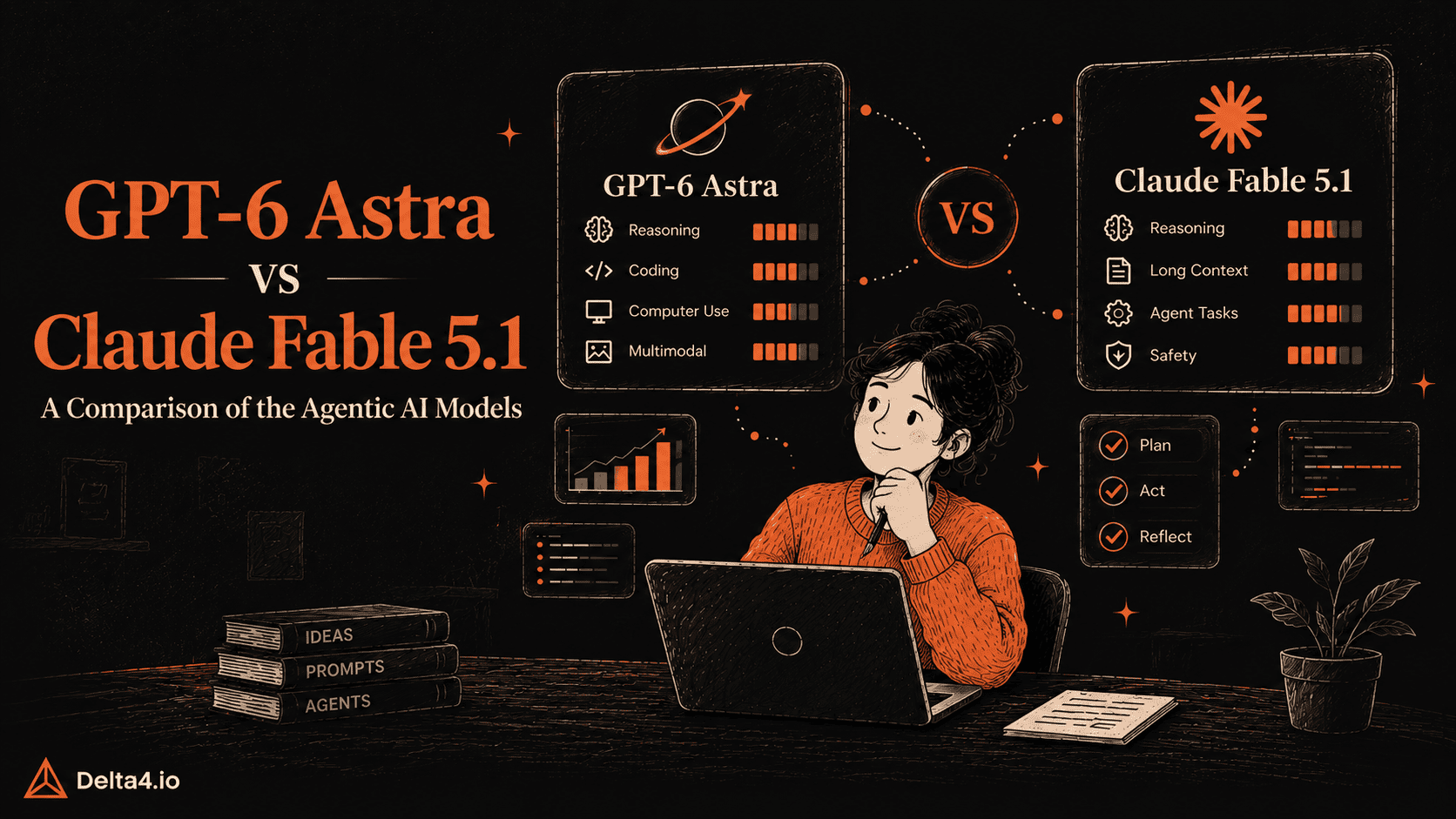
GPT-6 Astra and Claude Fable 5.1 are closely matched overall, but they lead in different kinds of work. Astra has the stronger case for computer use, technical benchmarks, and lower cost per completed task, while Fable 5.1 is better suited to very large prompts and agents that repeatedly reuse cached context. Independent testing puts them level on overall intelligence and coding-agent performance, so the better choice depends on how your workload actually runs.
Summarize this post with AI
A Comparison of the Agentic AI Models
Quick Answer
TL;DR
Release dates: Claude Fable 5.1 launched September 1, 2026. GPT-6 Astra launched September 3, 2026, starting with a limited set of organizations.
List price: Both charge $10 per million input tokens and 50permillionoutputtokens.Thegapsareincachereads(0.25 vs $1.00 per million) and in Astra’s higher rates above 272,000 input tokens.
Real cost per task: Artificial Analysis measured Astra at $3.26 per Intelligence Index task against $7.63 for Fable 5.1, because Astra used far fewer output tokens.
Coding: Independent scores are tied. OpenAI’s own table shows Astra slightly ahead on Terminal-Bench 4.0 (57.9% vs 55.8%).
Safety: Astra is the first OpenAI model to reach the “Critical” cybersecurity level. Fable 5.1 can identify software vulnerabilities but is not allowed to build exploits for them.
A fair warning: Most vendors report their benchmark scores in launch posts. Consider them as claims to test against your work.
GPT-6 Astra vs Claude Fable 5.1 is one of the biggest AI model comparisons of 2026. Anthropic released Fable 5.1 on September 1, 2026, and OpenAI followed with Astra just two days later. Both are agentic models, which means they do far more than answer questions. They can plan a task, use tools, work across software, write and test code, and continue through long-running jobs with little supervision.
Choosing between them is where things get more complicated. Price alone will not settle it, because both charge $10 per million input tokens and $50 per million output tokens. The real differences show up in computer use, coding, science, safety, long-context workloads, and what each completed task actually costs.
This comparison breaks those differences down in plain language, so you can see where each model performs better, where the trade-offs are, and which one fits your workload. Each benchmark is labelled by who reported it, making it easier to separate independent results from vendor claims.
What Is GPT-6 Astra?
GPT-6 Astra is OpenAI’s flagship model, launched on September 3, 2026. OpenAI calls it the world’s most intelligent and aligned model and positions it around computer use, browsing, software engineering, science, and professional work, per OpenAI. The idea is simple: give Astra a goal, and it works through the steps across browsers, apps, code, and documents instead of stopping at an answer. In the API, it is called gpt-6-astra.
Key Features
These are the Astra strengths that matter most when weighing it against Fable 5.1. OpenAI reports benchmark scores.
Reasoning: Five effort settings, from low to max. OpenAI reports 96.0% on GPQA Diamond and 97.6% on FrontierMath Tier 4 (v2).
Coding: OpenAI calls it its best model for software engineering to date, with 57.9% on Terminal-Bench 4.0 and 74.1% on DeepSWE v1.1.
Browser and computer use: It can fill in forms, update CRM records, run frontend QA checks, and work inside specialized software. OpenAI reports 72.6% on OSWorld 2.0 (offline set) and 92.7% on ScreenSpot-Pro.
Tool-based workflows: In the Responses API, it supports web search, file search, code interpreter, hosted shell, apply patch, computer use, MCP, skills, and tool search.
Long context: A 1,050,000-token context window with up to 128,000 output tokens. OpenAI reports 96.3% on a 512K to 1M-token retrieval test (MRCR v2 8-needle).
Professional tasks: Built to produce documents, spreadsheets, and slides that follow a company’s own templates and style. OpenAI reports 59.3% on Agents’ Last Exam.
API availability: OpenAI lists the OpenAI API, Microsoft Azure, AWS Bedrock, and ChatGPT Plus, Pro, Business, and Enterprise as access routes, rolled out in stages from launch. Enterprise admins can enable it for their workspace.
Pricing
Astra’s list price matches Fable 5.1’s, so the differences show up in caching and very long requests.
Standard rates: $10 per 1M input tokens and $50 per 1M output tokens.
Caching: $1.00 per 1M cached input tokens. Cache writes cost $12.50 per 1M.
Long requests: Prompts above 272K input tokens are billed at 2x the input and cache rates and 1.5x the output rate for the full request.
Discounts and speed: Batch and Flex run at 50% of standard rates. Fast mode costs 2x the applicable rates.
In ChatGPT: Astra usage is included in existing plan allowances, with credits available for extra usage.
What Is Claude Fable 5.1?
Claude Fable 5.1 is Anthropic’s most capable generally available model, released on September 1, 2026, as the update to Fable 5. Anthropic positions it for “demanding reasoning and long-horizon agentic work” and says it brings stronger long-running agentic coding, multistep research, and document, spreadsheet, and slide work, per Anthropic’s API documentation. In short, it is aimed at big jobs that run for hours, span many apps, and end with work ready for review. In the API, it is called claude-fable-5-1.
Key Features
Fable 5.1 is built for work that runs long and mostly unattended. Unless noted, Anthropic reports benchmark scores.
Long-running agentic work: Built for jobs that run for hours across many apps, such as working a backlog, operating a browser, or running unattended as a managed agent.
Coding: Anthropic calls it its most capable model for ambitious coding, from whole-codebase features to code review and multi-day sessions. Scores 55.8% on Terminal-Bench 4.0 (Fable 5: 42.0%) and 73.4% on CursorBench 3.2.0.
Research: 52.6% on Terminal-Bench-Science 0.1, against 24.7% for Fable 5 (standard error: 3.5 to 4.5 points).
Knowledge work: Handles multi-stage projects with little oversight, from deep research to review-ready deliverables.
Documents, spreadsheets, and slides: Anthropic says it brings stronger document, spreadsheet, and slide work, and it reads charts and tables inside files and PDFs.
Tool execution: Two beta controls arrived with this release: per-message effort and progress updates between tool calls. Forced tool use now returns an error.
Improvements over Fable 5: Per Anthropic, it matches or beats Fable 5 at low or medium effort for less cost, and performs much better at higher effort. Speed is slower than other Claude models.
Context and access: 1M-token context and 128K max output. Available on Claude Pro, Max, Team, and Enterprise, plus the Claude Platform, AWS, Google Cloud, and Microsoft Foundry.
Pricing
Fable 5.1 keeps Fable 5’s base prices and cuts the price of cache reads, where long agent loops spend much of their budget.
Standard rates: $10 per 1M input tokens and $50 per 1M output tokens, unchanged from Fable 5.
Cache reads: $0.25 per 1M tokens, 75% less than Fable 5’s $1.00. Cache writes cost $12.50 (5-minute) or $20 (1-hour) per 1M.
Estimated savings: Anthropic estimates about 25% lower cost on typical workloads and up to about 45% on highly agentic ones, compared with Fable 5.
Long context: The full 1M-token window is billed at standard rates, with no surcharge.
Discounts and options: Batch processing costs $5 input and $25 output per 1M tokens. US-only inference is available at 1.1x pricing.
GPT-6 Astra vs Claude Fable 5.1
GPT-6 Astra
Claude Fable 5.1
Maker
OpenAI
Anthropic
Launch date
September 3, 2026 (limited organizations first)
September 1, 2026 (generally available)
API model ID
gpt-6-astra
claude-fable-5-1
Context window
1,050,000 tokens
1M tokens, at standard pricing
Price per 1M tokens (input / output)
$10 / $50
$10 / $50
Cached input read, per 1M tokens
$1.00
$0.25
Above 272K input tokens
2x input and cache rates, 1.5x output, for the whole request
Claude Pro, Max, Team, Enterprise; Claude Platform; AWS; Google Cloud; Microsoft Foundry
Restricted sibling
Advanced cyber capability is gated, with wider access planned through OpenAI’s Daybreak program
Mythos 5.1, for vetted organizations
Coding and Software Development
On coding, the independent numbers say it is a tie, and the vendor numbers lean slightly toward Astra. Artificial Analysis scored GPT-6 Astra in Codex at 62 on its Coding Agent Index, level with Claude Fable 5.1 in Claude Code at 62. Each model ran inside its coding tool, so part of any gap comes from the tool and not the model.
The tie hides a cost difference. At max effort, Astra cost $7.09 per task, about 40% less than Fable 5.1, according to Artificial Analysis. The reason is token use: Astra needed about a third of the tokens its predecessor, GPT-5.6 Sol, used per task. Same score, much smaller bill.
Benchmark
GPT-6 Astra
Claude Fable 5.1
Reported by
Coding Agent Index
62 (in Codex)
62 (in Claude Code)
Artificial Analysis
Terminal-Bench 4.0 (real tasks finished from a command line)
In Codex, Astra can keep searchable notes across context windows instead of squeezing earlier work into one summary (experimental at launch). It can also ask a clarifying question while continuing to work on parts that do not depend on the answer.
Anthropic says Fable 5.1 can write its tests and use vision to check outputs against the design. Its documentation also notes trade-offs: parallel tool calling is more variable than in Fable 5, and the model sometimes rewrites whole files instead of making targeted edits.
Computer Use and Workflow Automation
Astra has the stronger case for computer-use and software automation, especially when the task involves navigating apps, clicking through interfaces, or completing multi-step workflows. The main limitation is that there is still no clean OSWorld 2.0 comparison where Astra and Fable 5.1 were tested under the same setup.
OpenAI reports Astra at 72.6% on the offline OSWorld 2.0 set, which measures how well a model works across desktop applications. That is up from 65.7% for GPT-5.6 Sol. Astra also completed tasks in about 40 minutes on average, compared with roughly 75 minutes for Sol, which OpenAI describes as a 47% reduction in task time. Claude Opus 5 scored 70.2% on the same set, but Fable 5.1 was not included.
Anthropic tested Fable 5.1 on a newer OSWorld 2.0 task release and says the results should not be compared directly with earlier published scores. MarkTechPost reports Fable 5.1 at 41.7% on the strict version of the benchmark, but the different test setup makes that number unsuitable for a direct comparison with Astra’s 72.6%.
The more useful head-to-head results come from automation benchmarks:
ScreenSpot-Pro (finding the right thing to click on a screen): Astra 92.7% vs 87.3% for the earlier Fable 5.
Artificial Analysis’s own AutomationBench-AA: Astra scored 68% and Fable 5.1 scored 59%, both at max effort, with Fable run on its default fallback setting.
There is one important caveat for Fable 5.1. Anthropic tested it with safeguards enabled, and any OSWorld task blocked by those safeguards received a score of zero. That means part of the gap may reflect safety restrictions rather than the model’s raw ability to complete the task.
For teams building agents that work inside browsers, desktop apps, or business software, Astra currently has the stronger evidence. The clearest advantage comes from the direct automation benchmarks, while OSWorld is better treated as supporting evidence because the two models were tested under different conditions.
Reasoning and Technical Benchmarks
On OpenAI’s published table, Astra leads on math and science benchmarks. Fable 5.1 leads on Humanity’s Last Exam with tools, a broad test of very hard questions. All four rows below are vendor-reported, and both vendors published the Humanity’s Last Exam figure for Fable 5.1 (65.0%).
Benchmark
GPT-6 Astra
Claude Fable 5.1
FrontierMath Tier 4 (v2)
97.6%
87.8%
GPQA Diamond (graduate-level science)
96.0%
93.7%
Terminal-Bench Science 0.1 (research tasks in a terminal)
The Terminal-Bench Science gap is about 12 points. Anthropic reports a standard error of 3.5 to 4.5 points per model on this test, so the gap is wider than that range. These are still vendor-reported scores, though, and the result is not a formal test of statistical significance.
Artificial Analysis’s September 9 write-up scores both models 53 on its Intelligence Index, a tie. OpenAI’s launch table cites an older version of the same index, with Astra at 61.2 and Fable 5.1 at 65.7, so the two sources are not on the same scale. Compare rankings and costs within one source and avoid mixing the numbers.
Safety and Cybersecurity
Both vendors restrict their most capable cybersecurity features, but they handle access and safeguards differently.
GPT-6 Astra
OpenAI says Astra is its first model to reach the “Critical” cybersecurity threshold in its Preparedness Framework. Without production safeguards, it scored 100% on ExploitBench, which tests whether a model can turn known vulnerabilities into working exploits, compared with 78.5% for GPT-5.6 Sol.
The public version refuses advanced cyber requests, including tasks such as generating proof-of-concept exploits. OpenAI plans to expand access to more capable cyber use cases through its Daybreak program.
Safety checks can also interrupt legitimate work. In ChatGPT and Codex, users may be asked to review an action before it continues, while API tasks can stop when a safeguard is triggered.
On an OpenAI-run computer-use safety test, where lower is better, Astra scored 2.4% compared with 9.5% for Fable 5.1. OpenAI also notes that Astra’s written reasoning is harder to monitor than Sol’s and identifies this as an ongoing research issue.
Claude Fable 5.1
Fable 5.1 and Mythos 5.1 use the same underlying model with different safeguards. Mythos 5.1 is available only to vetted organizations through Anthropic’s trusted-access programs.
Fable 5.1 can identify vulnerabilities in source code but will not generate working exploits. Anthropic says Claude Code users should see around 60% fewer safeguard interventions per session than with the previous safeguards used for Fable 5.
Fable 5.1’s safety classifiers can decline a request, for example in the cyber or bio categories. API customers can opt in to a beta fallback setting that retries a declined request on a model Anthropic recommends for that category. The permitted targets are Opus 4.8 and Opus 5, and Anthropic does not publish the routing by category. With Anthropic’s fallback credit, a retry is billed as if the conversation had been on the fallback model all along.
For most users, the practical difference is not which model has the stricter safety policy on paper, but how often those safeguards interrupt legitimate work. Both companies are trying to reduce unnecessary blocks while keeping higher-risk cyber capabilities restricted.
Pricing: Same Rate Card, Different Bills
Both models list at $10 per million input tokens and $50 per million output tokens, so the real differences sit in three places: caching, very long requests, and how many tokens each model spends to finish a job.
1. Caching. Agents resend the same instructions and context on every step, so cached reads add up fast. Anthropic cut Fable 5.1’s cache-read price to $0.25 per million tokens, 75% less than Fable 5, which it says lowers typical workloads by about 25% and highly agentic ones by up to about 45%. Astra’s cached reads cost $1.00 per million, per OpenAI’s API pricing.
2. Long requests. OpenAI’s docs say any Astra prompt above 272,000 input tokens is billed at 2x the input and cache rates and 1.5x the output rate for the full request. Anthropic’s pricing page says Claude models from 4.6 onward, including Fable 5.1, include the full 1M-token window at standard rates.
Here is what those two rules do to the bill. These are list-price illustrations, not measurements.
Scenario
GPT-6 Astra
Claude Fable 5.1
200,000 input + 5,000 output tokens, no caching
$2.25
$2.25
300,000 input + 5,000 output tokens, no caching
$6.38
$3.25
A 100,000-token cached prefix read 1,000 times (100M cached tokens, reads only)
$100
$25
How the middle row works: Astra charges 300,000 tokens at 20permillion(6.00) plus 5,000 output tokens at 75permillion(0.375). Fable 5.1 charges 10permillionforinput(3.00) and 50permillionforoutput(0.25).
3. Tokens spent per task. This is where Astra pulls ahead. Artificial Analysis measures what each model costs to complete the same set of tasks, and the rate card turns out to matter less than the token count.
Artificial Analysis test (September 9, 2026)
GPT-6 Astra (max effort)
Claude Fable 5.1 (max effort, default fallback)
Intelligence Index, cost per task
$3.26
$7.63
Intelligence Index, output tokens per task
27,000
78,000
Coding Agent Index, cost per task
$7.09
Not published; Astra is about 40% cheaper
“Default fallback” is Artificial Analysis’s label for a Fable 5.1 run with Anthropic’s fallback setting on, which lets declined requests be retried on another Claude model. Artificial Analysis also says every Astra effort level, from $0.82 per task at low to $3.26 at max, sits on its cost frontier for the Intelligence Index.
OpenAI’s own estimates point the same way. It puts Astra’s API cost per task at roughly 63% below Fable 5.1 on Terminal-Bench 4.0 and roughly 31% below on Terminal-Bench Science 0.1, at the effort settings OpenAI chose. Those are vendor estimates, so weigh them accordingly.
The takeaway: Astra’s lower cost per task can outweigh Fable 5.1’s cheaper caching, but only if your workload looks like the benchmark mix. Huge prompts and cache-heavy loops flip the result. Measure cost per finished task on your traces before committing.
One more lever: OpenAI offers a Fast mode for Astra with up to 2x the speed at 2x the Standard price. Both vendors discount batch processing by 50%.
Access and Availability
Fable 5.1 was generally available on launch day. Astra started with a limited set of organizations and expanded in stages across ChatGPT, the API, and cloud platforms. Access depends on your plan and workspace settings, so check your account or admin console before planning around either one.
GPT-6 Astra
Claude Fable 5.1
Apps
ChatGPT Plus, Pro, Business, Enterprise. GPT-6 Astra Pro on Pro, Business, Enterprise
Claude Pro, Max, Team, Enterprise
API
OpenAI API as gpt-6-astra; no free tier
Claude API as claude-fable-5-1
Cloud platforms
Microsoft Azure, AWS Bedrock
AWS, Google Cloud, Microsoft Foundry
Data handling
Zero Data Retention for eligible API customers
30-day retention by default. Eligible enterprise customers can use zero data retention until Enterprise Frontier Safeguards is available
Admin notes
Enterprise admins can enable Astra for their workspace. It was off by default at launch
US-only inference is available at 1.1x pricing
Developers moving from Fable 5 should test first. According to MarkTechPost’s summary of Anthropic’s launch notes, Fable 5.1 returns an error when a request forces a specific tool (tool_choice set to any or tool), and editing earlier turns of a conversation can invalidate its stored thinking.
Choosing the Right Model
The better model depends on what your agents actually do, how much context they process, and how much each completed task costs.
Desktop and browser-based agents → GPT-6 Astra. Choose Astra if your agents regularly navigate apps, interact with interfaces, or complete multi-step software workflows. It has the stronger published computer-use and automation results.
Lower cost per completed agent task → GPT-6 Astra. Astra is the better starting point when you run large volumes of agent tasks and cost per finished job matters more than cache pricing alone.
Math and science-heavy workloads → GPT-6 Astra. OpenAI’s published results give Astra the advantage across several mathematical and scientific benchmarks.
Very large prompts above 272K tokens → Claude Fable 5.1. Fable is more attractive when you regularly send large contexts because it does not add Astra’s long-context surcharge.
Cache-heavy agent loops → Claude Fable 5.1. Choose Fable if your agents repeatedly read the same large context. Its cached-input reads cost less, which can add up over long-running workflows.
Broad reasoning tasks → Test both. Fable 5.1 leads on Humanity’s Last Exam with tools, while Astra leads on several math and science benchmarks. Independent overall intelligence testing puts them level, so there is no clear general reasoning winner.
Existing Codex or Claude Code workflow → Stay with your current stack unless testing shows a clear gain. Artificial Analysis gives both coding-agent setups the same score, so switching models may not improve results enough to justify changing tools.
Defensive security research → Access may matter more than model choice. Both vendors gate their most advanced cyber capabilities, so eligibility for their restricted-access programs may determine which model you can use.
Frequently Asked Questions
Is GPT-6 Astra better than Claude Fable 5.1?
Neither model is clearly better overall. In Artificial Analysis’s September 9 testing, GPT-6 Astra and Claude Fable 5.1 tie on the Intelligence Index at 53 each and the Coding Agent Index at 62 each, while Astra costs less per task. OpenAI’s own table shows Astra ahead on most math, science, and computer-use rows, while Fable 5.1 scores higher on Humanity’s Last Exam with tools at 65.0% versus 57.2%.
How much do GPT-6 Astra and Claude Fable 5.1 cost?
Both models list at $10 per million input tokens and $50 per million output tokens, with 50% off for batch jobs. Cached reads cost $0.25 per million on Claude Fable 5.1 and $1.00 on GPT-6 Astra. Astra adds higher rates for requests above 272,000 input tokens, while Fable 5.1 adds no surcharge across its 1M-token context window.
Which model is better for coding?
The independent coding scores are level at 62 each. Astra leads OpenAI’s published coding benchmarks by small margins, including 57.9% versus 55.8% on Terminal-Bench 4.0, and Artificial Analysis found it cheaper per coding task. Anthropic reports 73.4% for Fable 5.1 on CursorBench 3.2.0. Since each model was tested inside its own coding tool, Codex or Claude Code, the better choice depends on the tool you already use.
Which model is better for computer use?
GPT-6 Astra has stronger published computer-use results, including 72.6% on the OSWorld 2.0 offline set and 92.7% on ScreenSpot-Pro, compared with 87.3% for the earlier Fable 5. Anthropic’s OSWorld 2.0 numbers use a newer task release and are not directly comparable, so there is no clean head-to-head result yet.
What is the difference between Claude Fable 5.1 and Mythos 5.1?
Claude Fable 5.1 and Mythos 5.1 are the same base model with different safeguards. Fable 5.1 is generally available, while Mythos 5.1 has looser safeguards for cybersecurity and life-science work and is limited to vetted organizations.
What does Critical cybersecurity level mean for Astra?
OpenAI says GPT-6 Astra meets the Critical threshold in its Preparedness Framework, marking a major jump in cyber capability, including finding and developing previously unknown exploits. The released version refuses advanced tasks such as writing proof-of-concept exploits, and OpenAI plans wider access for defenders through its Daybreak program.
Can I use both models today?
Claude Fable 5.1 is available on Claude Pro, Max, Team, and Enterprise plans and through the Claude API. OpenAI lists ChatGPT Plus, Pro, Business, and Enterprise, the OpenAI API, Microsoft Azure, and AWS Bedrock as GPT-6 Astra access routes, rolled out in stages from September 3. Enterprise admins can enable Astra for their workspace, but current access depends on your account.
Conclusion
The better model depends less on which one wins the most benchmarks and more on how your agents actually work. If they spend most of their time inside browsers, desktop apps, or other software, GPT-6 Astra is the stronger starting point. It has the better published computer-use, math, and science results, and Artificial Analysis found that it completed comparable tasks with fewer tokens and a lower cost per finished job.
Claude Fable 5.1 makes more sense when context size matters more than raw task efficiency. If your prompts regularly go beyond 272K tokens, or your agents keep rereading the same large context, Fable’s lack of a long-context surcharge and cheaper cached reads can reduce costs significantly over time.
For coding and general intelligence, the independent results are much closer. That means switching models just because one wins a few vendor benchmarks may not improve your real workflow. If you already use Codex or Claude Code effectively, test before changing your stack.
The most useful comparison is therefore not benchmark score versus benchmark score, but cost and reliability per completed task. Run both models on a small set of your real workloads, track how often they finish without intervention, how long they take, how many tokens they use, and what each successful result costs. That will tell you far more than any leaderboard about which model is actually better for your team.
Himanshu is Head of Growth & Engineering at Delta4 Infotech, writing about AI agents, MCP, and no-code automation from a go-to-market view. He covers how teams evaluate, adopt, and get real value from AI tools, translating what the tech does into what it means for a business.