Claude Sonnet 5 vs Opus 4.8

Written by
Taniya
Reviewed by
Himanshu
Last edited 27 July 2026
Expert Verified
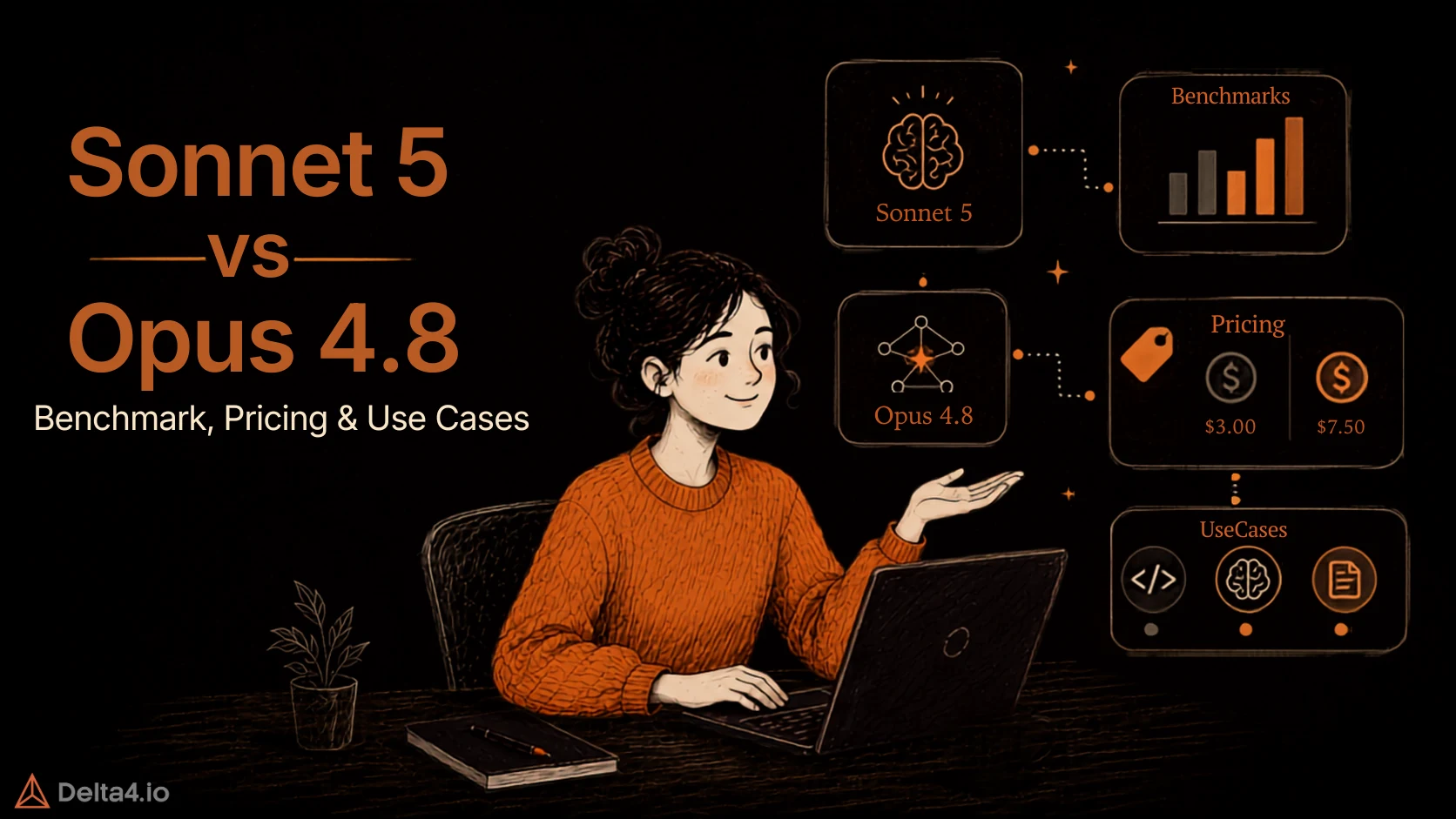
Which Claude Model Should You Use in 2026
TL;DR
- Claude Sonnet 5 (launched June 30, 2026) closes most of the benchmark gap to Claude Opus 4.8 (launched May 28, 2026) while costing 40% less at standard pricing and 60% less through the August 31, 2026 introductory window.
- Opus 4.8 still leads on hard coding (SWE-bench Pro), olympiad-level math, and computer use. Sonnet 5 wins on Terminal-Bench 2.1 and ties on knowledge work.
- Both models share a 1M token context window, a 128K token output cap, and a January 2026 knowledge cutoff. The real difference is depth of reasoning per task, not capacity.
- Sonnet 5’s new tokenizer produces roughly 30% more tokens for the same input text, which quietly eats into the sticker-price savings unless you recount your prompts.
- Default to Sonnet 5 for production agents, coding, and content work. Reserve Opus 4.8 for accuracy-critical reasoning, deep multi-file coding, and anything security-sensitive.
This comparison walks through the benchmark numbers Anthropic and independent outlets published, the actual price-per-task math (not just the sticker price), the safety and cybersecurity differences that matter for agentic deployments, and a concrete framework for when Opus 4.8 still justifies its premium.
Claude Sonnet 5 vs Opus 4.8: Benchmark Head-to-Head
Both models were tested with adaptive thinking enabled. Here’s how they stack up on the evaluations Anthropic published at launch, cross-checked against Sonnet 4.6 for context.
| Benchmark | Sonnet 5 | Opus 4.8 | Sonnet 4.6 |
|---|---|---|---|
| SWE-bench Pro (agentic coding) | 63.2% | 69.2% | 58.1% |
| Terminal-Bench 2.1 (shell tasks) | 80.4% | 74.6% | 67.0% |
| OSWorld-Verified (computer use) | 81.2% | 83.4% | 78.5% |
| Humanity’s Last Exam, with tools | 57.4% | 57.9% | 46.8% |
| GDPval-AA v2 (knowledge work, Elo) | 1,618 | 1,615 | — |
| USAMO 2026 (olympiad math) | 79.5% | 96.7% | — |
Figures per MarkTechPost’s benchmark breakdown, TechCrunch’s launch coverage, and The Decoder’s report, all citing Anthropic’s June 30 launch post and system card. USAMO figure from llm-stats.com’s comparison.
The pattern is consistent. Opus 4.8 keeps a real lead where a task needs sustained, high-stakes reasoning: SWE-bench Pro’s harder multi-file tasks, and especially USAMO, where a 17-point gap says something about how far Sonnet-class reasoning still trails on proof-heavy math. Sonnet 5 pulls ahead specifically on Terminal-Bench 2.1, a 5.8-point win Anthropic’s own system card credits to the mini-SWE-agent harness, and it edges Opus on knowledge work. On Humanity’s Last Exam with tools, the two are close enough (57.4% vs 57.9%) that the gap disappears into noise.
Sonnet vs Opus Pricing: The Real Price-Per-Task Math
The sticker prices, confirmed on Anthropic’s live models page:
| Sonnet 5, intro (through Aug 31, 2026) | Sonnet 5, standard | Opus 4.8 |
|---|---|---|
| Input | $2 / MTok | $5 / MTok |
| Output | $10 / MTok | $15 / MTok |
That’s 40% cheaper on both input and output at standard pricing, and 60% cheaper during the introductory window. On paper, an agentic workflow that costs $1,000 a day on Opus 4.8 should land near $400 a day on Sonnet 5 at standard rates.
The catch is the tokenizer. Sonnet 5 ships with a new tokenizer that produces roughly 30% more tokens for the same input text than Sonnet 4.6 did, and Anthropic’s own docs put the range as high as 1.35x depending on content type. Anthropic set the introductory pricing specifically to offset this, describing the transition as roughly cost-neutral against Sonnet 4.6. But if you’re comparing Sonnet 5 to Opus 4.8 rather than to its own predecessor, that extra token volume chips away at the headline discount. Recount your actual prompts with Anthropic’s token counting tool before you budget off the sticker price.
Effort level matters too. One hands-on review from CodeRabbit found that cranking Sonnet 5 to maximum effort roughly doubled the cost of a code review task without finding meaningfully more bugs. The savings show up at low and medium effort, where most day-to-day work actually runs. At xhigh effort on hard tasks, Sonnet 5 can cost more than Opus 4.8 for comparable output.
Agentic Reliability: How the Two Models Actually Behave
Benchmarks measure a snapshot. Agentic reliability shows up over a full session, and that’s where the two models diverge in ways a spec sheet won’t tell you.
Sonnet 5’s biggest behavioral shift is that it now writes tests before it writes the feature, then runs everything before reporting back. That single change explains a lot of the qualitative feedback from early testers. One team described handing Sonnet 5 a two-part job, updating account tiers and sending an announcement, and having it finish end to end where earlier Sonnet versions would stall halfway.
That thoroughness has a cost, though. CodeRabbit’s review noted Sonnet 5 is slower than Sonnet 4.6 on small requests, tends to hand back more helper functions and test files than a one-line change calls for, and uses noticeably more tokens per response. On a large feature, that looks like good engineering discipline. On a quick fix, it looks like a model that can’t stop tidying up.
Not every developer sees this as a win. On the Hacker News launch thread, one commenter using Sonnet mostly for agent-assisted rather than fully autonomous development pushed back directly, arguing that models optimized harder for full autonomy tend to get worse at taking narrow, specific instructions without over-delivering. If your workflow is closer to pair programming than to unattended agents, that’s worth testing on your own tasks before migrating wholesale.
Opus 4.8’s improvements run in a different direction: self-awareness about its own uncertainty. Anthropic reports it’s about four times less likely than Opus 4.7 to let a flaw in its own code pass unremarked. For teams running long, unattended Claude Code sessions or MCP-connected agent workflows across many tools, that honesty gain matters more than a benchmark percentage point, since the failure mode it prevents is silent, not loud.
Agentic Security: Cybersecurity Safeguards in Sonnet 5 vs Opus 4.8
If either model is going to touch credentials, run terminal commands, or operate with reduced human oversight, the safety posture matters as much as the benchmark score.
Sonnet 5 is the first Sonnet-tier model with real-time cybersecurity safeguards built in, which detect and block dangerous cyber usage as requests come in. Anthropic explicitly did not train Sonnet 5 on cybersecurity tasks. In a joint evaluation built with Mozilla testing exploit development against Firefox 147, neither Sonnet model produced a full working exploit, scoring 0.0% on both counts. Sonnet 5 showed only a slightly higher partial-success rate than Sonnet 4.6, well below what Opus-class models score on the same test.
Opus 4.8 sits in a different risk tier by design. Its alignment assessment found rates of misaligned behavior, deception, and cooperation with misuse that are substantially lower than Opus 4.7 and close to Anthropic’s most-aligned research model. That’s the tradeoff: Opus 4.8 is both more capable at legitimate high-risk work (security research, red-teaming, sanctioned penetration testing) and more carefully governed around it. Sonnet 5’s weaker cyber capability isn’t a flaw for most teams. It’s a feature if you never wanted a mid-tier model handling that class of task in the first place. Anthropic’s own guidance is direct on this point: route real cybersecurity work to Opus 4.8, not Sonnet 5.
On the honesty side covered above, Sonnet 5 also shows lower rates of hallucination and sycophancy than Sonnet 4.6, and better resistance to prompt injection in agentic contexts. It’s an improvement over its own predecessor on every safety axis Anthropic tested. It’s just not at Opus 4.8’s level yet, and Anthropic says so plainly in the system card.
Where Opus 4.8 Still Earns Its Premium
Sonnet 5 makes Opus optional for most day-to-day work. It doesn’t make Opus unnecessary. Three situations still justify the 40-60% price premium:
- Deep, multi-file coding on legacy systems : The 6-point SWE-bench Pro gap (69.2% vs 63.2%) is concentrated in exactly this kind of task: large codebases, ambiguous requirements, and changes that touch code nobody wants to own. If your review process is thin and the cost of a wrong merge is high, that gap is real money.
- Math-heavy or proof-based reasoning : A 17-point spread on USAMO 2026 isn’t noise. If your workload involves rigorous quantitative reasoning, financial modeling with edge cases, or scientific computation, Opus 4.8 is doing meaningfully more work under the hood.
- Sanctioned security work : As covered above, Opus 4.8 is the model Anthropic itself recommends for reduced-guardrail cybersecurity tasks. Sonnet 5 was never meant to compete here.
Outside those three cases, the benchmark gap is close enough that price and latency become the deciding factor, not raw capability.
Which Model Should You Actually Use
A simple routing rule covers most teams: default to Sonnet 5, escalate to Opus 4.8 only for the specific step that needs it.
- Customer-facing agents and support automation – Sonnet 5’s speed and lower cost per interaction make it the better fit for high-volume, latency-sensitive workloads, the same category covered in our guide to building an AI customer service agent.
- Standard coding, content drafting, and internal tooling – Sonnet 5 at medium effort delivers Opus-adjacent quality for a fraction of the cost. Save xhigh effort for the tasks that genuinely need it.
- Architecture decisions, large refactors, and anything security-sensitive – Escalate to Opus 4.8. The reliability gain is worth the per-token cost when a mistake is expensive to unwind.
- Mixed pipelines – Anthropic’s own framing supports this directly: use the effort parameter to tune Sonnet 5 up before reaching for Opus, and reserve Opus for the steps where the effort dial alone won’t close the gap.
The Bottom Line
Six weeks after Opus 4.8 shipped as the safe, expensive default, Sonnet 5 makes that default worth questioning. It isn’t the stronger model. It’s the model that’s strong enough for most of what teams actually run, at a price that makes testing it on your own workload close to free. Pilot it against your highest-volume task first, recount your tokens against the new tokenizer before you trust the sticker price, and keep Opus 4.8 on call for the handful of jobs where being wrong costs more than the upgrade would have.
Frequently asked questions
What is the difference between Claude Sonnet and Claude Opus?
Sonnet and Opus are two tiers in Anthropic’s Claude model family, not different products. Sonnet is the mid-tier, agentic workhorse, built for speed and cost efficiency across everyday coding, writing, and support tasks. Opus is the top tier, built for sustained, high-stakes reasoning: large codebases, complex math, and security-critical review. Opus costs more per token and takes longer to respond, because it reasons more deeply.
Which Claude model should I use?
Start with Claude Sonnet 5 for most work. It handles day-to-day coding, content drafting, summarization, and customer-facing agents at a fraction of Opus 4.8’s cost. Switch to Opus 4.8 only when a task involves deep multi-file coding, rigorous math or financial modeling, or work where a wrong answer is expensive to unwind. Anthropic’s own platform docs recommend the same default-then-escalate pattern rather than picking one model for everything.
Is Claude Sonnet 5 as good as Opus 4.8?
Close, but not equal. Sonnet 5 ties or beats Opus 4.8 on Terminal-Bench 2.1 and knowledge-work benchmarks, and sits within a few points on Humanity’s Last Exam with tools. Opus 4.8 still leads by a wide margin on SWE-bench Pro (69.2% vs 63.2%) and olympiad-level math (96.7% vs 79.5%), so “as good” depends entirely on which task you’re running.
How much cheaper is Claude Sonnet 5 than Opus 4.8?
At standard pricing, Sonnet 5 costs 40% less than Opus 4.8 on both input and output tokens ($3/$15 vs $5/$25 per million). Through the August 31, 2026 introductory window, that gap widens to 60%. There’s a catch, though. Sonnet 5’s new tokenizer produces roughly 30% more tokens for the same input, so real savings run lower than the sticker price suggests. Our team recounts prompts before trusting any headline discount, whether we’re evaluating a model for MCP360 or elsewhere.
Do Claude Sonnet 5 and Opus 4.8 have the same context window?
Yes. Both models support a 1 million token context window and cap output at 128,000 tokens per response (up to 300,000 on the Batch API with a beta header). Both also share a January 2026 knowledge cutoff. The specs are nearly identical between the two, which is exactly why the real decision comes down to reasoning depth and price, not capacity.
When should I use Opus 4.8 instead of Sonnet 5?
Reach for Opus 4.8 in three situations: deep, multi-file coding on legacy systems where a wrong merge is costly, math-heavy or proof-based reasoning where accuracy compounds, and sanctioned cybersecurity work, since Anthropic built Opus 4.8 with stronger safeguards for that category. Outside those cases, Sonnet 5 at medium or high effort closes most of the gap for a fraction of the price.
Is Claude Sonnet 5 safe enough for agentic tasks that call external tools?
Yes, for most workloads. Sonnet 5 ships with real-time cybersecurity safeguards and showed lower hallucination and prompt-injection rates than Sonnet 4.6 in Anthropic’s own testing. It wasn’t trained on cybersecurity tasks, so its real-world exploit capability stays well below Opus 4.8’s. For agents that connect through a gateway like MCP360 to dozens of tools, that’s a reasonable safety floor for routine automation, not for red-team or sanctioned security work.
Can Claude Sonnet 5 power customer support agents?
Yes, and it’s a strong fit. Sonnet 5’s lower latency and cost per interaction suit high-volume, customer-facing workloads better than Opus 4.8, which reasons more slowly and costs more per token. Platforms like YourGPT that run no-code support and sales agents benefit most from Sonnet 5 on routine tickets, with Opus reserved for the rare escalation where getting the answer wrong carries real cost.

Article by
TaniyaPeople & AI at Workplace
Taniya writes at the intersection of people and AI at Delta4 Infotech. From the people-and-culture side of the business, she covers how AI agents, automation, and new tools are reshaping hiring, onboarding, and the way teams work — always keeping people at the center.