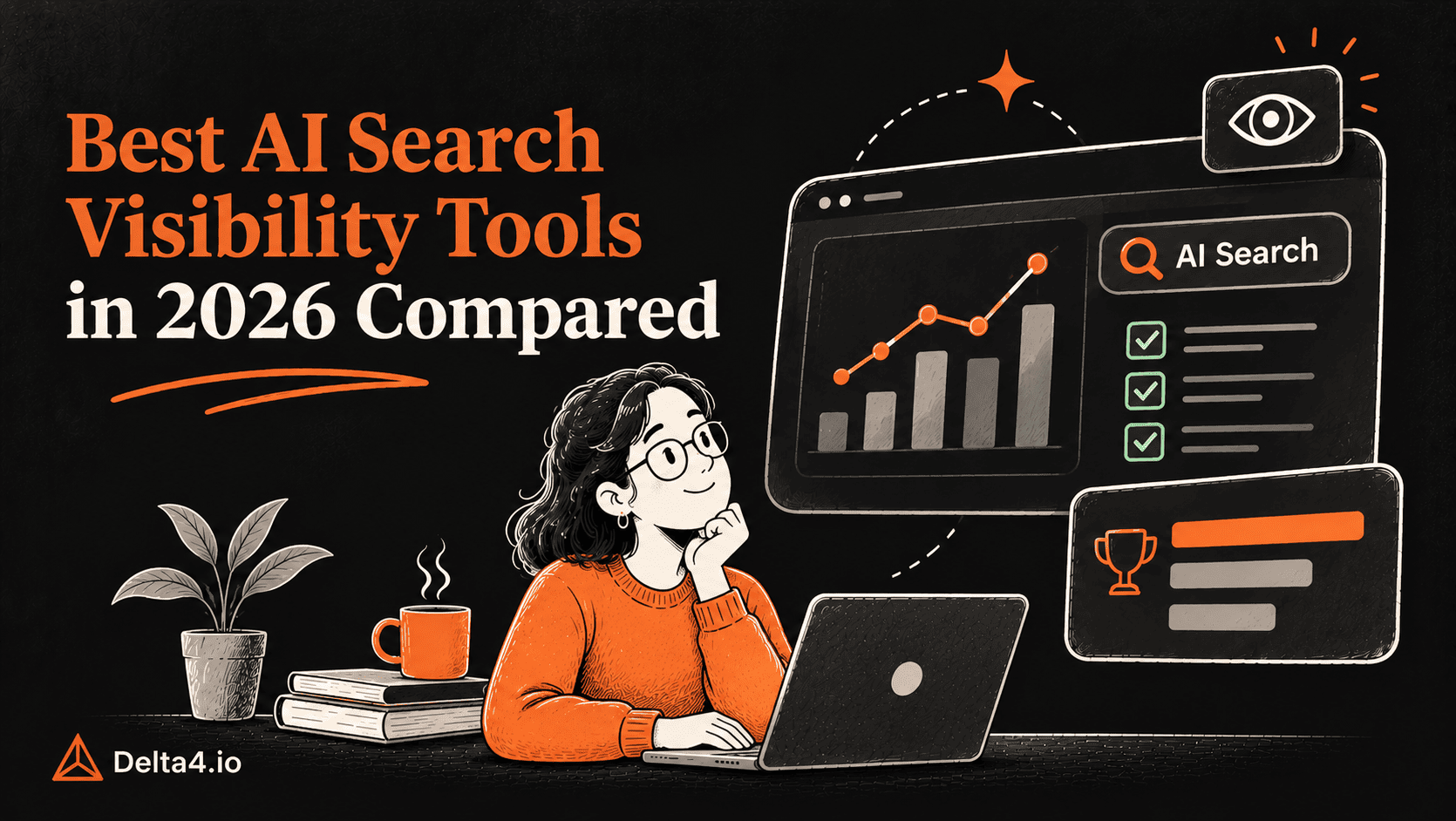
Best AI Search Visibility Tools in 2026 Compared

Written by
Rajni
Reviewed by
Himanshu
Published 19 November 2026
Expert Verified
Quick Answer
The best AI search visibility tools in 2026 include Semrush, Ahrefs Brand Radar, Peec AI, Otterly.AI, SE Visible, Scrunch, Profound, and Writesonic. These tools help you see whether AI answers mention your brand, which pages they cite, and how often competitors appear for the same questions.
To narrow your shortlist, check which AI platforms each tool covers, how many prompts your plan can track, and whether its reports show the sources behind each answer.
TL;DR
- What these tools track. AI search visibility tools run a sample of prompts across supported platforms such as ChatGPT, Gemini, Perplexity, and Google AI Overviews. They show when your brand and competitors appear, which pages AI answers cite, and how your share of voice changes.
- What we compared. We reviewed eight tools across AI platform coverage, prompt limits, features, and pricing. The comparison uses vendor documentation where available and labels third-party figures. It’s a desk review without hands-on testing.
- What you’ll pay. Most published entry plans in this comparison range from $29 to $300 per month. Otterly.AI has the lowest listed starting price at $29 per month, while Profound is listed as quote-only. Check whether usage is billed by tracked prompt or by each run across models and days. Confirm which AI platforms cost extra.
- Where to start. If you already use Semrush or Ahrefs, evaluate their visibility tools first. Consider Otterly.AI for a low-cost pilot, Peec AI for unlimited users, and SE Visible or Scrunch for higher prompt allowances. Profound is an enterprise option, while Writesonic suits teams that want tracking alongside content creation.
- How to read the results. Visibility scores reflect the prompts each tool samples, and scoring methods vary. Use the dashboard to track mentions and citations, then check your own AI referral traffic and conversions to see what visitors do after they arrive.
AI search visibility tools help businesses understand how often their brands appear in AI-generated answers. But with so many tools available in 2026, choosing the right one can be confusing.
Some tools track brand mentions in ChatGPT and Gemini, while others monitor competitor visibility, website citations, and AI search traffic. The challenge is finding a tool that offers insightful information without paying for features you don’t need.
So, which AI search visibility tool should you choose? This guide compares 8 AI search visibility tools based on their features, pricing, tracking capabilities, and limitations. Whether you’re a marketer, SEO professional, or business owner, you’ll find out which tool best fits your needs and budget.
What is an AI Search Visibility Tool?

An AI search visibility tool tracks how brands, products, and websites appear in AI-generated answers across ChatGPT, Gemini, Perplexity, and Google AI Overviews.
Also known as AI search monitoring tools, LLM visibility tools, GEO tools, or AEO tools, these platforms monitor brand mentions, citations, and competitor visibility.
Unlike traditional SEO tools that focus on search rankings, AI visibility tools measure:
- Brand Mentions: How often AI platforms mention or recommend your brand.
- Website Citations: Which websites AI-generated answers reference.
- AI Share of Voice: How frequently your brand appears compared with competitors.
- Prompt Visibility: Whether your brand appears in responses to relevant user questions.
Example: Your website might rank on Google’s first page for “best project management software” but rarely appear in ChatGPT’s recommendations. An AI visibility tool helps identify this gap and shows which competitors appear instead.
Key Metrics to Track with AI Visibility Tools
A good AI visibility tool should do more than track brand mentions. It should show how AI platforms represent your brand, how you compare with competitors, and where your visibility can improve.
Here are the key metrics to consider:
- Brand Visibility: How often your brand appears in AI-generated answers.
- Share of Voice: How frequently your brand appears compared with competitors.
- Position: Where your brand appears in AI-generated recommendations or lists.
- Citations and Sources: Which websites and URLs AI platforms reference when generating answers.
- Brand Sentiment: Whether AI responses describe your brand positively, negatively, or neutrally.
- Prompt Coverage: Whether your brand appears for relevant customer questions and search prompts.
- AI Traffic: Visits from AI search platforms and activity from AI crawlers.
The best AI visibility tools connect these metrics to actionable insights, helping businesses identify missing mentions, understand competitor visibility, and prioritize improvements.
Factors to Consider When Comparing AI Visibility Tools
We selected eight AI search visibility tools, including SEO platforms, dedicated AI trackers, and enterprise solutions. Each tool was compared based on the following factors:
- AI Platform Coverage: Support for ChatGPT, Gemini, Perplexity, Google AI Overviews, and other AI engines.
- Prompt Tracking: Number of prompts supported and how frequently results are updated.
- Pricing and Limits: Subscription costs, plan restrictions, and additional charges.
- Brand Visibility Metrics: Ability to track brand mentions, share of voice, sentiment, and positioning in AI-generated answers.
- Competitor Analysis: How effectively the tool monitors competitors and identifies visibility gaps.
- Citation and Source Tracking: Ability to identify websites and URLs referenced in AI-generated responses.
- Features and Recommendations: Availability of content audits, visibility insights, and suggestions for improvement.
- Reporting and Integrations: Support for reports, data exports, APIs, and connections with existing marketing tools.
- Ease of Use: Setup requirements, dashboard accessibility, and suitability for different experience levels.
- Best Use Cases: Suitability for small businesses, SEO teams, marketing agencies, and enterprises.
The comparison is based on official product documentation, pricing pages, and third-party sources where needed. The tools were not tested hands-on, so their accuracy, ease of use, and performance have not been independently verified.
Tools are compared by their features and suitability rather than ranked from best to worst. Pricing and plan details may change, so check the vendor’s website before purchasing.
Quick Glance
- Semrush AI Visibility Toolkit: Semrush’s add-on for tracking brand mentions in AI answers, with prompt research and an AI crawler audit alongside its SEO suite.
- Ahrefs Brand Radar: Ahrefs’ index of search-backed prompts that lets you look up any brand across seven AI platforms, with custom prompt tracking on top.
- Peec AI: A focused analytics platform for marketing teams and agencies, with daily tracking, source analysis and unlimited users on every plan.
- Otterly.AI: A low-cost monitoring tool that tracks brand mentions, citations and sentiment daily and adds GEO audits.
- SE Visible (by SE Ranking): SE Ranking’s stand-alone AI visibility tracker, built around large prompt allowances and competitor benchmarking.
- Scrunch: A platform for tracking AI visibility with personas, page audits and AI agent traffic monitoring across seven platforms.
- Profound: An enterprise-focused AI visibility platform with a free trial, custom Enterprise pricing and AI agents for content work.
- Writesonic (GEO): A content platform that bundles AI search tracking with an article writer and SEO audits, with tracking from its Basic plan.
Best AI Search Visibility Tools
Each tool below gets the same breakdown: what it does, its features, pros and cons, pricing, and who it suits best. Every pricing note says whether the figure is official, taken from the vendor’s own page, or reported by reviewers.
1. Semrush AI Visibility Toolkit
If your team already works in Semrush, its AI Visibility Toolkit is the closest add-on. Its knowledge base says it is built for SMBs, agencies and mid-market teams. It benchmarks how your brand appears in AI-generated answers and tracks chosen prompts every day. A site audit also checks whether AI crawlers can reach your pages.
Features
- Visibility Overview with an AI Visibility Score for any brand, worldwide or by region
- Competitor Research showing prompts and topics where others are cited but you aren’t
- Prompt Research with topic-level volume, difficulty and intent
- Brand Performance reports on share of voice, sentiment and key narratives, with recommendations
- Daily Prompt Tracking on platforms such as Google AI Mode and ChatGPT
- AI Search Site Audit that flags blockers for AI crawlers
Pros
- Prompt tracking covers 220+ countries and territories
- Prompt research helps you choose what to track before you spend prompts
- Tracking, research and the crawler audit live in one place
- CSV exports (up to 1,000 rows) and presentation-ready reports through My Reports
- Bundled with the SEO toolkit in Semrush One
Cons
- Only 25 tracked prompts at the entry price, and extra domains, users and prompt packs add cost
- Brand Performance reports refresh weekly, not daily
- The documentation doesn’t list every engine covered
Pricing
- $99 a month: 1 project, 1 Brand Performance domain, 25 tracked prompts, AI search checks for up to 100 pages
- Extras: 50 more prompts for $60 a month, an extra domain for $99, an extra user license for $99
- Semrush One bundles the SEO and AI toolkits with 50, 100 or 200 prompts (monthly prices of $199, $299 and $549 are reported)
- No free trial for the stand-alone toolkit, but Semrush’s help center says free accounts can try Semrush One free for 7 days
Best For: Teams already working inside Semrush who want AI tracking beside their SEO data. A sensible first step if 25 prompts is enough to start.
2. Ahrefs Brand Radar
Brand Radar flips the usual setup. Instead of starting from your own prompt list, Ahrefs‘ index lets you look up any brand, product or person across 405+ million search-backed prompts on seven AI platforms, according to its help center. You can also add Custom Prompts to track your own questions daily, weekly or monthly.
Features
- AI visibility index covering Google AI Overviews and AI Mode, ChatGPT, Perplexity, Gemini, Copilot and Grok
- Custom Prompts, with Claude available for custom prompts only
- Share of voice, mentions, citations and impressions against competitors
- Top cited pages and domains
- Search demand data, plus YouTube, Reddit and TikTok indexes in beta
- API, MCP, a Looker Studio connector and Report Builder widgets
Pros
- No cap on how many brands or domains you can analyze
- Data is there from day one, with no prompt list to build first
- The index uses People Also Ask questions, so it mirrors search demand
- Custom Prompts checks are included in paid Ahrefs plans from Lite upward
- You can buy only the index or only custom prompts
Cons
- The chatbot index refreshes once a month, and Ahrefs says it can’t currently collect new Grok data
- Pricing counts “checks,” not prompts: a Claude check uses 8, and 25 prompts daily on five platforms is 25 × 5 × 30 = 3,750 checks
- The beta indexes become a paid add-on later
Pricing
- $199 a month per platform index, or $699 for all platforms, including 2,500 custom-prompt checks
- Custom Prompts alone: Basic $50 (2,500 checks), Growth $100 (7,000), Scale $250 (25,000)
- Paid Ahrefs plans include 150 (Lite), 300 (Standard) or 600 (Advanced) checks, per Ahrefs’ custom prompts guide
- YouTube, Reddit and TikTok indexes: free on paid plans during beta
Best For: Research-minded SEO teams, especially those already on Ahrefs, who want market-level benchmarking as well as tracking of their own prompts.
3. Peec AI
Peec AI is built for marketing teams and agencies that want clear analytics rather than a toolbox. It tracks visibility, position, sentiment and share of voice every day, shows which sources AI relies on, and ranks recommended actions to close gaps. Every self-serve plan on its pricing page includes unlimited users.
Features
- Daily visibility overview with position, sentiment and share of voice
- Source analytics with domain and URL detail, citation share and source classification
- Gap analysis of sources that name competitors but not you, plus ranked recommended actions
- Prompt discovery with a relative volume score (1 to 5), suggestions and intent classification
- Crawlability audit of which AI bots your robots.txt allows (40+ bots) and AI referral tracking
- Peec Agent with included credits and pre-built skills for reports and diagnostics
Pros
- Unlimited users on every plan
- Daily tracking on every self-serve plan
- Position tracking and gap analysis go beyond counting mentions
- Integrations with CDN and log providers such as Cloudflare, Vercel and AWS for bot analytics
- Looker Studio on Advanced, and API access and SSO on Enterprise
Cons
- Only 3 models per self-serve plan, with extra models as paid add-ons
- Claude, GPT-5 Search and DeepSeek are listed under Enterprise only
Pricing
- Starter: 50 prompts, 1 project. Pro: 150 prompts, 2 projects. Advanced: 350 prompts, 5 projects, multi-country tracking, Looker Studio
- All self-serve plans: choose 3 models, unlimited users, daily tracking
- Enterprise: custom, with all models, API, SSO and up to 13 LLMs
- Annual billing takes 15% off (Peec’s own FAQ)
- Reported prices: $95, $245 and $495 a month, or about $80, $205 and $420 billed annually (Xtrusio). Some regions see €85, €205 and €425 (GeoToolbox)
- Free trial: offered on the page, with no length stated
Best For: Marketing teams and agencies that want focused analytics with no per-seat fees and can work with three engines at a time.
4. Otterly.AI
Otterly.AI is the low-cost entry point in this comparison. It runs your chosen prompts daily on four AI engines and reports mentions, citations and sentiment. It also audits your URLs for AI readiness and suggests fixes. Plans start at $29 a month, and every plan, add-on and limit is listed on one pricing page.
Features
- Daily tracking of ChatGPT, Google AI Overviews, Perplexity and Microsoft Copilot, with Claude, Google AI Mode and Gemini as add-ons
- Brand Visibility Index, share of voice and sentiment analysis
- Citation source tracking, link citation analysis and domain ranking
- GEO audits with crawlability and content checks, plus recommendations
- AI prompt research and a query fan-out tool
- Looker Studio connector, API, MCP and agent analytics on Standard and above
Pros
- The lowest published entry price here
- Unlimited team members, brands, competitors, countries and languages on every plan
- A free trial and a 15% annual discount
- Lite includes 1,000 GEO URL audits a month
- Standard adds unlimited workspaces, which suits agencies
Cons
- Claude, Google AI Mode and Gemini cost extra. With all three, Lite becomes $76, Standard $416 and Premium $1,226 a month (our sums from the page’s prices)
- Lite is fixed at 15 prompts and 3 recommendations a week
Pricing
- Lite: $29 a month for 15 prompts and 1 workspace
- Standard: $189 for 100 prompts, 5,000 GEO URL audits, 2,000 API and 2,000 MCP requests
- Premium: $489 for 400 prompts, 10,000 GEO URL audits, 5,000 API and 5,000 MCP requests
- Enterprise: custom, from 1,000 prompts, with SSO
- Annual billing: 15% off ($25, $160 and $422 a month on the page)
- Add-ons: 100 extra prompts for $99 (Standard and Premium). Google AI Mode and Gemini cost $9, $59 or $149 each. Claude costs $29, $109 or $439
Best For: Solo marketers and small teams who want the cheapest way to start, and agencies that want unlimited workspaces from Standard.
5. SE Visible (by SE Ranking)
SE Visible is SE Ranking’s stand-alone AI visibility product. It shows how brands appear, compete and are described in AI answers. At setup it suggests competitors, prompts and topics, so you don’t start with a blank dashboard. SE Visible says it uses real AI responses rather than simulations, according to its own guide to AEO tools.
Features
- AI Visibility Score showing how often and how prominently your brand appears
- Competitor benchmarking within the same topics
- Prompt and topic analysis
- Source insights on the domains and URLs AI engines rely on
- Sentiment scoring from -100 to +100 (its site marks a dedicated sentiment page “coming soon,” so confirm what is live)
- Daily refresh, multiple countries and languages, and CSV export
Pros
- A large prompt allowance for the price: 200 prompts at entry
- A ready-made first view from suggested competitors, prompts and topics
- Unlimited user invites and multi-client projects, according to SE Visible
- The same engines on every plan: ChatGPT, Gemini, Google AI Overviews and AI Mode in its own table, with Perplexity added by reviewers
- Pairs with SE Ranking for rank tracking and technical SEO
Cons
- CSV-only exports, and per-seat permission controls are still on its roadmap
- Query fan-out and local AI visibility are also marked “coming soon”
- It overlaps with the AI tracker inside SE Ranking’s own plans, which can confuse buyers
Pricing
- Basic: $99 a month for 200 prompts and 3 projects
- Core: $189 a month for 450 prompts and 5 projects
- Plus: $355 a month for 1,000 prompts and 10 projects
- Custom plan for larger needs, and a 10-day free trial
- A 20% annual discount is reported by VisibilityOS, not stated in the blog
- Separate product: SE Ranking’s trial page shows its Core plan, which includes AI tracking, from $103.20 a month on annual billing
Best For: Agencies and brand teams that want a lot of prompts on a stand-alone plan and a clear view of how AI describes their brand, without technical setup.
6. Scrunch
Scrunch goes beyond watching mentions. It tracks prompts and citations, runs page audits for AI visibility and monitors AI agent traffic to your site. Its AXP (Agent Experience Platform) generates an AI-friendly version of your site for AI-driven experiences. Personas let you test prompts from different buyer angles.
Features
- Prompt Manager to centralize, monitor and test prompts
- Insights that spot opportunities and content gaps
- Citation tracking showing when and how AI agents reference your brand
- Page Audits with fixes (5 on Starter, 10 on Growth)
- Agent traffic monitoring to attribute AI-driven visits
- Personas, unlimited Key Topic monitoring and a reporting dashboard
Pros
- The same seven platforms on every plan: ChatGPT, Claude, Gemini, Perplexity, Google AI Mode, Google AI Overviews and Meta
- Large allowances: 350 custom plus 1,000 industry prompts on Starter
- A 7-day Starter trial with no credit card
- Customer Success on all plans, plus onboarding on Starter and Growth
- If you approach your limits, Scrunch says it will contact you instead of blocking you
Cons
- Nothing below $250 a month on annual billing, a big step up from tools starting at $29 or $95
- Only 3 users on Starter and 5 on Growth, and SAML/OIDC SSO and the Data API are Enterprise-only
Pricing
- Starter: $250 a month billed annually, or $300 month to month. 3 users, 350 custom prompts, 1,000 industry prompts, 3 personas, 5 page audits
- Growth: $417 billed annually, or $500 month to month. 5 users, 700 custom prompts, 2,500 industry prompts, 5 personas, 10 page audits
- Enterprise: custom, with SAML/OIDC, an Enterprise Data API and a dedicated GTM team
- Annual billing includes a 17% discount. Extra seats cost $25 a month per user
- 7-day free trial of Starter, no credit card
Best For: Marketing teams that want high prompt volume, personas and page audits in one tool, and are comfortable paying from $250 a month.
7. Profound
Profound is aimed at large brands and agencies. It tracks visibility across answer engines, estimates prompt volumes and offers AI agents for content work. Brands get a free 7-day trial or a custom Enterprise plan, and agencies have separate workspace pricing. SSO and SOC 2 are listed for Enterprise.
Features
- Visibility dashboard with scores and competitor comparisons
- Prompt Volumes that estimate AI search volume
- Up to 9 answer engines on Enterprise: ChatGPT, Perplexity, Google AI Mode, Gemini, Copilot, DeepSeek, Claude, Google AI Overviews and Exa Search
- Prompt Designer for managing and generating custom queries
- AI Marketer credits and agents for content tasks
- API access, SSO/SAML and SOC 2 on Enterprise
Pros
- Built for large organizations with security and procurement needs
- Wide engine coverage at the Enterprise level
- Prompt Volumes estimate demand, which many trackers lack
- Unlimited seats on the Trial and Enterprise, according to SE Visible’s comparison
- A free 7-day trial lets you test it before talking to sales
Cons
- No published brand price beyond the trial, and Enterprise requires a demo
- The trial covers three engines for seven days, and the full list is Enterprise-only
- Reviewers say the data interface needs analyst skills
Pricing
- Brands, Trial: free for 7 days, 50 prompts daily across ChatGPT, Gemini and Google AI Overviews
- Brands, Enterprise: custom, demo required, no published price
- Agencies: Agency Growth at $99 a month plus $399 a month per client workspace, and a custom Agency Enterprise plan
- The old $99 Starter and $399 Growth brand plans were reported removed in mid-September 2026 (PricingSaaS). One reviewer says they may still appear in the in-app checkout (SlateHQ)
Best For: Large brands and agencies with high-profile clients that need enterprise-grade research and security reviews, and are happy to go through sales.
8. Writesonic (GEO)
Writesonic bundles content creation, SEO tools and AI search tracking in one subscription, according to its documentation. Its GEO plans start at Basic and scale up to Enterprise. Basic and Growth track three engines, while Enterprise adds more. It suits teams that want writing and tracking in the same place.
Features
- AI prompt tracking: 100 prompts a month on Basic, 200 on Growth, unlimited on Enterprise
- Brand presence across ChatGPT, Gemini and Google AI Overviews on Basic and Growth
- Prompt Explorer, sentiment analysis and AI prompt search volume on Growth
- Citation tracking, Missing Prompts and Citation Opportunities pages, plus AI bot traffic analytics
- AI Article Writer, SEO checker and site audits (40 a month on Basic, 60 on Growth)
- Enterprise adds Perplexity, Google AI Mode, Claude, Copilot and Grok, plus the Action Center
Pros
- Tracking and content creation share one subscription
- API access from Basic
- Article volumes included: 100 a month on Basic and 200 on Growth
- Enterprise offers unlimited prompts, SSO/SAML and a dedicated account manager
- Annual billing lowers Basic from $249 to $199 a month
Cons
- Basic and Growth cover only three engines, per the docs
- Prompt allowances are modest, and the Action Center is listed for Enterprise only
- Newer reviews quote different prompt limits, so confirm in the app
Pricing
- Basic: $249 a month, or $199 billed annually. 2 users, 2 projects, 100 articles, 40 site audits, 100 AI prompts a month
- Growth: $499 a month, or $399 billed annually. 5 users, 3 projects, 200 articles, 60 site audits, 200 AI prompts a month
- Enterprise: custom, with unlimited prompts, all platforms, the Action Center and SSO
- The docs table lists AI tracking only from Basic. A competitor’s comparison mentions a cheaper Starter plan, and we could not confirm whether it includes tracking
Best For: Content teams that want article writing, SEO audits and AI tracking in one subscription, and can work within 100 to 200 tracked prompts a month.
Side-by-Side Comparison
This table compares all eight tools on seven criteria. “Not stated” means the sources did not specify. Prices are entry-plan USD figures.
| Comparison basis | Semrush | Ahrefs Brand Radar | Peec AI | Otterly.AI | SE Visible | Scrunch | Profound | Writesonic |
| Tracking and engine coverage | Engines not fully listed; 25 prompts; daily | 7 platforms; check-based; monthly index | 3 chosen models; 50 to 350 prompts; daily; tracks position | 4 engines (3 more as add-ons); 15 to 400 prompts; daily | 4 to 5 engines; 200 to 1,000 prompts; daily | 7 platforms; 350 to 700 prompts; frequency not stated | Trial: 3 engines; Enterprise: up to 9 | 3 engines (Basic, Growth); 100 to 200 prompts a month |
| Competitor analysis and share of voice | Competitor Research; share of voice, sentiment | Share of voice against competitors | Share of voice, sentiment, gap analysis | Share of voice, sentiment | Competitor benchmarking | Not stated | Competitor comparison dashboard | Competitor views; sentiment (Growth) |
| Citation and source analytics | Competitor citation gaps | Top cited pages and domains | URL and domain analysis, citation share | Citation and link tracking | Cited domains and URLs | Citation tracking | Not stated | Citations and opportunities |
| Prompt research and insights | Volume, difficulty, intent | Custom Prompts; prompt index | Volume score, suggestions | Prompt research, query fan-out | Prompt and topic analysis | Prompt Manager, personas | Prompt Volumes | Prompt Explorer (Growth) |
| Optimization and AI traffic | AI site audit | None named | Recommendations, crawlability audit, AI referrals | GEO audits; agent analytics (Standard+) | None listed | Page audits, agent traffic | AI agents | Article writer, SEO audits, bot traffic analytics |
| Integrations, reporting and teams | CSV, reports; $99 per extra user | API, MCP, Looker Studio | Unlimited users; API on Enterprise | Unlimited members; API from Standard | Unlimited users; CSV only | 3 to 5 users; $25 per extra seat | API and SSO on Enterprise | 2 to 5 users; API from Basic |
| Pricing and best fit | $99; no toolkit trial. Semrush users | $199; custom prompts from $50. SEO research teams | About $95 (reported); trial. Analytics teams | $29; trial. Small teams, pilots | $99; 10-day trial. Agencies | 300(250 annual); 7-day trial. High prompt volume | Custom; 7-day trial. Enterprise | 249(199 annual). Content teams |
How to choose an AI search visibility tool
Start with the platforms where customers ask about your category. Then count the prompts, domains, and team members you need to cover. That gives you a better basis for comparing costs than the starting price alone. These recommendations are based on published features and plan limits.
- Existing Semrush subscription. Start with the AI Toolkit if you want prompt research, visibility tracking, and AI crawler audits in one place. Check whether the 25-prompt starting limit covers your needs and factor in charges for additional domains and users.
- Existing Ahrefs subscription. Use the custom-prompt checks included in paid plans from Lite to test a few questions. Consider the paid Brand Radar index for broader research, such as how AI answers describe your category and which competitors they mention. Ahrefs custom-prompt guide
- Low-cost pilot. Otterly.AI Lite has the lowest published starting price in this comparison at $29 per month, with a free trial, 15 tracked prompts, and four supported platforms. Otterly.AI pricing
- Shared access for agencies and analytics teams. Peec AI offers unlimited users on every plan. Check whether the three included platforms cover your reporting needs and budget for any extras.
- Higher prompt limits. Compare SE Visible and Scrunch. SE Visible lists more prompts per dollar on its entry plan, while higher-priced Scrunch plans offer larger allowances and persona-based tracking. Confirm current limits before choosing.
- Enterprise security and access controls. Shortlist Profound for a rollout that requires SSO and a vendor security review. Request enterprise quotes from Peec AI and Otterly.AI as well, since both list SSO at that tier.
- Content creation alongside tracking. Writesonic combines writing tools and AI visibility tracking. Tracking starts on the Basic plan at $249 per month, or $199 per month billed annually.
Limitations of AI Visibility Tools
A dashboard full of percentages looks precise. Keep these limits in mind before you present one to your boss or a client.
- It is a sample, not the whole market. The tools run the prompts you choose or prompts built from the vendor’s database. Ahrefs says its prompts come from People Also Ask questions in its keyword data, so they mirror search demand. That is not the same as how people phrase questions to a chatbot.
- Real users may see something different. Ahrefs states it runs prompts in the web version of each AI platform with no stored user data, personalization, or pre-prompting. Real people have histories and settings, so their answers can differ. That is my inference, not a vendor claim.
- Refresh rates differ inside the same product. In Ahrefs, the chatbot index updates once a month while your own custom prompts can run daily. In Semrush, prompt tracking updates daily but Brand Performance reports update weekly.
- Scores are defined differently. Semrush’s AI Visibility Score compares how often your brand is mentioned with the median for your top industry competitors. Another tool’s “visibility” number may be calculated another way, so don’t compare scores across tools.
- Engine coverage has gaps. Claude, Gemini and Google AI Mode are paid add-ons or higher-tier features in several tools, and Ahrefs says it is temporarily unable to collect new Grok data.
- Visibility is not revenue. A March 2025 Pew Research Center study found fewer link clicks when a Google AI summary appeared, but none of the vendor pages read for this guide prove that being mentioned leads to sales. Pair the dashboard with AI referral traffic in your own analytics.
Frequently Asked Questions
What is an AI search visibility tool?
It runs a set of prompts on a schedule across AI platforms such as ChatGPT, Google AI Overviews, and Perplexity. It reports when AI answers mention your brand or cite your website, which competitors appear, and which sources the answers cite.
What is the cheapest AI search visibility tool?
Among the tools in this guide, Otterly.AI Lite has the lowest published starting price at $29 per month. It covers 15 prompts across four platforms, which makes it suitable for a small pilot.
Do I need a separate tool if I already use Semrush or Ahrefs?
Start with your existing platform. Semrush offers its AI Visibility Toolkit at $99 per month with 25 tracked prompts. Ahrefs includes a monthly allowance of custom-prompt checks in paid plans from Lite. Consider a dedicated tool if you need higher limits or broader platform coverage.
Can AI visibility tools help improve my rankings in ChatGPT and Gemini?
These tools show where competitors appear, which sources AI answers cite, and which questions leave your brand out. Use those findings to prioritize content updates and track whether mentions and citations change over time. Placement in AI answers can vary between runs.
How many prompts do I need?
For a pilot, start with 20 to 30 questions buyers actually ask. Adjust the number based on how many products, markets, and languages you track. Otterly.AI also offers a prompt calculator to estimate how many you may need.
Will appearing in AI answers bring me traffic?
Visibility can lead to visits when an answer includes a link and the reader clicks it. In Pew Research Center’s analysis of March 2025 browsing data, users clicked a link within a Google AI summary in about 1% of visits to search results pages that included one. Use visibility reports to track mentions and citations, and use your site analytics to measure referral traffic.
Are there free ways to check AI visibility?
Semrush lists a free AI Visibility Checker, and Otterly.AI offers several free tools for checking AI visibility. Check which platforms and metrics each tool covers before using it for ongoing reporting.
Conclusion
Start with a question your customers ask before buying. If an AI answer recommends a competitor, check which sources it cites. That gives you a concrete next step, whether it’s updating a product comparison, clarifying pricing, or filling a gap in your documentation.
Use a trial to see whether the tool helps you make that kind of decision. Once you act on a finding, track mentions and citations for the same questions over time. Review AI referral traffic and conversions alongside those results to see what visitors do when they reach your site.