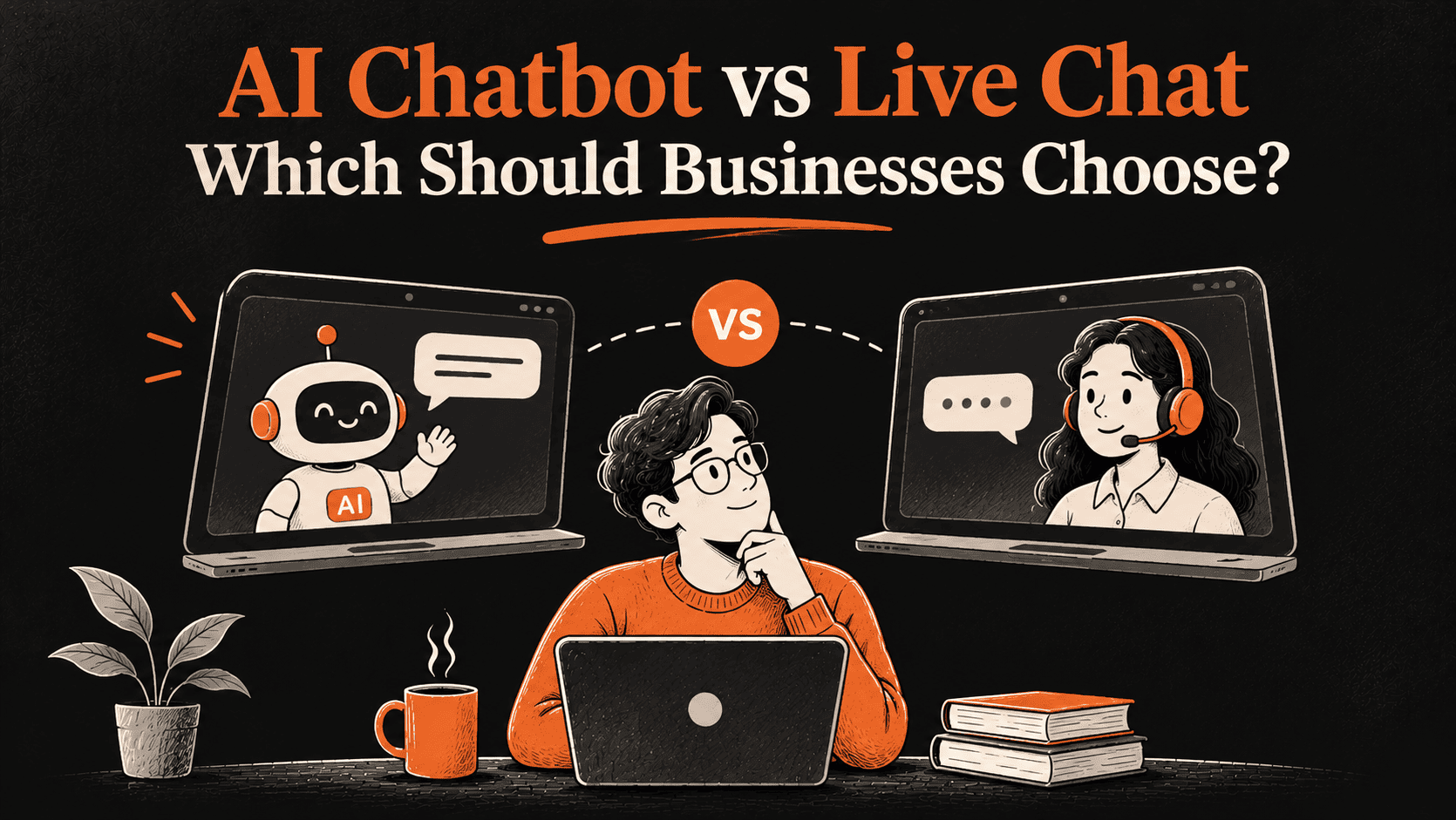
AI Chatbot vs Live Chat: Which Should Businesses Choose?

Written by
Rajni
Reviewed by
Himanshu
Published 17 November 2026
Expert Verified
Quick Answer
AI chatbots are best for 24/7 support, repetitive questions, and routine task automation. Live chat is better for complex issues and conversations requiring human judgment. For most businesses, a hybrid approach works best, combining AI automation with human support. The right choice depends on support volume, costs, and customer needs.
TL;DR
- AI Chatbots vs Live Chat: AI chatbots automate customer responses, while live chat connects customers directly with human agents.
- AI Chatbots Work Best for Repetitive Queries: They provide 24/7 assistance, handle multiple conversations, and help businesses manage high support volumes.
- Live Chat Is Better for Complex Issues: Human agents are better suited to sensitive conversations, technical problems, complaints, and high-value sales inquiries.
- Cost Depends on Business Needs: AI chatbots can reduce costs for routine support at scale, while live chat requires ongoing staffing and operational expenses.
- Customers Still Want Human Support: Gartner’s 2026 research found that 87% of customers consider access to a human agent essential when businesses use generative AI.
- A Hybrid Approach Often Works Best: Combining AI chatbots with live chat allows businesses to automate common requests while keeping human assistance available when needed.
- Choose Based on Your Support Needs: Review customer inquiries, support volume, costs, and resolution rates before deciding which approach fits your business.
Customers want their questions answered quickly, but speed alone doesn’t guarantee good support. A chatbot may respond instantly without resolving the issue, while a human agent may provide the right solution after a longer wait. For businesses, the challenge is balancing response time, resolution quality, and support costs.
AI chatbots can handle routine inquiries, retrieve customer information, and automate supported tasks. Live chat connects customers with human agents who can investigate complex issues, handle exceptions, and provide personalized assistance.
So, AI chatbot vs live chat: which should your business choose? This guide compares their capabilities, costs, limitations, and customer experience to help you decide when to use AI, human support, or a combination of both.
What Is an AI Chatbot and How Does It Work?

An AI chatbot is software that uses artificial intelligence to understand customer questions and respond in natural language. Unlike traditional rule-based chatbots that follow predefined scripts, modern AI chatbots use natural language processing (NLP) and large language models (LLMs) to interpret requests and generate relevant responses.
Businesses use AI chatbots to answer customer questions, provide product information, troubleshoot common issues, and automate support tasks. With AI agent capabilities and external integrations, they can also retrieve order details, schedule appointments, and perform authorized actions.
Key Features of AI Chatbots
- Natural Language Understanding: Interprets customer questions, including different ways of asking the same thing.
- 24/7 Availability: Provides automated assistance outside business hours.
- Knowledge-Based Answers: Uses company websites, FAQs, and support documentation to answer questions.
- Multiple Conversations: Handles several customer inquiries simultaneously.
- Business Integrations: Connects with CRM, ecommerce, and helpdesk systems to retrieve information.
- Task Automation: Completes supported tasks, such as order tracking, appointment scheduling, and ticket creation, through connected workflows and APIs.
- Multilingual Support: Communicates in multiple languages, depending on the platform.
- Human Handoff: Transfers unresolved or sensitive conversations to human support agents.
- Conversation Analytics: Tracks customer questions, resolution outcomes, and chatbot performance.
What Is Live Chat and How Does It Work?

Live chat is a customer communication tool that allows businesses to interact with website or app visitors in real time. Unlike AI chatbots that generate automated responses, human-operated live chat connects customers directly with support or sales agents who can understand their concerns, investigate issues, and provide personalized assistance.
Businesses use live chat to resolve technical problems, handle billing inquiries, answer product questions, and assist customers during purchases. Agents can access customer information, review previous conversations, and coordinate with other teams to resolve issues.
Key Features of Live Chat
- Real-Time Communication: Connects customers with support or sales agents through a chat interface.
- Personalized Assistance: Allows agents to respond based on customer needs, account details, and conversation history.
- Complex Problem-Solving: Helps agents investigate technical issues, complaints, and requests requiring human judgment.
- Human Interaction: Enables agents to address customer frustration and handle sensitive conversations with empathy.
- Customer Context: Gives agents access to previous conversations and relevant customer records through connected systems.
- Conversation Routing: Assigns incoming chats to available agents or appropriate departments.
- Team Collaboration: Supports internal notes, chat transfers, and coordination between support agents.
- File Sharing and Chat History: Allows customers and agents to exchange files and review previous conversations.
- Business Integrations: Connects with CRM and helpdesk software to manage customer requests and support tickets.
- Agent Availability: Provides human assistance based on staffing, working hours, and agent capacity.
AI Chatbot vs Live Chat: A Side-by-Side Comparison
AI chatbots and live chat both help businesses support customers, but they differ in availability, response time, scalability, and how they resolve issues. AI chatbots automate responses and supported tasks, while human-operated live chat provides direct assistance for issues requiring investigation or judgment.
The table below compares their capabilities, costs, and limitations to help you choose the right approach.
| Comparison Factor | AI Chatbot | Live Chat |
|---|---|---|
| Communication | Uses AI to understand questions and generate automated responses. | Connects customers directly with human support agents. |
| Availability | Provides 24/7 automated assistance. | Depends on agent schedules and staffing. |
| Response Time | Delivers near-instant responses to supported questions. | Varies based on agent availability and chat queues. |
| Scalability | Handles multiple conversations simultaneously, subject to platform capacity and usage limits. | Requires sufficient staffing as conversation volume increases. |
| Problem-Solving | Handles routine and multi-step requests when properly configured and integrated. | Handles complex, sensitive, and exceptional cases requiring human judgment. |
| Personalization | Uses customer data, preferences, and conversation history when available. | Agents adapt responses based on customer needs and individual circumstances. |
| Human Empathy | Can recognize emotional language and generate empathetic responses. | Agents can demonstrate genuine empathy and respond to emotional situations. |
| Cost | Involves subscription, usage, integration, and maintenance costs. | Involves software, staffing, training, and operational expenses. |
| Language Support | Supports multiple languages, depending on the AI model and platform. | Depends on agent language skills and available translation tools. |
| Accuracy | Relies on connected knowledge and systems but can generate incorrect responses. | Agents can verify information and apply judgment, though human errors remain possible. |
| Integrations | Connects with CRM, helpdesk, and business systems to retrieve data and perform authorized actions. | Integrates with business systems to help agents access information and manage requests. |
| Task Automation | Can automate order tracking, appointment scheduling, and other supported workflows. | Agents complete tasks manually or with assistance from automation tools. |
| Human Handoff | Can escalate unresolved or sensitive requests to human agents when configured. | Enables direct human assistance and transfers between agents or teams. |
| Performance Improvement | Requires monitoring, knowledge updates, testing, and workflow improvements. | Improves through agent training, quality reviews, and customer feedback. |
AI chatbots are well-suited to high-volume, repeatable support tasks, while live chat provides human judgment for complex or sensitive situations. Businesses that need both automation and personal assistance can combine them in a hybrid support model.
Choosing an AI Chatbot for Your Business
AI chatbots help businesses manage growing customer inquiries without relying on human agents for every interaction. They provide instant responses, automate routine tasks, and offer support beyond regular business hours. They are particularly useful for businesses with high support volumes, recurring customer questions, and reliable information or connected systems that AI can use.
Consider an AI Chatbot If
- Repetitive Questions Are Common: Customers frequently ask about order status, pricing, shipping, product details, or return policies.
- 24/7 Support Is Needed: Customers expect assistance outside business hours or across different time zones.
- Support Volume Fluctuates: Seasonal sales, promotions, or product launches create sudden increases in customer inquiries.
- Routine Tasks Need Automation: Connected AI agents can track orders, schedule appointments, qualify leads, and complete supported workflows.
- Multilingual Support Is Required: Customers communicate in different languages, making AI-powered multilingual responses useful.
- Support Teams Face High Workloads: Automating common inquiries allows human agents to focus on issues requiring investigation or judgment.
- Lead Generation Is a Priority: AI chatbots can engage website visitors, collect contact information, qualify leads, and direct potential customers to sales teams.
Example: An ecommerce business receiving hundreds of daily questions about deliveries, returns, and product availability can use an AI chatbot to answer common inquiries and retrieve order details through connected systems. Human agents can then focus on disputed refunds, unusual requests, and complex complaints.
Before choosing an AI chatbot, ensure your business has updated support documentation, reliable integrations, and a clear process for escalating unresolved requests. The goal is to resolve customer issues accurately, not simply respond faster.ese requests, allowing human agents to focus on more complicated issues.
Choosing Live Chat for Your Business
Live chat helps businesses provide direct, personalized support when customer issues require human attention. It allows support agents to investigate problems, understand individual needs, and make decisions that automated systems may not be equipped to handle. It is particularly valuable for businesses managing complex inquiries, sensitive conversations, or high-value customer relationships.
Consider Live Chat If
- Customer Issues Are Complex: Technical problems, billing disputes, and unusual requests require investigation or human judgment.
- Personal Attention Is Important: Customers dealing with complaints, frustration, or sensitive situations benefit from empathy and direct communication.
- Sales Conversations Are High-Value: Prospective customers need product consultations, detailed explanations, or personalized recommendations before purchasing.
- Human Approval Is Required: Pricing negotiations, contract changes, refund exceptions, and special requests require authorized decisions.
- Support Requires Flexible Decisions: Agents need to assess individual circumstances and make exceptions within company policies.
- Conversation Volume Is Low but Valuable: Each customer interaction has a significant impact on revenue, retention, or long-term relationships.
- Cross-Team Collaboration Is Needed: Support agents must coordinate with technical, billing, or account management teams to resolve customer issues.
Example: A B2B software company handling enterprise sales inquiries can use live chat to connect potential customers with sales representatives. Agents can discuss technical requirements, explain pricing options, and address concerns before customers make purchasing decisions.
Before choosing live chat, evaluate your team’s availability, expected response times, and staffing costs. Human support works best when agents have access to relevant customer information, clear escalation procedures, and the resources needed to resolve issues without unnecessary delays.
Customer Perspectives on AI Chatbots and Live Chat

Customer opinions on AI-powered support are changing, but one expectation remains clear: customers want quick answers without losing access to human assistance.
Recent research highlights why businesses need to balance automation with human support:
- Human Support Still Matters: A 2026 Gartner survey found that 87% of customers consider access to a human agent essential when businesses use generative AI in customer service.
- AI Is Becoming More Accepted: In the same survey, 50% of customers said generative AI makes their interactions with businesses easier.
- Poor Experiences Reduce Trust: Gartner reported in September 2026 that only 27% of customers would try a chatbot again after a negative experience.
- Self-Service Has Limitations: Gartner’s 2024 research found that self-service channels fully resolved only 14% of customer service issues. This includes more than just AI chatbots.
Transparency also matters. Under Article 50 of the EU AI Act, applicable AI systems that interact directly with people must disclose that users are interacting with AI, unless it is already obvious. These transparency obligations generally became applicable on August 2, 2026. Other jurisdictions may have different requirements.
For businesses, the takeaway is simple: AI chatbots can improve response times, but customers should know when they’re interacting with AI and have a clear way to reach a human agent when needed.
Frequently Asked Questions
What is the main difference between an AI chatbot and live chat?
An AI chatbot uses artificial intelligence to respond to customer questions automatically, while live chat connects customers with human agents in real time. AI chatbots are better suited to repetitive queries, whereas live chat is useful for complex issues requiring human judgment.
Is an AI chatbot cheaper than live chat?
AI chatbots can be more cost-effective for businesses handling large volumes of repetitive queries. However, the total cost depends on software pricing, setup, integrations, maintenance, and usage. Live chat also involves staffing, training, and operational expenses.
Can AI chatbots completely replace human live chat agents?
AI chatbots can automate many routine support tasks, but they cannot reliably replace human agents in every situation. Complex complaints, sensitive issues, and unusual requests often require human involvement. A hybrid approach is generally more practical.
Which is better for small businesses, AI chatbots or live chat?
It depends on the business’s support needs. Small businesses with frequent, repetitive inquiries may benefit from AI chatbots, while those handling fewer but more complex customer conversations may prefer live chat. Businesses requiring both can combine the two.
Can AI chatbots and live chat work together on the same website?
Yes. Many customer support platforms allow AI chatbots and human live chat agents to operate through the same chat interface. AI can answer common questions and transfer unresolved or complicated requests to human agents, ideally with the conversation history included.
How do AI chatbots handle questions they cannot answer?
Depending on their configuration, AI chatbots can ask clarifying questions, suggest relevant support resources, create support tickets, or transfer conversations to human agents. Businesses should establish clear escalation rules to prevent customers from getting stuck with unresolved issues.
Are AI chatbots suitable for multilingual customer support?
Yes. Many modern AI chatbots support multiple languages and can respond to customers in their preferred language. However, language accuracy varies by platform, model, and available knowledge. Businesses should test important languages before relying on automated responses.
How can businesses measure whether AI chatbots or live chat are performing better?
Businesses can compare customer satisfaction (CSAT), response time, resolution rate, cost per resolved issue, and customer feedback. For AI chatbots, monitoring successful automated resolutions and human handoff rates also helps identify where automation works and where human support remains necessary.
Conclusion
The best customer support strategy isn’t necessarily the one that automates the most conversations. It’s the one that resolves customer issues accurately, without unnecessary delays or costs. A business handling hundreds of predictable inquiries may benefit more from AI automation, while one managing fewer, high-value conversations may need greater human involvement. The right balance depends on the nature of your customer requests, not just their volume.
Before making a decision, review your recent support conversations and identify which issues follow clear, repeatable processes. Start by automating those requests, measure successful resolutions rather than response speed alone, and track where customers still need human assistance. The most useful measure of success is how reliably customers get their problems solved, regardless of whether AI or a human handles the conversation.