Best AI tools for multilingual customer support in 2026

Written by
Himanshu
Reviewed by
Rohit Joshi
Published 28 September 2026
Expert Verified
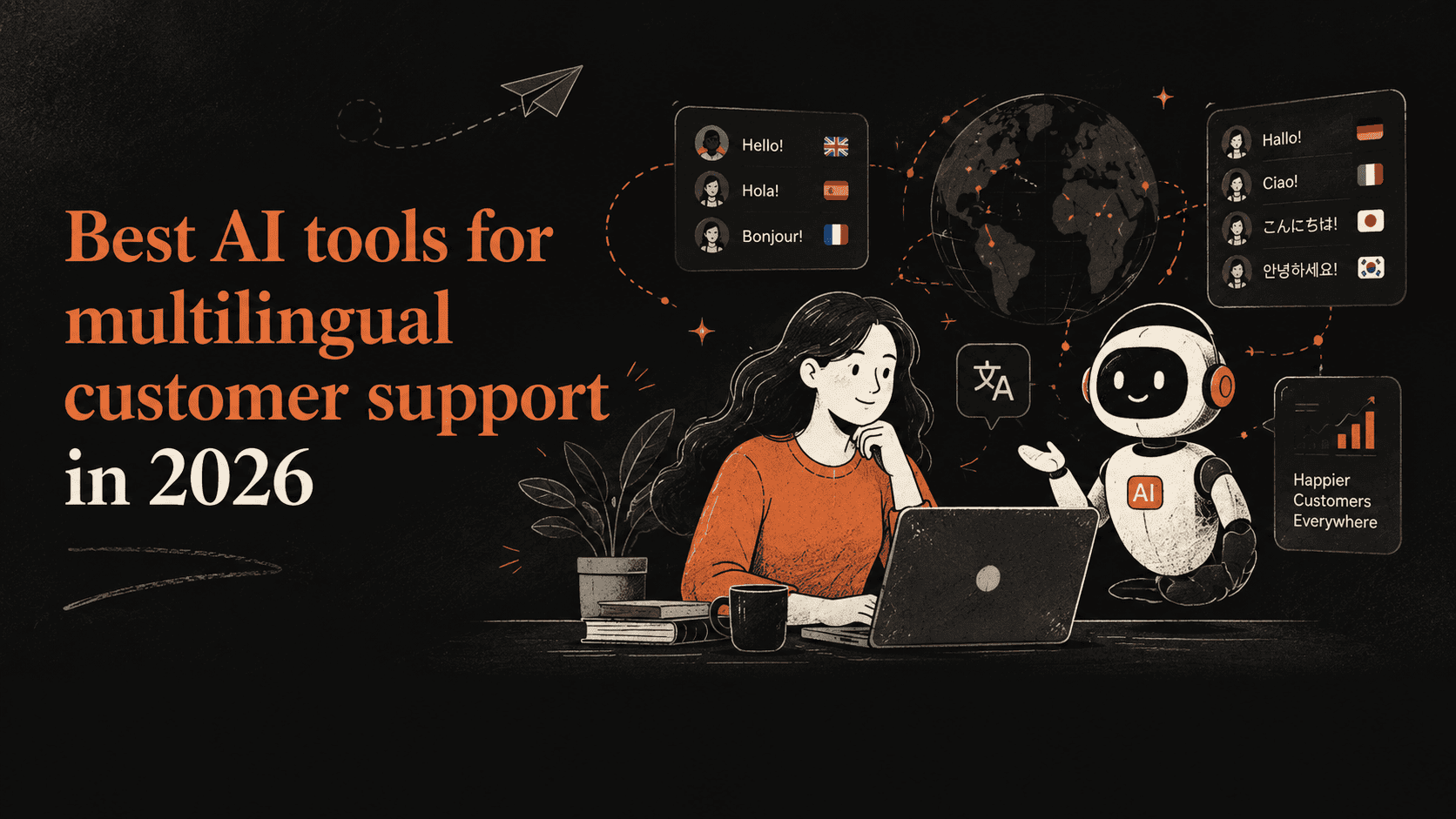
Quick Answer: YourGPT and Fin by Intercom lead this list for most teams in 2026. YourGPT covers 100+ languages at every paid tier starting at $39/month, with omnichannel deployment from a single build. Fin suits teams already on Intercom’s helpdesk who want pay-per-resolution pricing at scale. Zendesk and Ada remain the stronger picks for large enterprises with dedicated implementation resources, and Yellow.ai leads for high-volume, voice-heavy support across many markets.
Global support teams don’t lose customers to bad answers. They lose them to answers that never arrived in the customer’s own language.
The AI customer support software market solved this on paper years ago. Every vendor now advertises 50, 80, or 100+ languages. What that badge doesn’t tell you is whether the knowledge base, the routing logic, and the reporting dashboard actually work in those languages too, or whether only the chat reply gets translated while everything behind it stays English-only.
This guide compares eight AI customer support platforms with real multilingual capability, using pricing and language claims pulled directly from vendor sites and G2 review data current as of September 2026.
Why Businesses Are Investing in Multilingual AI Support
The case for multilingual support isn’t theoretical anymore. The data on what happens without it is specific.
CSA Research’s “Can’t Read, Won’t Buy” study, based on 8,709 consumers surveyed across 29 countries, found that 76% of online shoppers prefer to buy products with information in their own language, and 40% say they will never buy from a website in another language at all. That study is from 2020, but the underlying buying behavior it documents hasn’t reversed. If anything, AI has made native-language support cheap enough that the excuse for skipping it has mostly disappeared.
On the support-delivery side, Deloitte Digital’s 2026 Global Contact Center Survey found that 64% of service leaders report higher agent productivity from AI, and 39% report a lower cost per contact. Multilingual AI support sits at the intersection of both trends. It’s the mechanism that lets a support team serve every language market without hiring native speakers for each one, and it’s increasingly cheap enough to run that “we’ll add that language later” is a harder call to defend to customers.
TL;DR: Best AI Tools for Multilingual Customer Support
- Best overall for broad language coverage: YourGPT, 100+ languages, omnichannel deployment, plans from $39/month
- Best for teams on Intercom’s helpdesk: Fin by Intercom, pay-per-resolution from $0.99, 4.5/5 on G2 (3,916 reviews)
- Best for existing Zendesk shops: Zendesk AI agents, 80+ languages, bundled into every Suite plan
- Best for a single reasoning engine: Ada, 60+ languages, structured human handoff, quote-only pricing
- Best free tier: Freshworks Freshchat, free for up to 10 agents, translation unlocks at $49/agent/month
- Best low-cost entry point: Tidio (Lyro), free plan available, paid tiers start at $24.17/month
- Best for email-first small teams: Help Scout, AI Answers add-on at $0.75/resolution on top of per-seat plans
- Best for high-volume voice support: Yellow.ai, Enterprise tier covers 35+ channels including voice
What “Multilingual AI Support” Actually Means
A language count on a pricing page tells you almost nothing about whether support in that language will actually work.
Real multilingual support depends on four things working together:
- Detection. The system correctly identifies what language the customer is writing or speaking in, including mid-conversation switches.
- Knowledge retrieval. The AI can find the right answer in your knowledge base even if that content was written in English.
- Reasoning and reply. The AI generates a response that’s accurate, not just grammatically correct, in the target language.
- Routing and reporting. Tickets, tags, and analytics stay usable for your team, not just for the customer-facing chat window.
Most vendors are strong on layer 3 and weak on layer 4. A platform that resolves 80% of English tickets often resolves meaningfully fewer in a lower-resource language, because the underlying knowledge base and guardrails were built and tuned in English first. Ask any shortlisted vendor to show you a dashboard in a non-English language before you buy, not just a chat transcript. For more on what separates a genuine conversational agent from a scripted, single-language bot, see our guide to conversational AI for customer service benefits and features.
Quick Comparison
| Platform | Languages | Starting Price | G2 Rating |
|---|---|---|---|
| YourGPT | 100+ | $39/month | 4.7/5 (29 reviews) |
| Fin by Intercom | Multilingual, auto-translate | $0.99/resolution | 4.5/5 (3,916 reviews) |
| Zendesk | 80+ | $19/agent/month | 4.3/5 (7,082 reviews) |
| Ada | 60+ | Quote-only | 4.6/5 (173 reviews) |
| Freshworks Freshchat | 45+ (Pro tier+) | Free / $19/agent/month | 4.4/5 (502 reviews) |
| Tidio (Lyro) | Multilingual, unpublished count | Free / $24.17/month | 4.6/5 (1,962 reviews) |
| Help Scout | 50+ (KB needs add-on) | Free / $30/user/month | 4.4/5 (431 reviews) |
| Yellow.ai | 135+ (vendor-cited, unconfirmed on pricing page) | Free / custom Enterprise | 4.4/5 (107 reviews) |
1. YourGPT
YourGPT is a no-code AI agent platform built for customer support, sales, and omnichannel deployment. It supports over 100 languages out of the box, including English, Spanish, French, German, and Italian, and trains its knowledge base directly from PDFs, Google Drive, Notion, and YouTube rather than requiring a separate content migration step.
Features:
- Deployment across web chat, WhatsApp, Instagram, email, SMS, and voice from a single build
- AI Helpdesk for self-service resolution without human intervention
- Choice of underlying model (GPT, Claude, or Gemini)
- API and webhook access for connecting to existing CRMs and databases
- Essential plan starts at $39/month, Professional is $79/month, Advanced is $349/month, Enterprise is custom
- 4.7/5 on G2 from 29 reviews
For a wider field of no-code options in this category, see our best no-code chatbot platforms roundup.
Pros:
- 100+ languages included at every paid tier, not gated to a higher plan
- One build deploys across six-plus channels
- Flexible model choice instead of being locked to a single LLM vendor
Cons:
- Smaller review sample on G2 than category leaders like Zendesk or Intercom, so there’s less independent data to weigh
- The jump from Professional ($79/month) to Advanced ($349/month) is steep if you need the higher-tier model access
Best for: Teams that want broad language coverage and omnichannel deployment without stitching together separate tools for chat, WhatsApp, and voice.
2. Fin by Intercom
Fin is Intercom’s AI agent, sold either as an add-on to an existing helpdesk or bundled with Intercom’s own. It includes an auto-translate feature that reviewers specifically call out as useful for managing multilingual communications, plus a Copilot add-on aimed at giving human agents AI-assisted replies in the customer’s language.
Features:
- Auto-translate across email, live chat, WhatsApp, and SMS
- Copilot add-on that drafts AI replies for human agents in live conversations
- “Fin with your current helpdesk” runs $0.99 per resolved outcome with a 90-day free trial (minimum 250 conversations required)
- “Fin with Intercom helpdesk” starts at $19/seat/month, Copilot add-on is $35/user/month, Pro (including Operator) is $99/month
- 4.5/5 on G2 from 3,916 reviews, the second-largest review base in this list
Pros:
- Pay-per-resolution option lets teams test without committing to seats
- Large, well-established review base to validate claims against
- Auto-translate works across email, live chat, WhatsApp, and SMS
Cons:
- Per-resolution billing can get expensive fast at high ticket volume
- Full functionality is easiest to access by also adopting Intercom’s own helpdesk, which adds seat costs on top of resolution fees
Best for: Teams already running Intercom’s helpdesk who want AI resolution and human handoff in one console. If Fin isn’t the right fit, our Intercom alternatives comparison covers 13 options by use case.
3. Zendesk
Zendesk bundles AI agents into every Suite and Support tier rather than selling them as a separate product. The company states its AI agents support 80+ languages and can resolve “up to 80%+” of complex service issues across channels.
Features:
- AI agents included at every tier, not sold as a bolt-on
- Wide marketplace of pre-built integrations
- Support Team starts at $19/agent/month, Suite Team is $55/agent/month, Suite Professional is $115/agent/month, Suite Enterprise with Copilot is custom
- 4.3/5 on G2 from 7,082 reviews, by far the largest review base of any platform in this comparison
Pros:
- AI agents included in every tier rather than sold as a bolt-on
- Massive review base makes it easier to validate vendor claims
- Wide marketplace of pre-built integrations
Cons:
- Per-resolution AI charges on top of seat pricing aren’t clearly published and require a sales conversation to pin down
- Reporting and analytics have historically been strongest in English, with less visibility into non-English ticket quality
Best for: Enterprises already inside the Zendesk ecosystem who want AI agents added without switching platforms. Weighing whether to stay or switch? Our Zendesk alternatives breakdown covers five options worth a look.
4. Ada
Ada positions itself around a single AI agent architecture deployable across voice, messaging, email, and custom channels in 60+ languages, with structured escalation to a human agent built in rather than bolted on.
Features:
- Playbooks builder for structuring conversation logic without code
- Single reasoning engine shared across every deployed channel
- Pricing is quote-only, requiring a sales conversation before you can compare costs against per-seat or per-resolution competitors
- 4.6/5 on G2 from 173 reviews, one of the higher average ratings in this list despite a smaller sample size
For a broader field of enterprise-grade options in this bracket, see our best enterprise AI chatbots roundup.
Pros:
- High G2 rating relative to review volume
- Single engine across channels avoids the inconsistency of stapling multiple tools together
- Structured human handoff rather than a hard stop when the AI can’t resolve something
Cons:
- No published pricing makes early-stage comparison shopping harder
- Smaller review base than Zendesk, Intercom, or Tidio
Best for: Enterprises that want one reasoning engine handling voice, chat, and email consistently, rather than stitched-together point solutions.
5. Freshworks Freshchat
Freshchat’s free tier supports up to 10 agents at no cost, which is unusually generous for the category. Real-time translation across 45+ languages is available, but only unlocks starting on the Pro tier.
Features:
- Unified inbox across chat, email, and WhatsApp
- Real-time translation across 45+ languages, available from the Pro tier
- Free for up to 10 agents, Growth is $19/agent/month, Pro is $49/agent/month, Enterprise is $79/agent/month
- 4.4/5 on G2 from 502 reviews
Pros:
- Free tier is large enough for small teams to run real production support, not just a demo
- Per-seat pricing is transparent, with no per-resolution surprise fees
- Reviewers consistently cite ease of use
Cons:
- Multilingual translation is locked behind the Pro tier, so the free and Growth plans are effectively English-only for AI replies
- 45+ languages is the lowest published count of any platform in this list
Best for: Teams that want to test AI support on a genuinely free plan before paying for translation. If the translation gate is a dealbreaker, see our Freshchat alternatives comparison.
6. Tidio (Lyro)
Tidio’s Lyro AI agent ships across five pricing tiers, from a free plan with one-time trial conversations up to a $2,999/month Premium tier with a guaranteed 50% AI resolution rate. It has the second-largest G2 review base in this comparison.
Features:
- Conversation-based pricing that’s easy to estimate against ticket volume
- Free includes 50 one-time Lyro conversations, Starter is $24.17/month, Growth is $49.17/month, Plus is $749/month, Premium is $2,999/month
- 4.6/5 on G2 from 1,962 reviews
For teams running Tidio on a Shopify storefront specifically, see our best AI chatbots for Shopify roundup.
Pros:
- Genuinely free entry point, not just a time-limited trial
- Large, high-scoring review base
- Clear conversation-based pricing that’s easy to estimate against your ticket volume
Cons:
- Steep gap between Growth ($49/month) and Plus ($749/month), with nothing in between for teams that outgrow the low tier but aren’t ready for enterprise pricing
- Tidio doesn’t publish a specific supported-language count anywhere in its pricing or marketing materials
Best for: Small teams and solo store owners who want to start free and scale gradually.
7. Help Scout
Help Scout charges by contacts helped per month rather than strictly by seat, and adds its AI Answers feature as a separate line item rather than folding it into the base plans.
Features:
- Email-like interface built for lean teams, not a chat-first console
- Free covers 5 users and 100 contacts/month, Standard is $30/user/month, Plus is $54/user/month, Pro is $90/user/month
- AI Answers is billed separately at $0.75 per resolution, with a free trial period before charges begin
- 4.4/5 on G2 from 431 reviews
For more options built specifically for lean SaaS support teams, see our best AI help desk software for SaaS teams roundup.
Pros:
- Clean, low-friction interface that reviewers consistently praise
- AI Answers has a free trial window before per-resolution billing starts
- Contact-based pricing can work out cheaper than per-seat models for lean teams
Cons:
- Knowledge base localization needs a third-party add-on rather than being native
- Per-resolution AI fees stack on top of per-user plan costs, so the full bill takes two line items to calculate
Best for: Small support teams that want an email-like, human-toned interface with AI layered on top rather than AI-first.
8. Yellow.ai
Yellow.ai’s Enterprise tier is built around scale, with unlimited AI agents and access to 35+ channels including voice through its VoiceX feature. Third-party coverage widely cites 135+ supported languages, though Yellow.ai’s own pricing page doesn’t state a specific number, so treat that figure as vendor-claimed rather than independently confirmed.
Features:
- Voice-native support through VoiceX, alongside chat and 35+ other channels
- SOC2/GDPR/ISO compliance controls available at Enterprise
- Free tier includes 1 AI agent and 500 chat sessions/month, with additional resolutions at $0.99 each. Enterprise is unlimited, with custom pricing
- 4.4/5 on G2 from 107 reviews
If voice is your primary support channel rather than one option among several, our dedicated AI voice agent platforms guide covers that comparison in more depth than this piece does.
Pros:
- Enterprise tier covers voice alongside chat, which several competitors in this list don’t offer natively
- Free tier is enough to test the platform before committing
- SOC2/GDPR/ISO compliance controls available at Enterprise
Cons:
- Actual supported-language count isn’t published on Yellow.ai’s own site, only referenced in third-party reviews
- Enterprise pricing isn’t public, so budgeting requires a sales call
Best for: Enterprises running high-volume support across many markets, including voice.
Which Multilingual AI Support Tool Is Best for Your Business?
The right pick depends more on your existing helpdesk and team size than on language count alone.
Enterprises with a dedicated implementation team Ada and Zendesk both reward a longer rollout with deep customization and higher review volume to validate claims against. Choose Ada for one reasoning engine across every channel. Choose Zendesk if you’re already inside its ecosystem and want AI added without a platform switch.
Teams already committed to a specific helpdesk If you’re already running Intercom or Zendesk, staying inside that ecosystem and adding Fin or Zendesk’s own AI agents is usually simpler than migrating to a new platform just for multilingual coverage.
SMBs and lean teams wanting to move fast YourGPT, Freshchat, Tidio, and Help Scout all let a small team go live without an implementation project. YourGPT’s language breadth and channel count suit teams that need broad coverage immediately. Freshchat and Tidio suit teams that want to test on a free plan first. Help Scout suits teams that want an email-like interface over a chat-first console.
High-volume, voice-first, multi-market support Yellow.ai is the only platform in this list that treats voice as a primary channel rather than a secondary one, which matters if phone support carries a meaningful share of your multilingual ticket volume.
What This Actually Costs
Pricing models in this category aren’t apples-to-apples, and that’s the single biggest source of billing surprises.
- Per-seat platforms (YourGPT, Zendesk, Freshworks, Help Scout base plans) charge by agent or user, which is predictable but doesn’t scale down if your AI is doing most of the work.
- Per-resolution platforms (Fin’s base tier, Help Scout’s AI Answers add-on, Yellow.ai’s overage) charge per ticket the AI resolves, which scales with actual usage but can spike unpredictably during high-volume periods.
- Quote-only platforms (Ada, Zendesk and Yellow.ai at Enterprise tier) require a sales conversation before you get a real number, which slows down early-stage comparison shopping.
Before you commit, ask every vendor on your shortlist for their per-resolution cost at your actual monthly ticket volume, not just their published per-seat rate. That’s where the real cost difference between platforms shows up.
How to Choose
- Confirm the language count applies to knowledge retrieval and reporting, not just the chat reply. Ask for a demo in your second- or third-most-common customer language, not just English.
- Match the pricing model to your ticket volume shape. Steady, predictable volume favors per-seat pricing. Spiky, seasonal volume favors per-resolution or a quote-based enterprise deal with volume protections built in.
- Check whether translation is included at your tier or gated to a higher one. Freshchat and Zendesk both restrict full multilingual capability to specific tiers, so the sticker price on the entry plan isn’t the real price for multilingual support.
- Weigh G2 review volume against rating. A 4.6 from 173 reviews and a 4.3 from 7,082 reviews are both legitimate signals, but they tell you different things. The first is a strong signal from a small sample, the second is a reliable average across a huge one.
For a step-by-step walkthrough of evaluating and rolling out a shortlisted platform, see our complete guide to building an AI agent for customer service
Frequently Asked Questions
Which AI tool should I use for multilingual customer support in 2026?
It depends on what you’re optimizing for. If you want broad language coverage without paying extra for it, YourGPT covers 100+ languages across its paid tiers starting at $39/month. If you’re already using Intercom or Zendesk, adding Fin or Zendesk’s own AI agents may be simpler than switching platforms. If you want one AI engine handling voice, chat, and email consistently, Ada is another option to consider. Match the platform to your existing helpdesk, support channels, and ticket volume rather than choosing based only on the number of supported languages.
Will my customers actually get help in their own language, or just a translated reply?
That depends on the platform, and it’s worth checking before you buy. A high language count may only mean that customer-facing chat replies can be translated. Your knowledge base, ticket routing, agent tools, and reporting dashboard may still operate primarily in English. Ask vendors for a demo in your second-most-common customer language so you can see whether the entire support workflow works well, not just the front-facing chat window.
How much should I budget for multilingual AI support?
You can start with free or lower-cost plans from platforms such as Freshworks, Tidio, Help Scout, or Yellow.ai, while more advanced plans can cost several hundred dollars per month. YourGPT Advanced, for example, is priced at up to $349/month. Also watch for usage-based fees on top of the base subscription. Fin charges per AI resolution, Help Scout offers AI Answers as an additional usage-based feature, and Yellow.ai can apply overage charges. If your support volume is high, model those charges against your actual monthly ticket or resolution count before choosing a platform.
Is 100+ languages supported enough, or should I dig deeper before I buy?
Dig deeper. The language count tells you which languages the platform can respond in, but it doesn’t necessarily show how well the knowledge base, routing, automation, and reporting work in each language. A platform that performs well in English may behave differently in another language. Before signing up, test real support conversations in your second-most-common customer language and check response quality, knowledge retrieval, routing, and handoff behavior.
Should I pick per-seat or per-resolution pricing for my team?
If your support volume is steady and predictable, seat-based or fixed-plan pricing can be easier to budget because higher AI usage does not always create a separate charge for every resolution. Platforms such as YourGPT, Zendesk, Freshworks, and Help Scout offer plans built around subscriptions or seats, although individual AI features may still have usage limits or add-on costs. Per-resolution pricing, such as Fin’s AI resolution model or usage-based AI add-ons, can scale with actual usage but may become more expensive during seasonal spikes. Compare both models using your real monthly conversation and resolution volume before deciding.
Final Verdict
If broad, tier-independent language coverage and omnichannel deployment from a single build matter most, YourGPT covers 100+ languages starting at $39/month without gating translation behind a higher tier, which several competitors on this list do.
If you’re already committed to a specific helpdesk ecosystem, though, staying inside it usually beats switching. Fin makes the most sense on top of an existing Intercom setup, and Zendesk’s AI agents are the simpler path if your team already lives in Zendesk. For everyone else, match the pricing model (seat, resolution, or quote) to your actual ticket volume shape before you compare sticker prices, since that’s where the real cost differences in this category show up.
Want to see broad language coverage in action before committing to a platform? Start a free 7-day trial with YourGPT and have a multilingual agent live on your site in about 10 minutes, no migration project required.

Article by
HimanshuHead of Growth & Engineering
Himanshu is Head of Growth & Engineering at Delta4 Infotech, writing about AI agents, MCP, and no-code automation from a go-to-market view. He covers how teams evaluate, adopt, and get real value from AI tools, translating what the tech does into what it means for a business.