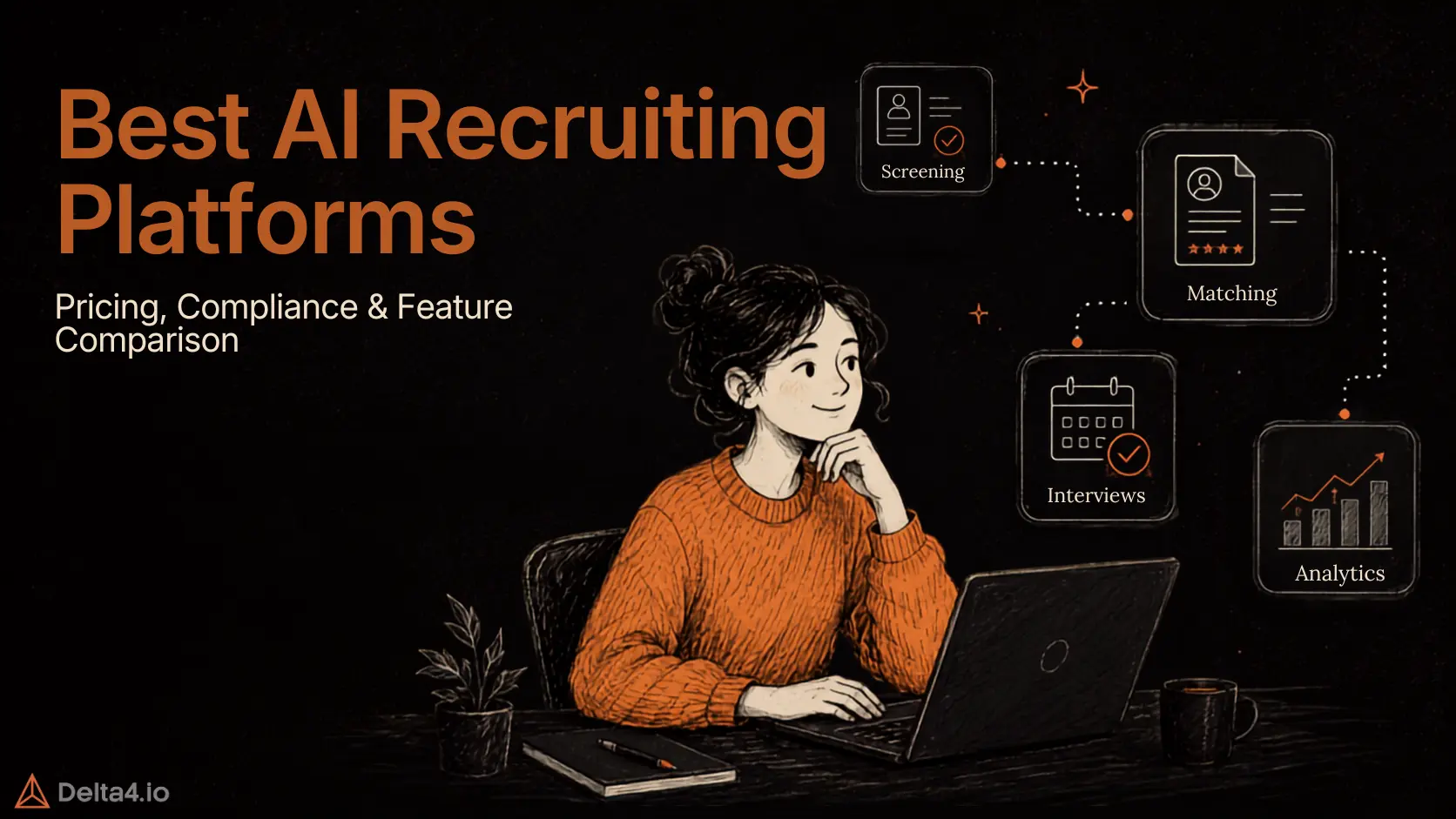
Best AI Recruiting Software in 2026 : Top 5 Tools Compared

Written by
Taniya
Reviewed by
Himanshu
Published 14 August 2026
Expert Verified
Recruiting should be viewed as business partner, someone who is critical to the success of the business– Stacy Zapar
TL;DR
- The best AI recruiting software in 2026 splits into two camps: enterprise ATS platforms with AI layered on (Greenhouse, HireVue) and dedicated AI-first tools (Eightfold AI, Workable, Paradox), and each fits a different company size and budget.
- Workable is the only tool here with published pricing starting under $300/month. The rest are quote-only, with enterprise contracts that can run into six figures.
Hiring teams aren’t short on options anymore. The problem is telling apart software that genuinely uses AI to source, screen, and interview candidates from an old ATS with a chatbot bolted on. Workday’s $1.0 billion cash acquisition of Paradox alone shows how fast this category is consolidating, and more deals like it are reshaping which tools survive as standalone products.
This guide covers five AI recruiting tools that come up most often in 2026 shortlists, covering what each one actually does, what it costs, and who it fits.
What Is AI Recruiting Software?
AI recruiting software uses machine learning or generative AI to handle one or more stages of hiring, such as sourcing candidates, screening resumes, scheduling interviews, running video assessments, or ranking applicants. Most tools in this category are traditional applicant tracking systems (ATS) with AI features added on top. A smaller group, like Eightfold AI, was built around AI matching from the start. Knowing which type you’re looking at matters more than any feature list, since it determines whether AI helps you organize an existing process or replaces parts of it.
Best AI Recruiting Software in 2026
1. Greenhouse

Greenhouse is a structured-hiring ATS built for mid-sized and large companies that need consistency across a complex hiring process, well beyond simple job posting.
Key features
- Structured interview kits and shared scorecards
- AI-powered candidate sourcing and report filters
- DEI and bias-mitigation tooling built into the workflow
- Enterprise governance, SSO, and advanced analytics on the top tier
Pricing: Custom quotes across three tiers, Core, Plus, and Pro. Buyer-reported contracts run from roughly $10,000 to more than $75,000 a year, with a median around $26,000 to $27,000 (Vendr data via Leonar). Third-party estimates for Greenhouse vary widely, so treat this as a directional range rather than a quote.
Key considerations
- Pros: Structured, auditable hiring process with strong governance and DEI tooling built in.
- Cons: Pricing is quote-only and requires a sales call, and implementation plus renewal fees add to the sticker price.

“Reviewing applications, scheduling interviews, and managing scorecards. These are features I use regularly, especially for scheduling. Makes it very easy to use where I can send a confirmation email with a click of a button.”
2. HireVue
Large organizations running high-volume hiring use HireVue to replace early-stage phone screens with structured video interviews and assessments.
Key features
- On-demand and live video interviews
- AI-supported screening, scoring, and adverse-impact benchmarking
- Game-based and coding assessments
- SOC 2 Type 2, ISO 27001, GDPR compliance, and FedRAMP certification, the only virtual interviewing vendor with it (HireVue pricing page)
Pricing: Enterprise-only, no public rate card. Third-party procurement data puts the entry tier around $35,000 a year, with average deals closer to $50,000 (Vendr data cited by Pin).
Key considerations
- Pros: Purpose-built for high-volume video screening, with strong compliance coverage including SOC 2 Type 2, ISO 27001, GDPR, and FedRAMP, and designed to support employer compliance with laws like Illinois’s AI Video Interview Act.
- Cons: Enterprise-only pricing with no real fit for smaller teams, and assessments or scheduling often cost extra on top of the base license.

“Recordings allow employers to re-watch and review applicant responses thoroughly and as many times as needed, instead of making unsubstantiated and knee-jerk conclusions on the spot based on whatever they think they heard.”
3. Paradox (Olivia), now inside Workday

Paradox built Olivia, a conversational AI assistant that lets candidates apply, get screened, and self-schedule through chat, SMS, or WhatsApp. It’s now integrated as the “Workday Paradox Candidate Experience Agent,” with former Paradox CEO Adam Godson now serving as general manager of talent acquisition products at Workday, leading the combined Workday Recruiting and Paradox product line.
Key features
- Conversational screening and self-scheduling via chat and SMS
- 24/7 candidate Q&A and onboarding document collection
- Workday is pushing Olivia toward more autonomous, “agentic” workflows through 2026
- Now part of Workday’s broader talent acquisition suite
Pricing: Not published. Third-party estimates run from roughly $1,000 to $2,000 a month for smaller deployments to $25,000 to $150,000+ a year for larger ones (Truffle). Quoted through Workday’s enterprise sales process.
Key considerations
- Pros: Strong conversational candidate experience proven at scale with frontline employers like 7-Eleven, Chipotle, and Wendy’s.
- Cons: No standalone product path anymore, buyers now go through Workday’s broader sales process with no independent pricing to compare.
“This product is able to connect us with great talent on a daily basis. Since the product does the screening for you, you can be sure you will be taking time to speak to a qualified candidate. We have had great success with hires using this platform”
4. Eightfold AI

Eightfold AI is a talent intelligence platform that matches candidates to roles using skills and career trajectory instead of keyword matching, and extends into internal mobility and workforce planning.
Key features
- Skills-based deep learning matching, not keyword search
- Internal talent marketplace for redeploying existing employees
- Candidate masking and DEI-focused blind screening
- Native integrations with Workday, SAP SuccessFactors, Oracle HCM, and Greenhouse
Pricing: Enterprise-only, based on org size and modules used. Analyst estimates put it at roughly $7 to $10 per employee per month, with annual contracts commonly reported in the $150,000 to $500,000+ range (Voyse, June 2026).
Key considerations
- Pros: Skills-based matching goes beyond keyword search, and internal mobility tools help reduce voluntary attrition.
- Cons: Built for large enterprises, and reviewers commonly report integration friction when connecting Eightfold to an existing Workday instance.
“Is a powerful AI platform for HR Talent Management, Career planning processes. Has some gaps in terms of implementation and integration capabilities but overall a solid platform with AI capabilities relevant for HR processes”
5. Workable
Workable bundles AI-powered sourcing, resume screening, interview scheduling, and an optional HR module into one platform, aimed at mid-sized companies that want a single tool instead of several.
Key features
- AI-powered candidate sourcing and matching
- One-click job posting across major boards
- Video interviews, texting, and assessments on higher tiers
- Optional HR module for post-hire employee management
Pricing: $299 to $719 a month for 1 to 20 employees (Standard, Premier, Enterprise), scaling up with headcount (Workable pricing on G2).
Key considerations
- Pros: Published, predictable pricing and an all-in-one platform with an optional HR module.
- Cons: Bill scales with total headcount, not recruiter seats, and video interviews or assessments require a higher tier.
“Workable is intuitive, AI-powered, and scalable, which is great for long-term needs. Its HRIS is decent for onboarding but not robust enough to replace a full HRIS system”
AI Recruiting Software Comparison
| Tool | Core AI Strength | Best For | Starting Price |
|---|---|---|---|
| Greenhouse | Structured sourcing + governance | Complex, auditable hiring processes | Custom quote |
| HireVue | Video screening + scoring at scale | High-volume video interviewing | ~$35,000/yr |
| Paradox (Workday) | Conversational screening/scheduling | Frontline, high-volume hiring | Custom quote |
| Eightfold AI | Skills-based matching + internal mobility | Large enterprises (2,000+ employees) | ~$7–10/employee/mo |
| Workable | All-in-one sourcing + ATS | Mid-market teams, published pricing | $299/mo |
How to Choose the Best AI Recruiting Software
Match the tool to the bottleneck you actually have instead of the longest feature list.
- Identify your real bottleneck – Sourcing, screening, interviewing, and internal mobility are different problems. A tool built for one won’t automatically fix another.
- Check ATS compatibility – If you already run an ATS, confirm the AI tool integrates cleanly instead of duplicating candidate data.
- Ask how AI decisions get explained – For screening or scoring tools, you need to see why a candidate was ranked the way they were, rather than only seeing the final score.
- Price the whole contract instead of just the headline number – Implementation fees, add-on modules, and renewal increases often add 20 to 50 percent to the first-year quote.
- Match company size to the tool’s actual audience – Eightfold AI and HireVue are built for large enterprises. Workable fits growing mid-market teams. Using the wrong one means paying enterprise prices for features you won’t use.
Conclusion
The best AI recruiting software depends on the hiring problem you’re solving, not the number of AI features on the spec sheet. Workable fits small and growing teams that want published pricing and a self-serve setup, with applicant tracking built in from the start. Greenhouse suits companies that need structured, auditable hiring workflows, while HireVue handles video interviews and candidate assessments at scale. For enterprise hiring, Eightfold AI leads on skills-based talent matching, and Paradox, now part of Workday, is built for high-volume candidate engagement and automation.
Before you pick an AI recruitment software, check how well it fits your hiring volume, your existing ATS or HRIS, and your actual budget. A platform with the most AI features rarely wins if it complicates the process it’s meant to simplify. The right AI recruiting software cuts down repetitive work and helps recruiters make faster, better-informed hiring decisions.
If you’re evaluating these as part of a broader HR tech stack, it’s worth comparing them against AI-powered HRMS platforms built for the full employee lifecycle, beyond hiring alone. And since most of these tools are really specialized AI agents built for one job, understanding that category helps set realistic expectations before you sign a contract.
Frequently Asked Questions
Will AI replace recruiters?
AI recruiting software automates repetitive tasks like resume screening, scheduling, and initial candidate outreach, but it doesn’t replace recruiters making final hiring decisions. Tools like Greenhouse and Eightfold AI surface and rank candidates. They don’t decide who gets hired. The role is shifting toward judgment calls, candidate relationships, and reviewing what the AI flags rather than manual sourcing and paperwork.
Does AI recruiting software introduce bias into hiring?
It can, if the underlying data reflects historical hiring patterns that were already biased. That’s why platforms like Greenhouse and Eightfold AI build in DEI tooling, candidate masking, and blind screening features specifically to counter this risk. The safer approach is choosing software that explains its scoring rather than treating AI recommendations as a final, unquestioned answer.
How much does Greenhouse cost?
Greenhouse doesn’t publish pricing. It sells through custom quotes across three tiers, Core, Plus, and Pro, based on your hiring volume and organizational complexity. Buyer-reported contracts run from roughly $10,000 to more than $75,000 a year, with a median around $26,000 to $27,000, though third-party estimates vary widely since Greenhouse doesn’t disclose numbers directly.
How much does Workable cost?
Workable is one of the few AI recruiting platforms that publishes real pricing. Plans run from $299 a month on the Standard tier to $719 a month on Enterprise, covering 1 to 20 employees, and the bill scales up as your headcount grows. That makes it easier to budget than quote-only competitors like Greenhouse or HireVue.
How much does HireVue cost?
HireVue doesn’t list pricing publicly and sells only to enterprise buyers. Third-party procurement data puts the entry-level tier around $35,000 a year, with average deals closer to $50,000 once assessments and scheduling add-ons are included. It’s built for large organizations running high-volume video interviews, not smaller teams doing occasional hiring.
How much does Eightfold AI cost?
Eightfold AI doesn’t publish pricing, and quotes are based on company size and the modules you deploy. Analyst estimates put the cost at roughly $7 to $10 per employee per month, with annual enterprise contracts commonly landing between $150,000 and $500,000 or more. It’s built for large enterprises, generally 2,000 or more employees.
What happened to Paradox after the Workday acquisition?
Workday completed its $1.0 billion cash acquisition of Paradox in October 2025, and Paradox’s conversational AI assistant Olivia is now branded the Workday Paradox Candidate Experience Agent. Former Paradox CEO Adam Godson now leads Workday’s combined talent acquisition product line. Paradox still serves companies that aren’t on Workday HCM, but standalone Paradox contracts no longer exist separately.
Is Greenhouse or Workable better?
It depends on company size and budget. Greenhouse fits mid-sized to large companies that need structured, auditable hiring workflows and enterprise governance, priced through custom quotes that can run past $75,000 a year. Workable fits smaller, growing teams that want published pricing starting at $299 a month and a simpler, self-serve setup instead of a sales process.

Article by
TaniyaPeople & AI at Workplace
Taniya writes at the intersection of people and AI at Delta4 Infotech. From the people-and-culture side of the business, she covers how AI agents, automation, and new tools are reshaping hiring, onboarding, and the way teams work — always keeping people at the center.