Top AI-Powered HRMS Platforms for Growing Businesses

Written by
Taniya
Reviewed by
Himanshu
Last edited 31 July 2026
Expert Verified
TL;DR
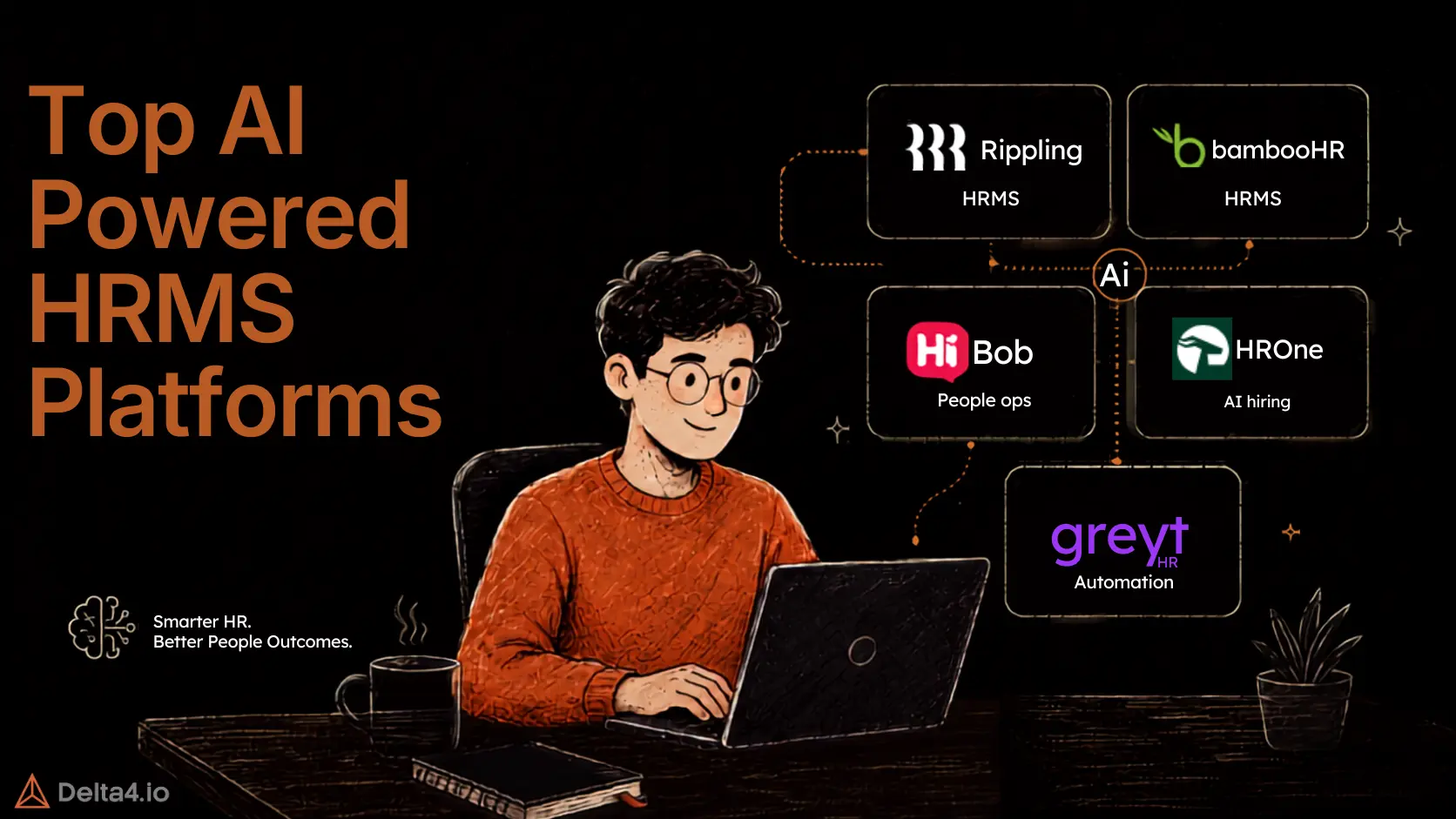
- Rippling, BambooHR, HiBob, HROne, and GreytHR are the five AI HRMS platforms compared here, each covering a genuinely different growing-business need rather than competing head-to-head.
- Real AI adoption in small-business HR is already high. ADP’s 2026 HR trends research found 59% of small business leaders already use AI in HR and 69% in payroll, but 85% still want a human involved in the decision.
- Pricing across this category is almost universally quote-based or inconsistently reported. Treat every figure in this piece as a starting estimate to confirm with sales, not a locked quote.
That’s the moment most companies start shopping for an HRMS (human resource management system), and in 2026 nearly every vendor in the category claims some form of AI. The claims range from genuinely useful (an assistant that answers a payroll question using your actual company data, or one that executes the task outright) to a rebranded search bar.
This roundup compares five HRMS platforms with genuinely documented AI features, priced and positioned for growing businesses rather than 2,000-person enterprises. Each entry covers what the AI actually does, who it fits, and what it costs as far as public pricing information allows.
What AI-Powered Actually Means in an HRMS Right Now
An AI HRMS platform in 2026 typically layers one or more of these on top of standard core HR (employee records, leave, onboarding, payroll):
- Natural-language querying, where an HR admin or manager asks a plain-English question and gets an answer pulled from live company data instead of a manually built report.
- Task execution, a newer and more capable layer where the AI doesn’t just answer a question but completes the action itself (approving a leave request, filing an expense claim).
- Predictive signals, like attrition risk scoring or payroll anomaly flags, built from historical patterns in your own workforce data.
- Automated screening, mainly resume parsing and candidate ranking in the hiring module.
The gap between vendors isn’t whether they have AI. It’s whether the AI is trained on enough of your specific data to be useful yet, and whether a human still reviews what it produces before it affects someone’s job or pay. That second point matters more than most vendor pages admit. ADP’s research found small business leaders are broadly positive on AI (79% say it helps cut costs, 77% say it improves compliance), but 85% still want a human in the loop and 79% cite data security as a top concern. Any platform on this list that lets you turn off or gate an AI action before it executes is doing something right.
How These Five Were Selected
Every platform included here had to clear four bars:
- A documented AI feature tied to an actual HR workflow, not just a marketing page listing “AI-powered” as an adjective.
- A track record with growing businesses specifically (30 to 500 employees), not only enterprise or only 1 to 10 person teams.
- Public pricing information, even if only a starting figure, so a growing business can model rough cost before a sales call.
- A genuinely distinct positioning from the other four, so the list doesn’t collapse into five versions of the same product.
The Top 5 AI-Powered HRMS Platforms for Growing Businesses
1. Rippling — Best for Unifying HR, Payroll, and IT Under One AI Layer

Rippling built its case around a single structured data layer spanning HR, payroll, IT, and finance, and its AI sits directly on top of that layer rather than bolted onto one module. Rippling AI launched in March 2026 and translates natural-language requests into actions across the whole platform, with permission-aware responses so a manager only sees or touches data they’re authorized to access. Every proposed action requires explicit human confirmation before it executes, which directly answers the human-in-the-loop concern most small business leaders raise.
- Key AI features: Natural-language queries and actions across HR, payroll, IT, and finance. A prompt library of 100+ prebuilt queries for onboarding audits, retention tracking, and payroll forecasting. Automated Compliance, which helps surface SOC 2 readiness gaps using data already in the platform.
- Best for: A growing business that wants HR, payroll, and IT device management running on one connected system instead of three vendors that don’t talk to each other.
- Pricing: The base Unity platform starts at roughly $8 per employee per month plus a mandatory monthly base fee (commonly cited around $35), according to Forbes Advisor’s 2026 pricing guide. Payroll, IT, and benefits are separate add-on modules, each with its own per-employee fee, and Rippling’s own pricing page does not publish a fixed number.
2. BambooHR — Best for Straightforward AI-Assisted Core HR

BambooHR remains the platform most reviewers point growing businesses toward first, mainly because the interface doesn’t require an implementation consultant to configure. According to BambooHR’s own pricing page, the platform includes an “HR Data Questions” AI sidekick that answers everyday employee questions (PTO balances, holiday schedules) using the company’s actual HR data, plus a more advanced “Benchmark Questions & Analysis” assistant for strategic reporting, and AI-driven categorization of open-text eNPS survey responses.
- Key AI features: An AI assistant scoped to answer routine HR questions from live company data. A separate benchmarking AI for forecasting and strategic questions. Automatic theme categorization for employee sentiment survey responses.
- Best for: A company under 350 employees that wants a fast-to-implement HRIS and doesn’t need deep customization or international payroll.
- Pricing: Third-party buyer reports converge around $10-25 per employee per month depending on tier (Core vs. Pro), with a flat $250/month minimum for companies under 25 employees, per Pin’s 2026 pricing breakdown.
3. HiBob — Best for AI-Driven People Analytics and Culture

HiBob (marketed as “Bob”) leans harder into engagement and culture than the other four platforms, with people analytics that reviewers consistently call stronger than a typical HRIS. It’s worth being direct about where its AI stands, though.
- Key AI features: An AI-assisted help center for employee self-service questions. People analytics dashboards built for headcount, attrition, and DEI reporting, though the predictive layer is less mature than competitors per user reviews.
- Best for: A mid-sized, often distributed team (roughly 50 to 600 employees) where culture, engagement, and manager enablement matter as much as core HR administration.
- Pricing: Estimates vary meaningfully by source, from $8-12 per employee per month on the low end to $16-25 on the high end, according to eLearning Industry’s 2026 guide and other buyer reports. HiBob does not include native payroll or benefits administration, so factor in a third-party payroll integration cost separately.
4. HROne — Best for an AI Agent That Executes Tasks, Not Just Answers Them

HROne takes a different bet than the other four platforms here. Instead of an assistant that answers questions, its One AI Suite is built around an Employee AI Agent that completes the task directly from a voice or chat prompt: apply for leave, regularize attendance, file an expense claim, and it’s done without navigating a form. HROne calls this “execution-first AI,” and it’s a genuinely different design choice from the query-and-answer pattern every other platform on this list uses.
- Key AI features: Employee AI Agent, a voice- and chat-based assistant that executes tasks rather than just answering questions. AI resume parsing and AI-assisted job description generation in the hiring module. AI receipt parsing for expense claims.
- Best for: An Indian growing business (50+ employees, due to HROne’s minimum commitment) that wants HR tasks completed through a single prompt rather than a multi-step form, and that needs statutory compliance (PF, ESI, TDS, PT) bundled in from the entry tier.
- Pricing: Basic starts at ₹4,950/month for up to 50 users (₹99 per additional user), Professional at ₹6,500/month for up to 50 users (₹130 per additional user), and Enterprise is custom-quoted.
5. GreytHR — Best for the Most Established Compliance Track Record Across India and the Gulf

GreytHR has been running since 1994, longer than any other platform on this list, and that history shows up as depth in statutory compliance rather than in AI ambition. What GreytHR offers instead is scale and reach. It serves over 30,000 companies and 3 million employees, with meaningful coverage across the GCC (UAE, Kuwait, Oman, Saudi Arabia, Qatar, Bahrain, Lebanon).
- Key AI features: An AI-powered chatbot for employee HR questions, included from the Essential tier. AI-powered facial recognition for attendance tracking, reducing proxy attendance and manual reconciliation.
- Best for: A growing business with employees across India and the Gulf that prioritizes compliance depth and vendor track record over cutting-edge AI, and that wants a free tier to start (up to 25 employees) before committing to a paid plan.
- Pricing: A free Starter tier covers up to 25 employees. Beyond that, sources disagree sharply. G2 reports an Essential plan at ₹3,495/month plus ₹35 per employee, while Capterra reports flat monthly USD tiers instead (Essential $50, Growth $60, Enterprise $80) with no per-employee component.
AI HRMS Platform Comparison
| Platform | Best For | Standout AI Feature | Starting Price (unconfirmed, verify with vendor) |
|---|---|---|---|
| Rippling | Unified HR, payroll, and IT | Permission-aware natural-language actions | ~$8/employee/month + base fee |
| BambooHR | Fast, simple core HR | AI sidekick for routine HR questions | ~$10/employee/month |
| HiBob | Culture and people analytics | AI-assisted help center (mixed reviews) | ~$8-25/employee/month |
| HROne | AI that executes tasks, not just answers | Voice/chat Employee AI Agent | ~₹4,950/month for 50 users (Basic) |
| GreytHR | India and GCC compliance depth | AI chatbot plus facial recognition attendance | Free up to 25 employees, then conflicting sources |
AI HRMS Security and Compliance Risks to Check Before You Buy
An HRMS holds the most sensitive data category most growing companies have. Bank details, tax IDs, performance records, and increasingly AI-generated inferences about who might quit or who’s underperforming. Adding AI on top raises the stakes rather than lowering them, and it’s worth checking three things before signing a contract.
- First, ask for SOC 2 Type II, not Type I. Type II confirms controls were tested over 6-12 months; Type I only checks a single date. Rippling holds SOC 1, SOC 2, SOC 3, and ISO 27001 — a broader published stack than most competitors. HROne says it runs on Azure and is GDPR-compliant, but doesn’t publish comparable independent certifications.
- Second, GDPR follows the data, not the vendor’s HQ. If any employees or infrastructure sit outside the US, this applies regardless of where the vendor is based relevant given AI-related GDPR fines have reached roughly €345 million as of 2026. For India-based operations, the DPDP Act’s consent and breach-reporting rules apply on top of this worth asking HROne or greytHR directly how their AI handles DPDP consent, since neither publishes this as clearly as Rippling publishes its SOC 2 status.
- Third, check if the AI touches actual employment decisions screening, ranking, or scoring not just Q&A. The EU AI Act classifies this as high-risk, with documented risk management and human oversight required starting August 1, 2026. This includes tools like HROne’s AI resume parsing, which functionally touches hiring even with a human making the final call.
How to Choose the Right AI HRMS Platform for Your Team
Run through this order rather than starting with price:
- Map your actual pain point first– If it’s manual payroll checks, Rippling’s anomaly detection matters more than HiBob’s engagement tools. If your team is buried in multi-step HR forms, HROne’s execution-first agent solves a different problem than a chatbot that only answers questions.
- Count your real headcount trajectory, not just today’s number– BambooHR’s $250/month floor under 25 employees and HROne’s 50-employee minimum commitment both punish companies that under-provision early and scale fast. GreytHR’s free tier up to 25 employees is the one genuine exception here.
- Ask what data the AI trains on-Rippling explicitly states usage data isn’t used to train AI models. Get the same commitment in writing from any vendor, including HROne and GreytHR, before rolling out an AI feature that touches employee records.
- Get a quote in your actual billing currency and headcount, not a published tier name– GreytHR in particular showed a real conflict between rupee-based and flat-rate USD pricing across sources, and HROne’s per-user overage rates change the effective price meaningfully once you cross the 50-user included threshold.
- Pilot with a small group before switching every workflow over – 10 Essential AI Tools Every Indian Startup Needs in 2026 covers the same staged-rollout logic for other AI tooling categories, and it applies just as directly to an HRMS migration.
The Bottom Line for Growing Businesses
There’s no single best AI-powered HRMS for growing businesses, only a best fit for where the company is right now. Rippling wins if HR, payroll, and IT need to run off one data layer. BambooHR wins on setup speed. HiBob wins on people analytics if you can live with an AI layer that’s still maturing. HROne wins if you want AI that completes a task instead of just describing how to do it. GreytHR wins on sheer track record and Gulf-region reach if compliance history matters more to you than AI novelty.
If your AI assistant strategy extends beyond HR into customer-facing chat, Top 10 AI Chatbot Platforms in India is a useful companion comparison for the conversational-AI layer sitting outside your HRMS.
Frequently Asked Questions
What is the difference between HRIS and HRMS?
An HRIS focuses on core HR data like employee records, payroll, and basic compliance, while an HRMS builds on that foundation with deeper functionality such as performance management, workforce analytics, and multi-country compliance. For a growing business with straightforward needs, an HRIS is often enough. Once headcount, geographic spread, or reporting demands grow more complex, an HRMS like the five platforms compared here becomes the better fit.
What does AI actually do inside an HRMS?
Inside a modern HRMS, AI usually handles one of four jobs: answering plain-English questions from company data, flagging attrition or payroll anomalies early, drafting routine HR content like job descriptions, and screening resumes during hiring. Quality varies a lot between vendors. Some AI features run on genuine machine learning trained on your workforce data, while others are closer to a search bar with a chat interface, so testing with a live demo matters more than the marketing page.
Which AI HRMS platform is the cheapest place to start?
GreytHR’s free Starter tier covers up to 25 employees with core HR, payroll, and leave and attendance management, no cost, no AI chatbot included until you upgrade. That beats BambooHR’s $250 monthly floor for teams under 25 and HROne’s 50-employee minimum commitment on every paid tier. Once you outgrow 25 employees, compare GreytHR’s paid tiers directly against HROne, since Indian statutory compliance comes bundled into both.
Is Rippling or BambooHR better for a growing business?
It depends on what’s slowing your HR team down. Rippling fits better if HR, payroll, and IT device management all need to run off one connected data layer, and its AI can act across all three with permission-aware controls. BambooHR fits better if the priority is getting a working HRIS live quickly without a heavy implementation, since its AI stays scoped to answering everyday HR questions rather than executing cross-system actions.
How secure is an AI-powered HRMS platform?
Security depends heavily on the vendor, so ask for a current SOC 2 Type II report rather than a Type I before signing anything. If any employees or infrastructure sit outside the US, GDPR obligations apply regardless of where the vendor is based, and India’s DPDP Act adds its own consent and breach-reporting rules. Also check whether the AI touches actual employment decisions like hiring or performance scoring, since that carries stricter regulatory requirements starting in 2026.
What’s the difference between HROne and GreytHR?
HROne bets on an AI agent that executes tasks directly from a voice or chat prompt, like approving leave or filing an expense claim, without navigating a form. GreytHR bets on track record instead, running since 1994 with the broadest reach across India and the Gulf, and its AI stays limited to a chatbot and facial recognition attendance. Pick HROne for execution-first automation, GreytHR for compliance depth and regional reach, especially if you have employees in the GCC.

Article by
TaniyaPeople & AI at Workplace
Taniya writes at the intersection of people and AI at Delta4 Infotech. From the people-and-culture side of the business, she covers how AI agents, automation, and new tools are reshaping hiring, onboarding, and the way teams work — always keeping people at the center.