Agentic RAG vs Traditional RAG: Differences and Use Cases

Written by
Himanshu
Reviewed by
Rohit Joshi
Published 04 November 2026
Expert Verified
Quick Answer
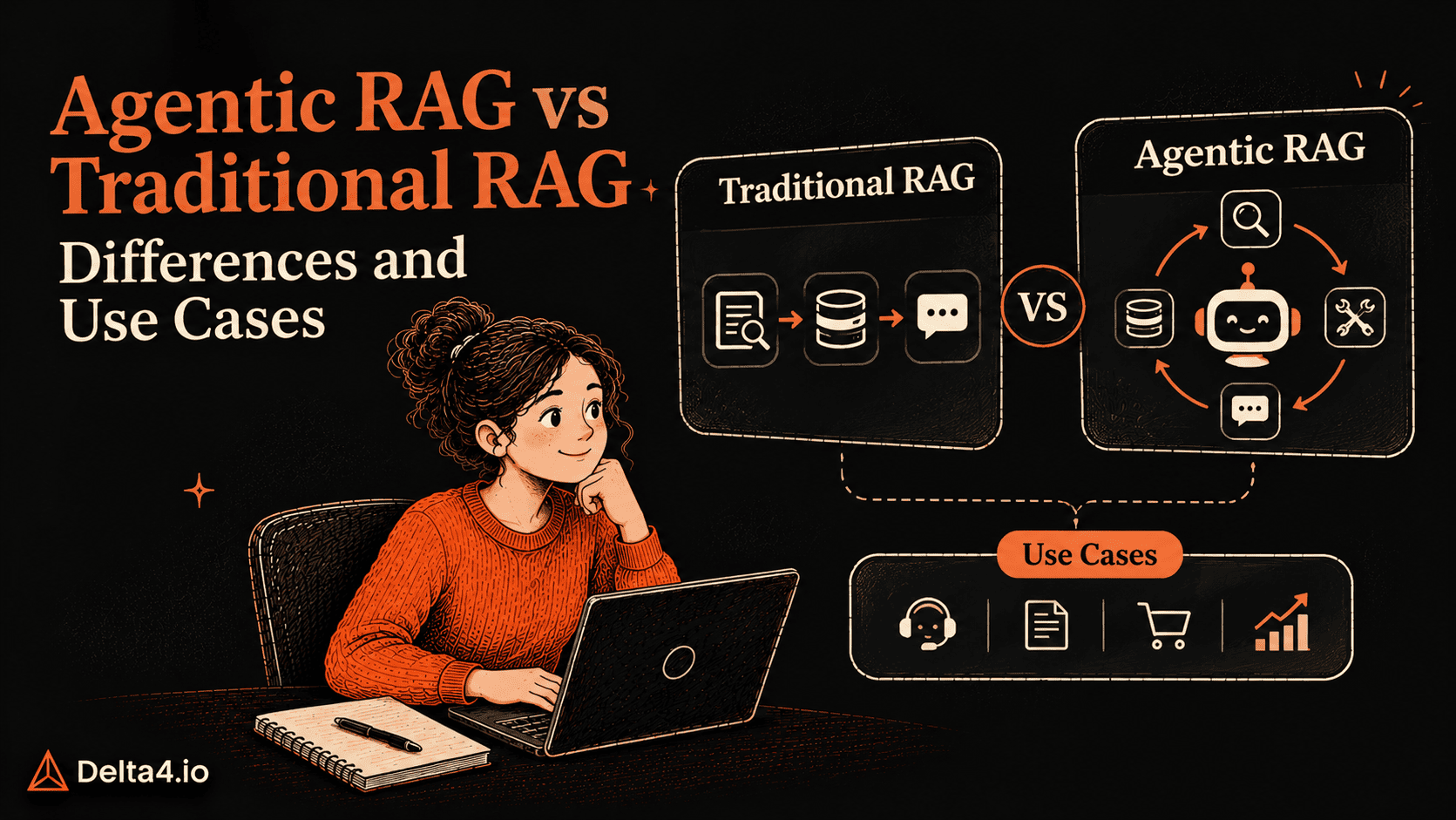
Traditional RAG follows a predefined retrieval pipeline to find relevant information and pass it to a language model for answer generation. Agentic RAG adds an AI agent that can decide when to search, break complex questions into smaller tasks, select tools, and refine retrieval based on earlier results. Traditional RAG is often sufficient for predictable knowledge retrieval, while agentic RAG is useful for complex, multi-step questions. The trade-off is additional flexibility versus potentially higher latency, cost, and operational complexity.
TL;DR
- Traditional RAG follows a predefined retrieval workflow, then generates. Agentic RAG lets an agent plan, search repeatedly, grade the results, and use tools.
- Agentic RAG handles multi-part questions better, but it adds latency, variable token costs, and a risk of compounding errors. Some vendor features are still in preview.
- Our view: most teams should exhaust hybrid search, reranking, and query rewriting before adding an agent. Many “agentic” problems turn out to be retrieval-quality problems.
Language models rely on knowledge learned during training, which can become outdated. When information is missing, they may also generate incorrect answers that sound convincing. Retrieval-augmented generation (RAG) helps address these problems by allowing models to retrieve relevant information before responding.
But traditional RAG has its own limitations. Many basic RAG systems retrieve a fixed number of passages, even when a question doesn’t require retrieval or the returned information isn’t useful. Research behind Self-RAG highlights how this fixed approach can lead to irrelevant evidence and weaker answers.
Agentic RAG takes a different approach. Instead of following a fixed retrieval process, an AI agent decides when and where to search, evaluates the results, and searches again when needed. This makes it more adaptable to complex questions, but also introduces additional costs, latency, and system complexity.
Not every application needs that level of flexibility. A well-designed traditional RAG pipeline can still be the better choice for straightforward tasks.
This blog explains how traditional and agentic RAG work, their key differences and limitations, real-world use cases, and how to build an agentic RAG system. It also helps you decide which approach fits your project.
What Is Traditional RAG?

Traditional RAG is the retrieve-then-generate design. It makes a language model check an authoritative knowledge base outside its training data before it responds, without retraining the model each time the knowledge changes. The approach was formalized in a 2020 research paper that paired a pre-trained sequence-to-sequence language model with a searchable index of Wikipedia. Modern pipelines have evolved since then, so the steps below describe a common implementation, not the exact architecture of that paper.
Two terms come up constantly. A language model (LLM) is the AI system that writes the answer. A knowledge base is the collection of documents you want it to rely on.
Traditional RAG Process
The pipeline consists of four steps. The first happens ahead of time, and the other three run in the same order for every question:
- Prepare the data. Documents from files, databases, or APIs are processed and indexed for retrieval. Depending on the application, the system may use keyword search, vector embeddings (numeric representations of meaning that are searched by similarity), or hybrid retrieval (keyword and vector search combined) to find relevant information.
- Retrieve. The user’s question is used to search the indexed information. The retrieval system returns relevant passages using the configured search method.
- Augment. The retrieved text is added to the prompt, and the instruction is sent to the model.
- Generate. The model writes the answer from the question and the retrieved text.
A fifth job runs in the background: documents and their index must be refreshed, or answers go stale.
Because every step is fixed, a basic pipeline is fast, cheap, and easy to predict.
Why Teams Use Traditional RAG
Retrieval is cheaper than retraining a model every time your knowledge changes, and it lets the model draw on current documents, feeds, or news. Answers can cite the documents they came from, which builds user trust, and teams keep control over which sources are used and who can see sensitive ones. That combination explains why so many teams never need to go further.
Limitations of Traditional RAG
These limits mainly apply to simple, single-pass pipelines. Predefined query rewriting, hybrid search, and re-ranking (which reorder results to bring the best matches first) can reduce these limits without making a system agentic.
- Basic pipelines may retrieve information for every query, even when retrieval adds little value. The model gets a fixed number of passages even when the question needs none or the passages are off topic, which can make the answer worse.
- Limited flexibility in fixed retrieval workflows. A single-pass pipeline can struggle with questions that hold several asks in one sentence, depend on earlier messages in the chat, or need data the configured knowledge base does not hold, such as live data.
- Relevance checks and retries must be explicitly configured. Nothing in a basic pipeline asks whether the retrieved text answers the question, so a weak search flows straight into the answer.
What Is Agentic RAG?

Agentic RAG keeps the same goal of retrieving facts and answering from them but lets an AI agent run the process, which is how it goes after the limits above. An AI agent is a system where the language model chooses its own next steps and uses tools to reach a goal.
In engineering terms, a workflow follows steps written in code ahead of time, while an agent directs its process. By that definition, traditional RAG is a workflow, while agentic RAG is an agent-style system. The practical test is who decides at run time: if your code fixes the steps, it is a workflow, even when it uses query rewriting or decomposition, and if the model chooses the steps, it is agentic. Many real systems sit between the two. Agentic RAG introduces an agent-controlled retrieval process that can select tools, refine searches, and decide subsequent steps based on the information retrieved.
Four Key Capabilities of Agentic RAG
An agent adds decision-making around retrieval. Three of these abilities answer the limits above, and the fourth is optional.
- Planning decides whether and how to search. It can skip retrieval when a question doesn’t need it, and it splits a multi-part question into subqueries and orders them.
- Tool use widens where answers can come from. The agent picks the right source for each step, such as a vector search, a database query, a web search, or an outside API. Tools can connect through the Model Context Protocol, a standard way for AI apps to reach external systems. For sites with no API, a browser agent can read pages the way a person would.
- Reflection replaces the missing quality check. The agent checks whether retrieved text is relevant and whether the draft answer is supported by it, then corrects course.
- Multi-agent collaboration splits the work among specialized agents, for example, one searching and another verifying.
These are design patterns, not a checklist. Many useful systems implement only one or two, and multi-agent collaboration is optional.
How an Agentic RAG Loop Runs
The abilities above work together in a loop. A retrieval agent built with the LangGraph framework follows five moves. This approach is one pattern among several, not the only design, and the official LangGraph agentic RAG tutorial demonstrates it. The tags show which ability each move draws on.
- Decide (planning). The model reads the question and decides whether to search at all. A simple greeting gets a direct reply.
- Search (tool use). For a knowledge question, the model writes a query and calls the retriever as a tool.
- Grade (reflection). A grading step judges whether the retrieved documents are relevant.
- Rewrite and retry (reflection). If they are not, the question is rewritten into a clearer query and the loop returns to step 2.
- Answer. If they are relevant, the model writes the final answer from them.
The loop ends when the grader accepts the documents or when a retry limit you set is reached.
Three Agentic Patterns Used in Practice
The loop above is a generic skeleton. These three named approaches build on it, and each suits a different situation.
- Azure AI Search agentic retrieval (planning). An LLM splits a complex query into subqueries, runs them in parallel, re-ranks each result set, and merges the best results into one response with source references. Useful when questions have several parts and you want a managed service to handle decomposition. LLM-based query planning is still in preview, as the costs section explains.
- Self-RAG (reflection built into the model). A model is trained to retrieve only when needed and to critique its output using special markers called reflection tokens. In the authors’ experiments it outperformed ChatGPT and a retrieval-augmented Llama 2 chat model on selected tasks, though these are reported research results, not proof it beats other models in general. Useful when you can train your own model and want retrieval decisions built into it.
- Corrective RAG (reflection plus a fallback tool). A lightweight evaluator scores the retrieved documents. A low score triggers a web search, and a filtering step strips irrelevant text from what remains. This approach is useful when your knowledge base may not hold the answer.
None of these guarantees a correct final answer.
Agentic RAG vs Traditional RAG
The table compares the two approaches on the points that affect real projects.
| Area | Traditional RAG | Agentic RAG |
| Architecture | Fixed retrieval-and-generation pipeline | Agent-controlled retrieval with tool execution and feedback loops |
| Control flow | Developer-defined sequence of operations | LLM decides the next action at runtime |
| Query processing | Uses predefined rewriting, expansion, or decomposition | Dynamically rewrites and decomposes queries based on retrieved evidence |
| Retrieval strategy | Uses configured vector, keyword, or hybrid search | Selects retrieval methods and tools based on the task |
| Data sources | Searches predetermined knowledge sources | Can dynamically choose among authorized databases, APIs, and search tools |
| Multi-step reasoning | Follows predefined retrieval and reasoning stages | Plans and adjusts multiple steps based on intermediate findings |
| Quality checks | Uses configured relevance scoring, reranking, or validation | Can evaluate retrieval results and decide whether another search is needed |
| Error recovery | Follows predefined retries and fallback rules | Can change search terms, tools, or strategies after failures |
| Execution time | Generally more predictable, with bounded retrieval steps | More variable because tool calls and iterations depend on model decisions |
| Token and API costs | Easier to estimate from a fixed pipeline | Potentially higher due to additional model calls and tool execution |
| Observability | Pipeline logs and retrieval metrics are usually sufficient to trace execution | Requires tracing model decisions, tool calls, intermediate results, and stopping conditions |
| Security | Fixed retrieval permissions and access controls | Requires tool-level permissions, execution limits, and protection against prompt injection |
Treat the table as general tendencies, not strict rules. Research on modular RAG shows that non-agentic systems can be far more sophisticated than a single-search pipeline, and having several data sources doesn’t automatically call for an agent, since a predefined workflow can query multiple systems too.
Use Cases for Agentic and Traditional RAG
Traditional RAG works well for predictable information retrieval, while agentic RAG is useful for tasks requiring multiple retrieval steps, dynamic source selection, or further investigation. Here are five use cases that highlight their differences. In each, the agentic version is needed only where the next step depends on what an earlier step returns. When the sources are known in advance, a predefined multi-source workflow can do the job.
1. Internal Knowledge Base and Enterprise Search
Internal knowledge assistants help employees access company policies, documents, and organizational information.
- Traditional RAG: Answers straightforward questions like “What is our remote work policy?” using indexed company documents.
- Agentic RAG (planning, tool use): Handles complex queries by retrieving and comparing information across departments, regional policies, and internal systems.
2. Customer Support and Issue Resolution
AI-powered support systems handle routine customer inquiries and complex account-related issues.
- Traditional RAG: Answers common questions about refunds, shipping, subscriptions, and product features using a knowledge base.
- Agentic RAG (tool use, planning): Investigates complex issues by checking customer records, order details, support history, and relevant policies.
3. Technical Documentation and Incident Investigation
Developers use AI retrieval systems to access documentation, troubleshoot errors, and investigate system failures.
- Traditional RAG: Retrieves answers from API references, setup guides, and troubleshooting documentation.
- Agentic RAG (tool use, planning): Investigates technical issues by examining logs, deployment records, runbooks, and previous incidents across multiple systems.
4. Financial Research and Compliance Analysis
Financial teams use RAG systems to retrieve policies, review records, and support compliance investigations.
- Traditional RAG: Retrieves relevant information from financial reports, regulatory documents, and internal policies.
- Agentic RAG (tool use, reflection): Compares policies, transaction records, and audit reports to identify potential discrepancies requiring human review.
5. Product Knowledge and Market Research
Product teams use AI retrieval to find specifications, compare features, and analyze market information.
- Traditional RAG: Answers questions about product specifications, pricing, features, and integrations from indexed documentation.
- Agentic RAG (reflection, tool use): Compares multiple products by gathering and verifying information across different sources.
The key difference: Traditional RAG is often sufficient for predefined retrieval workflows, while agentic RAG offers greater flexibility when information gathering requires decisions based on intermediate results.
Steps to Build an Agentic RAG System

Building an agentic RAG system starts with a reliable retrieval pipeline. Once that works, you can introduce agent capabilities to handle more complex queries, select tools, and retrieve information dynamically.
Step 1: Build a Traditional RAG Baseline
Create a basic RAG pipeline that retrieves relevant documents and passes them to an LLM. Test retrieval accuracy and response quality before adding agentic features. Keep a set of real user questions with known good answers. You will need it in every later step.
Step 2: Identify Where Agentic Retrieval Is Needed
Determine whether your application requires multiple data sources, query decomposition, or repeated searches. Add agentic capabilities only where a fixed retrieval workflow is insufficient.
Step 3: Choose an Orchestration Framework
- LangChain: for LLM integrations, retrieval components, and tool-enabled agents.
- LangGraph: for stateful workflows, conditional execution, and greater control over agent behavior.
- LlamaIndex: for data ingestion, indexing, retrieval, and knowledge-focused AI applications.
The framework matters less than the shape of the loop. Stripped of library code, a minimal agentic retrieval step looks like this:

Notice that your existing retriever slots in unchanged. The agentic part includes the decision, grading, and retry logic, as well as the hard stop at the end. The patterns above map onto this skeleton in different ways. Azure’s planning replaces the single query with parallel subqueries, a Corrective RAG-style fallback adds a web search when grading fails, and Self-RAG moves the decide and grade steps inside a trained model.
Step 4: Configure Retrieval Tools and Guardrails
Connect authorized data sources, define tool permissions, and set limits on retrieval iterations. Include error handling, access controls, and safeguards against untrusted content. Enforce access controls in the underlying tools and data systems rather than relying only on instructions to the LLM. Untrusted content matters because retrieved text or web pages can carry hidden instructions (prompt injection), and an agent with tools can act on them.
Step 5: Test and Optimize Performance
Evaluate retrieval relevance, answer accuracy, latency, cost, and tool failures. Trace each retrieval step to identify errors and optimize the workflow. Useful measures include whether the right passages were retrieved, whether the answer is supported by them, and whether the question was actually resolved. Re-run your Step 1 question set after every change.
Key Challenges and Limitations of Agentic RAG
Extra intelligence brings extra bills and extra ways to fail. Plan for these nine before you build.
Agentic RAG offers more flexibility, but it also introduces higher costs, slower responses, and additional technical challenges. Before implementing it, consider these nine limitations.
- Higher latency. Planning, tool selection, and repeated searches take extra time. A question that traditional RAG answers with one retrieval step may require several steps in an agentic system.
- Increased token costs. Every planning, evaluation, and rewriting step may require another LLM call. Costs can rise quickly when an agent performs multiple retrieval loops. Azure AI Search also uses different billing models for classic semantic ranking and agentic retrieval. Set retrieval limits, reduce unnecessary model calls, and monitor cost per successful answer.
- Compounding errors. One incorrect decision can affect everything that follows. An agent might select the wrong source, retrieve irrelevant information, and use it to generate an inaccurate answer. Use validation checks, maximum iteration limits, and clear stopping conditions.
- Product maturity. Not every agentic retrieval feature is production-ready. As of October 2026, Azure AI Search offers generally available minimal and extractive retrieval, while advanced LLM-based query planning remains in preview. Check feature availability, reliability, and SLA support before using it in production.
- Evaluation challenges. Measuring agentic RAG involves more than checking the final answer. Teams also need to assess retrieval quality, tool selection, reasoning steps, and task completion. Consistent evaluation methods are still developing.
- Security risks. Connecting agents to databases, APIs, and external tools increases the attack surface. Retrieved documents may contain prompt injection attempts, while poorly configured permissions can expose sensitive information. Enforce access controls at the tool and data levels.
- Complex debugging. Unlike fixed pipelines, agentic RAG can take different paths for similar questions. This makes failures harder to reproduce. Log tool calls, retrieval results, evaluations, and query rewrites to identify where problems occur.
- Inconsistent results. The same question may trigger different searches or reasoning steps across runs. Use clear instructions, execution limits, and repeatable test sets to improve consistency.
- Higher maintenance. More tools and integrations mean more components to monitor, update, and secure. Although agentic RAG can reuse an existing retriever, advanced implementations require ongoing work to maintain reliability.
Choosing the Right RAG Architecture
The right RAG architecture can make a significant difference in answer accuracy, response speed, and operating costs. Traditional RAG works well for predictable information retrieval, while agentic RAG provides greater flexibility for complex questions that require multiple searches or decisions.
The best approach depends on three factors: query complexity, data sources, and performance requirements.
Here’s how different RAG approaches fit specific use cases:
- FAQs and documentation searches → Traditional RAG. Best for predictable questions where a fixed retrieval pipeline can find and return relevant information.
- Complex, multi-step questions → Agentic RAG. Suitable for tasks requiring query decomposition, dynamic tool selection, and repeated searches based on intermediate results.
- Retrieval only when necessary → Self-RAG. Uses a model trained to decide when retrieval is needed and evaluate the relevance and quality of retrieved information.
- Incomplete or irrelevant search results → Corrective RAG. Evaluates retrieval quality and takes corrective steps, such as refining queries or searching external sources when existing information is insufficient.
- Managed retrieval and query planning → Azure AI Search Agentic Retrieval. Provides managed capabilities for processing complex queries and combining results from multiple searches. Advanced LLM-based query planning remains in preview as of October 2026.
- Live information across multiple systems → Traditional or Agentic RAG. Traditional RAG works when API calls and retrieval steps are predefined. Agentic RAG is more suitable when the model needs to select tools or decide which information to retrieve next.
- Better retrieval accuracy → Traditional RAG with advanced retrieval. Improve the existing pipeline with hybrid search, query rewriting, reranking, and relevance checks before adding agentic capabilities.
- Sensitive enterprise data → RAG with strict access controls. Both architectures can handle private information. However, agentic RAG requires additional safeguards for dynamic tool access, permissions, and data security.
- Fast responses and predictable costs → Traditional RAG. Fixed retrieval steps make latency, token usage, and infrastructure costs easier to estimate and control.
Which Approach Should You Start With?
Traditional RAG is a practical starting point for most applications. It is simpler to implement, easier to test, and often sufficient for straightforward knowledge retrieval.
Start by measuring answer accuracy, retrieval relevance, latency, and cost. If your system struggles with complex questions, selecting appropriate sources, or recovering from incomplete results, consider adding agentic capabilities.
Self-RAG and Corrective RAG address specific retrieval problems, while managed services such as Azure AI Search can reduce implementation work. These approaches can also be combined depending on your requirements.
The goal is to build a system that consistently provides accurate answers, rather than adding complexity without a clear benefit.
Businesses evaluating RAG alongside other technologies can also compare AI tools for business automation to find solutions for different workflows.
Frequently Asked Questions
Is agentic RAG better than traditional RAG?
Not always. It handles complex questions better, but it is slower and costs more, and simple lookups gain little from it. The simplest system that answers your questions correctly is usually the right one.
Can I use agentic RAG with my existing vector database?
Yes. Agentic RAG can use an existing vector database as a retrieval source. You can connect your current retriever as a tool and add agent-driven decisions around it. However, the integration requirements depend on your database, framework, and application architecture.
How can I reduce the cost of agentic RAG?
Limit unnecessary model calls, set maximum retrieval iterations, and use simpler retrieval workflows for straightforward questions. You can also cache suitable results and choose smaller models for tasks such as query classification or relevance checking. Track the cost per successful answer to understand whether additional steps provide enough value.
Can agentic RAG work with real-time data?
Yes. Agentic RAG can retrieve current information through connected databases, search services, and APIs. For example, an enterprise assistant could check live inventory records alongside product documentation. However, real-time access is not unique to agentic RAG; traditional workflows can also retrieve live data.
How do I measure whether agentic RAG performs better than traditional RAG?
Test both systems using the same set of representative questions. Compare answer correctness, retrieval relevance, response latency, cost, and task completion rates. Agentic RAG is worth adopting when its improvements justify the additional complexity and operating costs.
Does agentic RAG require more infrastructure than traditional RAG?
Not necessarily. A basic agentic RAG system can reuse an existing LLM, retriever, and knowledge base. However, more advanced systems may need additional tool integrations, workflow management, tracing, security controls, and monitoring to handle multiple retrieval steps reliably.
Conclusion
Platforms already treat this choice as a dial, not a switch. Azure AI Search illustrates this flexibility through configurable retrieval reasoning effort, including minimal, low, medium, and auto modes in its preview API. These settings let developers balance retrieval depth, cost, and latency.
The practical way to use that flexibility is to collect the questions your current system answers badly, label why each one failed, and let the largest group tell you what to add first. Add that one capability, measure it, and stop when the numbers stop improving. You end up with a system that is only as agentic as your questions require.