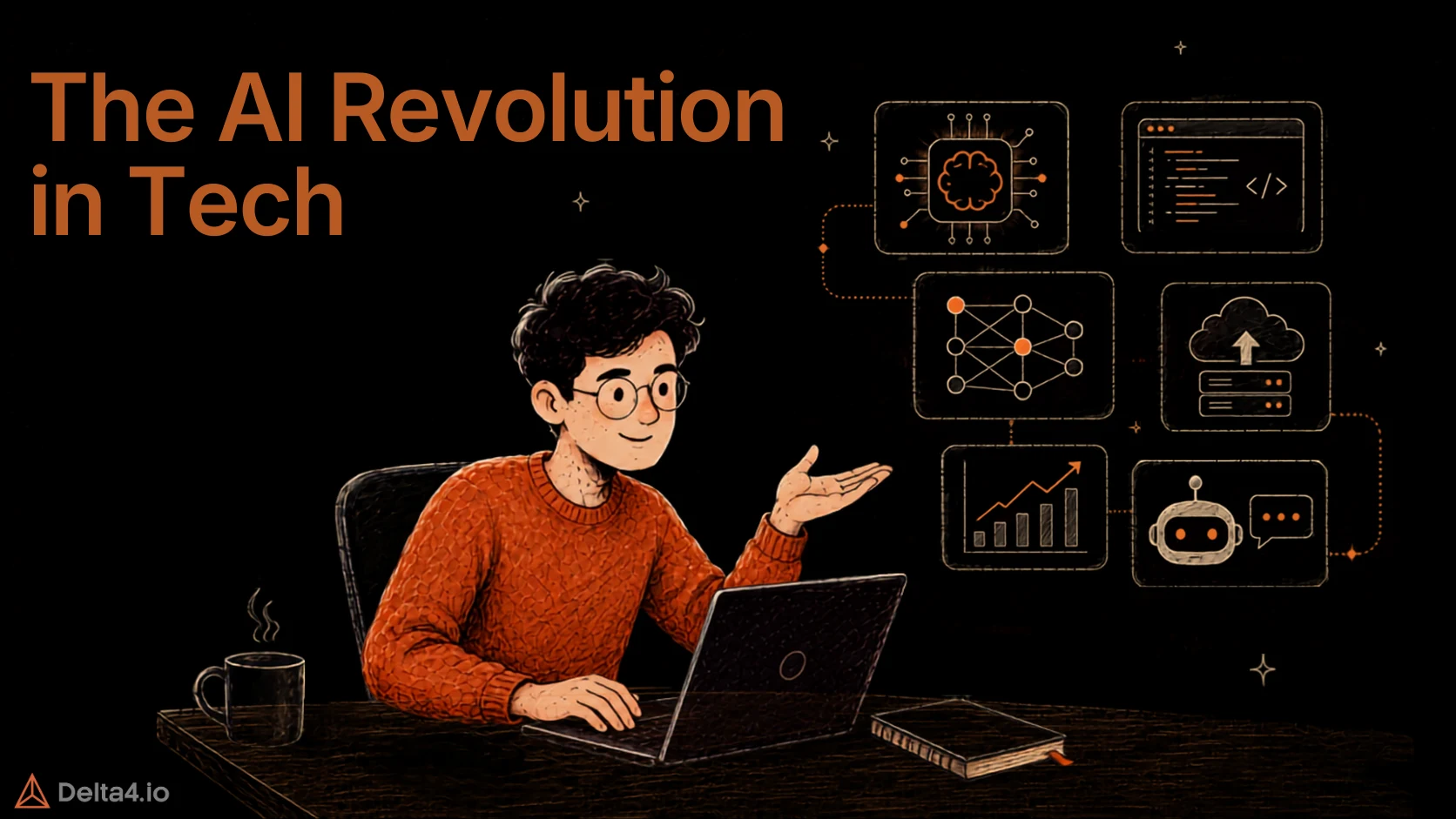
How Tech is Changing with AI

Written by
Himanshu
Reviewed by
Rohit Joshi
Last edited 22 July 2026
Expert Verified
“The last 10 years of IT have been about changing the way people work. The next 10 years of IT will be about transforming your business with AI at its core.” – Satya Nadella
Satya Nadella’s words highlight a clear shift in IT priorities. The focus is now on embedding AI into business processes to drive innovation and growth.
From smarter decisions to creative breakthroughs, AI technologies are transforming industries and unlocking new possibilities.
Let’s explore the impact of AI today.
Core AI Technologies: Transforming Our World
Current applications often rely on these central AI technologies:
Machine Learning (ML)
Machine Learning enables systems to process large datasets, identify patterns, and make decisions with minimal human input. the common applications like personalized recommendations, fraud detection in banking, and disease diagnosis in healthcare.
ML techniques include:
- Supervised Learning: Models learn from labeled data to predict outcomes, such as email spam detection.
- Unsupervised Learning: Finds hidden patterns in unlabeled data, useful for customer segmentation.
- Reinforcement Learning: Optimizes decisions through trial and error, seen in robotics and gaming.
- Semi-Supervised Learning: Combines small labeled datasets with larger unlabeled ones to improve efficiency.
- Self-Supervised Learning: Automatically generates labels from data, advancing natural language processing and vision tasks.
In 2024, advancements like federated learning and computing have enhanced ML’s capabilities. Real-time applications now include personalized healthcare predictions, smart city traffic management, and autonomous vehicle navigation.
Natural Language Processing (NLP)
Natural Language Processing enables machines to process and understand human language through computational techniques. Modern NLP has evolved significantly with transformer-based architectures, which use self-attention mechanisms to process text in parallel while capturing long-range dependencies. These models uses large-scale pre-training on vast text corpus to develop powerful language understanding capabilities.
Traditional NLP focuses on specific tasks like syntactic parsing, named entity recognition, and sentiment analysis. The emergence of Large Language Models (LLMs) like GPT, Claude, and Llama has expanded these capabilities through:
- Processing context across longer sequences using attention mechanisms that can capture relationships between distant words.
- Learning from diverse training data to handle multiple tasks without task-specific training.
- Generating coherent text by predicting tokens based on both left and right context.
Modern language models employ self-supervised learning during pre-training, where they learn to predict masked or next tokens by analyzing patterns in massive text datasets. Through instruction tuning and reinforcement learning from human feedback (RLHF), these models are refined to follow instructions and generate helpful responses.
Recent architectures have evolved to handle multiple modalities through specialized encoders and decoders. For instance, vision-language models like GPT-4o and Claude 3 can process images alongside text, performing tasks like visual analysis and generating contextually relevant descriptions. This represents a significant advance beyond traditional text-only NLP capabilities.
Recent Advancements (2024)
- Models now support dynamic context adjustments.
- Integration with real-time data sources allows up-to-date responses, making these tools relevant for fast-evolving fields like news analysis.
- Enhanced conversational memory improves interaction by maintaining context over long discussions.
NLP remains a core component, but tools like ChatGPT represent an evolution of AI, combining NLP with machine learning, generative AI, and multimodal processing for a richer, more versatile experience.
Computer Vision
Computer Vision allows machines to analyze and interpret visual data, making it indispensable in fields like autonomous driving, healthcare, manufacturing and now even chatbots.
Computer vision has also become a crucial component of multimodal AI, which integrates visual data with text and audio for a richer understanding of complex scenarios. For example, systems like GPT-4o and gemini combine computer vision with natural language capabilities to interpret images alongside textual descriptions.
This enables applications like summarizing visual data, answering questions about images, providing insights from graphs and charts or anything you can imagine.
Generative AI
Generative AI creates new content, including text, images, music, and synthetic voices, redefining how creativity and innovation merge.
- Text and Content Creation: Large Language Models (LLMs), such as GPT-4o, produce human-like text for tasks ranging from document drafting to brainstorming and coding. They have become essential tools for professionals in marketing, research, and entertainment.
- Image and Video Generation: AI models can generate realistic visuals and animations from simple text prompts, revolutionizing fields like design, advertising, and game development. Applications range from creating digital artwork to building virtual environments for training and simulations.
- Voice Synthesis: AI-driven voice synthesis produces highly realistic speech, useful for audiobooks, media production, and real-time translations. Recent innovations have enhanced expressiveness, making synthetic voices indistinguishable from real ones.
- Generative AI also integrates multiple modalities capabilities allowing systems to combine text, images, and audio for richer, more versatile outputs. For example, AI tools now generate videos with audio narration or create virtual avatars that respond to both visual and spoken inputs.
In 2024, generative AI has become more accessible, enabling businesses of all sizes to innovate with these tools. Companies are increasingly leveraging generative AI to create personalized customer experiences and optimize operational workflows.
How Different Sectors Are Using AI
Various technology sectors apply AI in ways that reflect their needs and goals:
- Software Development: Modern programming tools use AI to assist developers with code suggestions, autocomplete, bug detection, and automated testing. These features reduce development time while improving software quality and reliability.
For example tools like GitHub Copilot, Cursor, and Windsurf provide developers with intelligent code completions, debugging assistance, and real-time recommendations. Additionally, AI supports project management by predicting resource needs and delivery timelines, streamlining the entire development lifecycle. - Hardware Manufacturing: AI is transforming hardware production by integrating advanced technologies into manufacturing processes.
In chipmaking, NVIDIA uses AI to enhance design and fabrication, optimizing chip layouts and improving performance. AI also powers robotic systems on assembly lines, identifying defects before products leave the factory. Predictive maintenance systems analyze sensor data to detect early signs of equipment failure, reducing downtime and operational costs.
These advancements ensure higher product quality and more efficient production cycles. - Cloud Computing: AI enables cloud providers to manage large-scale infrastructures more effectively.
Resource allocation is optimized through AI-driven systems, ensuring servers can handle fluctuating workloads without delays. Security is enhanced as AI detects and mitigates cyber threats in real time. Additionally, AI-powered analytics enable cloud platforms to offer intelligent services that adapt quickly to client demands, from tailored data processing to predictive insights. - AI in transportation is transforming the industry in significant ways. Self-driving cars and AI-powered travel planners are examples of how AI changes the way we move from one place to another. While autonomous vehicles aren’t perfect yet, they help us travel more easily and efficiently.
- Telecommunications: AI in customer service changes how businesses interact with customers. AI Chatbots trained on your specific data can handle inquiries quickly and provide support around the clock. AI in Network optimization for dynamic resource allocation and predictive maintenance. AI analyzes network traffic patterns to enhance security and prevent outages.
- E-commerce: Recommendation systems use collaborative filtering and deep learning to personalize shopping experiences. Computer vision powers visual search capabilities. Demand forecasting helps optimize inventory management and pricing strategies.
Each industry uses AI based on its needs and level of technology, with the speed of adoption varying due to different requirements and regulations.
Potential Advantages of AI for Technology
AI offers several notable benefits in modern tech contexts:
- Higher Efficiency and Productivity: Automated processes handle repetitive work and allow teams to focus on unique tasks that require creativity, judgment, or specialized expertise. Shorter development cycles and improved code quality can follow.
- Improved User Interactions: AI can adjust recommendations and services to personal interests. Customers receive product suggestions, content feeds, or assistance shaped by their unique patterns and needs.
- Lower Costs: Automated systems reduce labor-intensive tasks and allow more precise resource allocation. This can drop operational expenses and leave more room for innovation.
- New Products and Services: By enabling applications that were once too complex, AI widens the scope of what businesses can create. AI agents performing specific task, tools like cursor helping developers, Voice Agents are just a few examples.
- Risk Management: AI security checks, fraud detection, and compliance with regulations. Systems that quickly identify anomalies help organizations protect themselves and their clients.
- Better Decision-Making: Algorithms can sift through massive datasets to provide meaningful insights. This reduces guesswork and leads to strategies grounded in evidence.
Practical Applications: Social Platforms, Autonomous Systems, and Creative Tools
AI extends well beyond code and data centers. It shapes online interactions, transportation, the arts, and public safety.
- Personalized Feeds on Social Media: Algorithms highlight posts and updates based on user interests, ensuring that time spent on social platforms aligns with individual tastes. Advertisers also rely on these algorithms to reach the right audiences.
- Autonomous Vehicles and Drones: AI supports cars, trucks, and drones that can move without direct human input. They perceive their surroundings, identify hazards, and select optimal routes. Over time, this may reduce accidents, lower transportation costs, and increase efficiency in delivery services.
- Creative Arts: AI systems can draft short stories, compose melodies, or assist in generating digital artwork. These tools do not replace human creativity but offer new methods for artists, writers, and musicians to develop fresh concepts or improve their output.
- Security and Surveillance: AI-powered cameras and analysis tools quickly spot unusual events in crowded places. They perform tasks such as facial recognition and object detection to support safety measures. Although this raises questions about privacy, there is no denying the potential for more effective security monitoring.
Challenges and Considerations
Despite its benefits, AI also presents serious challenges:
- Data Quality and Security: Quality training data is essential for better AI performance and reducing the risk of hallucination. Yet ensuring that data is clean, accurate, and secure is not simple. Sensitive information must be protected, and any breach risks harmful outcomes for businesses and individuals.
- Bias in Algorithms: AI systems learn patterns from the data they receive. If that data reflects historical inequalities or biased viewpoints, the resulting decisions can be unfair.
- Shortage of Skilled Professionals: There are not enough individuals trained in machine learning engineering, AI ethics, or advanced data analysis. Educational institutions, companies, and governments are encouraged to invest in training programs so that the workforce remains prepared.
- Deepfakes and Misinformation: Deepfakes are AI-generated manipulated media that can create fake videos, images, and audio, posing serious threats spreading misinformation and eroding public trust in authentic content.
- Automated Weapons: Autonomous weapons systems operate without human control using AI and sensors to select and engage targets independently, raising critical ethical concerns about accountability and civilian safety in warfare.
- Ethical and Societal Implications: AI becoming more effective at tasks once done by people, some types of work may shift or vanish. This can cause uncertainty for workers in sectors prone to automation. Policymakers, industries, and educational systems must find ways to help workers learn new skills and secure employment in roles that require human judgment and adaptability.
- Privacy Concerns: AI-driven surveillance and unethical data collection raise important questions about personal freedom. Without careful oversight, AI could be used to monitor individuals unfairly or at an excessive scale.
Overall Perspective
AI is no longer just a concept; over the years, it has become an important part of the technology we use daily. This shift has opened up new possibilities to create and improve solutions that make a real difference.
At the same time, we must approach AI with responsibility. Safeguarding data, ensuring fairness in algorithms, and adhering to ethical practices are essential to building trust and delivering value through technology.
The field is evolving rapidly, offering countless opportunities to innovate and grow.
Let’s work together to shape a smarter and brighter future with thoughtful and purposeful efforts.

Article by
HimanshuHead of Growth & Engineering
Himanshu is Head of Growth & Engineering at Delta4 Infotech, writing about AI agents, MCP, and no-code automation from a go-to-market view. He covers how teams evaluate, adopt, and get real value from AI tools, translating what the tech does into what it means for a business.