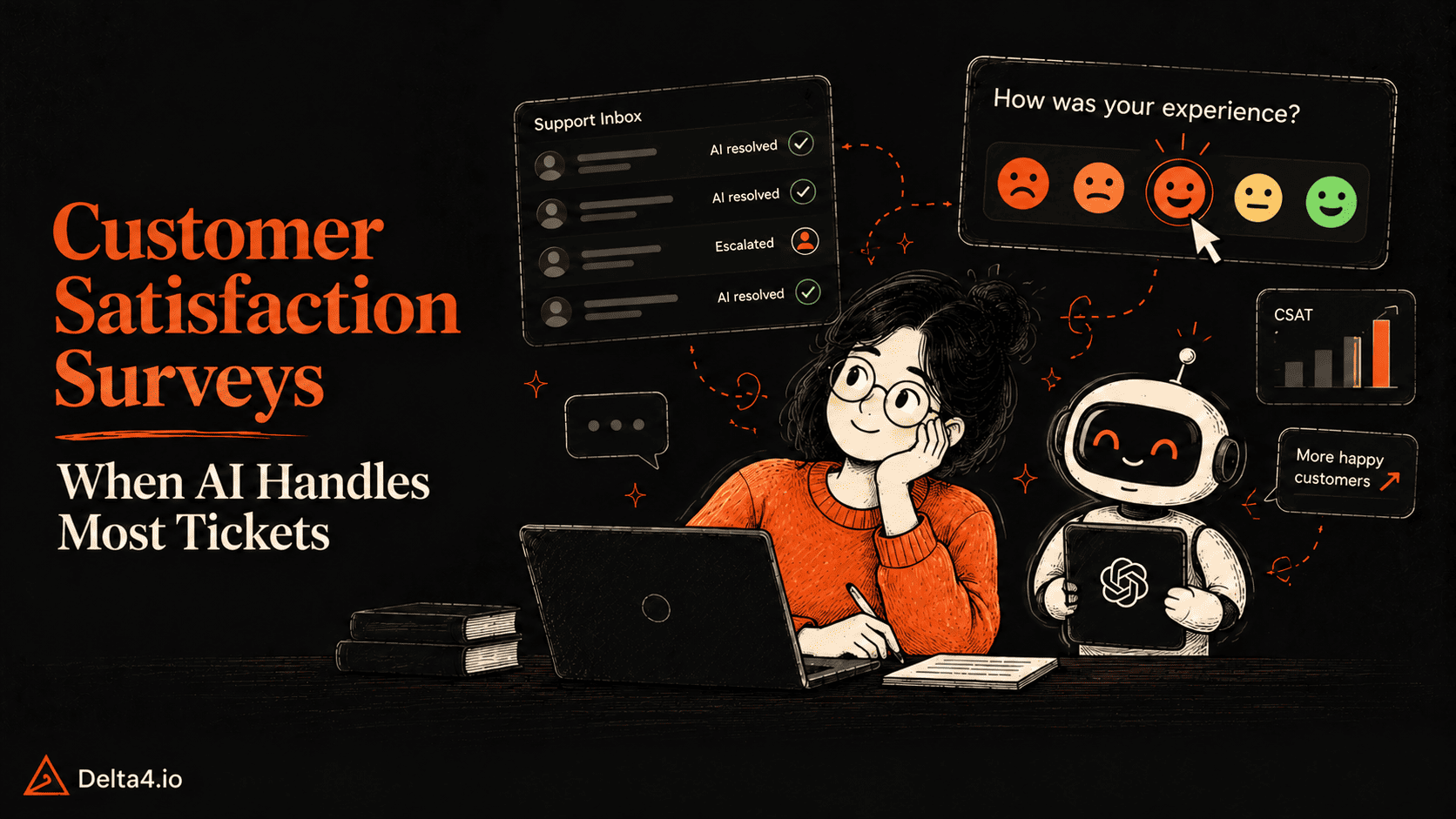
Quick answer: Customer satisfaction surveys still work when AI handles most of your tickets, but they rate only a small, self-selected slice of conversations. Close the gap by triggering surveys from a resolution signal, reporting AI and human scores separately, showing coverage beside every score, and adding signals that don’t depend on customers responding: behavioral data and validated model scoring.
TL;DR
The problem: Surveys fire from human-era triggers (ticket status, agent action), so AI-resolved conversations often never get one. The customers who do answer are self-selected, and “resolved” usually means the customer stopped asking, not that they were satisfied.
The fix: Fix the trigger, report AI and human scores separately, and print coverage next to every score.
The gap-filler: Measure your own response bias with a monthly reviewer sample, track recontact rate, and add model scoring only after validating it against human reviewers.
The caution: Most published figures come from vendors describing their own customers, so replicate key checks on your own data before changing targets.
A CSAT score reflects only the conversations that were rated, and AI agents change which ones get rated. Surveys fire from a ticket status or an agent action, and an AI agent can resolve a conversation without producing either. The customers who do answer are a self-selected group, so your score describes them, not your whole queue.
That gap has three causes, and each has a different fix. Surveys may never be sent (a trigger problem), may be sent but ignored (a design problem), or may be answered only by customers who differ from the ones who stayed silent (a representation problem). Most advice focuses on raising response rates, but in an AI-heavy queue the biggest losses usually happen before the customer sees a survey at all.
This blog shows how AI platforms define a “resolved” conversation, where surveys lose their reach, and how to read CSAT when AI handles most tickets. You’ll also get a simple monthly routine for measuring the conversations nobody rated, so your numbers reflect what customers actually experienced.
Three Reasons CSAT Surveys Miss AI-Handled Conversations
AI agents can resolve customer issues without triggering the ticket status changes or human actions that traditional CSAT surveys rely on. Even when surveys are sent, not every customer responds.
This creates three measurement gaps:
Gap
What happens
Impact on CSAT
First fix
Survey reach
AI resolves an issue, but no survey is sent.
AI conversations are missing from the score.
Fix resolution triggers.
Survey response
Customers receive a survey but don’t answer.
Fewer ratings reduce the reliability of the score.
Improve timing and placement.
Response representation
Respondents differ from customers who stay silent.
Scores may overstate or understate satisfaction.
Review unrated conversations.
CSAT Calculation and Scoring Differences Across Platforms
Customer Satisfaction Score (CSAT) measures the percentage of customers who give positive feedback after a support interaction. The calculation stays the same whether a human or an AI agent handles the conversation.
CSAT (%) = (Positive ratings ÷ Total ratings) × 100
The difference lies in how platforms classify responses. A rating of 3 on a five-point scale may be treated as negative or neutral, depending on the platform.
Platform
Scoring method
Positive ratings
Zendesk CSAT
1–5 satisfaction scale
Ratings of 4 or 5
Zendesk BSAT
Feedback on advanced AI agent conversations
Ratings of 4 or 5
Microsoft Copilot Studio
1–5 satisfaction scale
Ratings of 4 or 5; 3 is neutral
Intercom Fin
Positive feedback on Fin conversations
Positive ratings among submitted ratings
Example: Calculating CSAT From 100 Responses
Suppose customers submit these ratings:
Rating
Responses
5 (Very satisfied)
40
4 (Satisfied)
30
3 (Neutral)
15
2 (Dissatisfied)
10
1 (Very dissatisfied)
5
Using ratings of 4 and 5 as positive:
CSAT = (40 + 30) ÷ 100 × 100 = 70%
If a platform also classified 3 as positive, the score would rise to 85%, despite receiving exactly the same feedback.
This is why CSAT scores should not be compared across tools without checking their scoring rules, treatment of neutral responses, and rating denominators.
AI Resolution Rates vs. Customer Satisfaction
A high AI resolution rate doesn’t necessarily mean customers are satisfied. AI platforms use different rules to mark conversations as resolved, and some count interactions that end without explicit customer confirmation.
Platform
Resolution states
Resolution criteria
Intercom Fin
Confirmed, assumed
Confirmed when a customer acknowledges the answer. Assumed when Fin answers and the customer leaves without requesting more help.
Zendesk AI Agents
Contained, verified, assisted escalation
Contained when the AI handles the interaction without further assistance being requested. Verified when Zendesk’s verification process confirms resolution.
Distinguishes AI-handled outcomes from human involvement and unresolved conversations.
Microsoft Copilot Studio
Confirmed, implied, escalated, abandoned
Confirmed through customer acknowledgment. Implied when the agent’s logic determines resolution without explicit confirmation.
Why Resolution Rates Can Be Misleading
Intercom’s assumed resolutions, Zendesk’s contained resolutions, and Copilot Studio’s implied resolutions can include conversations where customers never explicitly confirm success.
A customer might leave because the answer helped, but they could also leave because they gave up. Both situations may look similar in resolution reporting.
To assess actual performance, track confirmed and unconfirmed resolutions separately and compare them with CSAT, escalation, and recontact rates. If customers frequently return after an assumed resolution, the reported success rate may overstate actual problem resolution.
How much support volume does a CSAT survey cover?
Among Intercom customers who use CSAT, the average response rate was 21%, but surveys were sent for only 39% of conversations. That left about 8% of all conversations with a score. On 1,000 conversations, this is arithmetic from one vendor’s averages, not a measurement of your team:
Stage
Conversations
Lever
Never sent a survey
610
The trigger
Sent, not answered
about 308
Survey design
Rated
about 82
Most of the loss happens before the customer sees anything. Surveying every conversation at the same 21% rate would return about 210 ratings, while raising the response rate nine points on the existing 390 adds only about 35. Widening the trigger beats polishing the survey. Also confirm your tool’s denominator: Intercom’s response rate chart divides ratings by all new conversations, not by surveys sent.
Why does a blended CSAT score hide AI performance?
A blended score follows the larger queue. With automation at roughly 80%, Intercom’s CX Score targets are 80% for Fin, 70% for human support, and 78% overall (0.8 × 80 + 0.2 × 70). At that mix, a ten-point slip in the human queue moves the blend only two points, so the overall number mostly reports the AI.
AI-heavy queues aren’t limited to one vendor. Salesforce reported in April 2025 that Agent force on its own help site handled more than 500,000 conversations in six months, resolved more than 84% of questions, and handed 4% to a human engineer [add link]. At that mix, very few human conversations remain to serve as a comparison group.
There’s a subtler problem too: as automation rises, humans get the harder cases. A hypothetical:
AI share
AI CSAT
Human share
Human CSAT
Blended
Before
80%
85%
20%
70%
82.0%
After
90%
85%
10%
62%
82.7%
The blend rises while the human queue loses eight points. Report AI, human, and escalated segments separately, by issue category, and treat any gap as a prompt to investigate, not a verdict.
Measuring Customer Satisfaction in AI-Handled Support
Measuring satisfaction when AI handles most support conversations requires more than collecting survey ratings. You need to track survey coverage, compare AI and human performance, and examine conversations that customers never rated.
1. Trigger Surveys After Resolution
Send a CSAT survey when an AI agent resolves an issue, rather than relying only on ticket status changes or human agent actions.
Test the trigger across every support channel to confirm that eligible conversations receive a survey. YourGPT can collect feedback directly within the chatbot after an interaction.
2. Keep Surveys Short and Relevant
Use a satisfaction rating, a resolution check, and an optional follow-up question.
Survey question
Format
When to ask
How satisfied were you with the answer?
1–5 rating or emoji
Every survey
Was your issue resolved?
Yes / No
Every survey
What could we have done better?
Short text or reason list
After negative feedback
The resolution question helps distinguish customer-confirmed outcomes from assumed resolutions. Define which ratings count as positive before calculating CSAT.
3. Track AI and Human CSAT Separately
A combined CSAT score can hide differences between AI and human support.
Report satisfaction separately for AI-resolved, human-resolved, and AI-to-human handoff conversations. Where possible, segment results by channel and issue type to make comparisons more meaningful.
4. Measure Survey Coverage
Display the number of rated conversations alongside every CSAT score.
For example, 80 ratings from 1,000 eligible conversations represent just 8% coverage. A high CSAT based on such a small share may not reflect the wider support queue.
Track surveys sent and response rates separately to identify whether low coverage comes from missing triggers or unanswered surveys.
5. Check for Response Bias
Customers who answer surveys may have different experiences from those who don’t. Review samples from both groups:
Have the same reviewers evaluate both samples without seeing customer ratings.
The difference between reviewer scores for the two groups estimates the selection gap. Comparing reviewer scores with customer ratings for Sample B helps identify differences between human reviewers and customers.
These sample sizes are starting points, not statistical standards. Larger or stratified samples may be needed for reliable comparisons.
6. Add Behavioral Metrics
Survey responses alone cannot show whether a resolution actually worked. Track:
Recontact rate: Customers returning about the same issue within a defined period, such as seven days.
Escalation rate: AI conversations transferred to human support.
Abandonment rate: Customers leaving before an issue is resolved.
Repeated requests: Customers asking the same question or repeatedly requesting a human.
Compare these metrics within similar issue categories. Human agents often handle more difficult cases, making overall AI-versus-human comparisons misleading.
7. Validate AI-Based Satisfaction Scoring
AI-based scoring can estimate satisfaction for conversations without survey responses.
Platforms such as Intercom and ServiceNow offer model-based customer experience scoring. However, these estimates should not replace direct customer feedback.
Before using them in reports:
Have trained reviewers independently score a representative conversation sample.
Compare model scores with reviewer judgments using correlation and weighted kappa for ordinal ratings.
Check accuracy across channels, issue categories, and AI-to-human handoffs.
Revalidate after significant model or prompt changes.
Keep model-generated satisfaction scores separate from survey-based CSAT because they measure satisfaction differently.
Review Low-Scoring Conversations Weekly
Assign a team member to review low-scoring AI conversations and identify recurring problems, such as incorrect answers, missing knowledge, failed integrations, or poor handoffs.
Use conversation logs, such as YourGPT’s Session Logger, to investigate failures and update the chatbot’s knowledge or workflows.
Track whether those changes reduce repeat contacts, improve resolution outcomes, and increase customer satisfaction over time.
Combining CSAT With Other Customer Satisfaction Metrics
CSAT surveys capture direct customer feedback, but they don’t cover every support interaction. Combining survey results with resolution confirmation, customer behavior, and AI-based scoring provides a clearer view of satisfaction.
Signal
What it measures
Coverage
Main limitation
CSAT surveys
Customer-reported satisfaction
Customers who submit ratings
Responses may not represent all customers
Resolution confirmation
Whether customers confirm their issue was resolved
Customers who provide confirmation
Doesn’t measure satisfaction directly
Recontact and behavior
Repeat issues, escalations, and abandonment
Conversations with available tracking data
Indicates potential problems, not their causes
AI-based scoring
Satisfaction estimated from conversation content
Eligible conversations supported by the model
Requires validation and may exclude some channels
Each metric answers a different question. CSAT captures how customers rate their experience, resolution confirmation checks whether the issue was solved, and behavioral metrics reveal what happens afterward.
AI-based scoring can help assess unrated conversations, but it should be validated against human reviews. Use these signals together rather than relying on a single satisfaction score.
Risks and Limitations of AI-Based Satisfaction Scoring
AI-based satisfaction scoring helps assess conversations without survey responses, but its results aren’t always accurate. Teams should consider five limitations before using these scores to measure support performance.
Model errors and drift: AI can misinterpret customer sentiment, and scores may change after model or prompt updates. Regular human reviews help identify inconsistencies.
Hidden customer frustration: Customers who leave without confirming resolution may be dissatisfied. Track repeat contacts, escalation requests, and customer-confirmed resolutions to identify these cases.
Data privacy: AI scoring requires access to conversation transcripts, which may contain sensitive information. Review data processing, storage, retention, and access controls before enabling it.
Score manipulation: Teams may encourage positive feedback or confirmation without fully resolving issues. Compare satisfaction scores with recontact and escalation rates.
Vendor-reported accuracy: Performance claims often come from vendors testing their own systems. Validate scoring accuracy using your own support conversations before setting performance targets.
AI-generated scores work best as a supporting measure alongside direct customer feedback, behavioral data, and regular human reviews.
Building a Reliable CSAT Baseline for AI Support
A reliable CSAT baseline helps teams track satisfaction consistently as AI handles more support conversations. Since platforms use different resolution and scoring methods, establish your own definitions before comparing performance.
Start with the previous month’s support data and record:
Conversation volume: Total conversations and the percentage handled by AI.
Survey coverage: Surveys sent, ratings received, and response rates.
CSAT by segment: Separate scores for AI-resolved, human-resolved, and escalated conversations.
Resolution outcomes: Confirmed, assumed, and unresolved conversations, using your platform’s definitions.
Response bias: Differences between rated and unrated conversations, estimated through independent reviews.
Recontact rate: Customers returning about the same issue within a defined period.
Scoring rules: Written definitions of positive ratings, resolution, and eligible conversations.
Keep these metrics in a monthly report and use the same calculation methods across reporting periods. Review changes in survey coverage and conversation mix before interpreting improvements or declines in CSAT.
A customer satisfaction survey asks customers to rate a
support interaction, usually shortly after it ends.
The percentage of positive ratings forms the Customer
Satisfaction Score (CSAT). In AI support, the survey
measures the customer’s experience with an AI agent.
2. How do you calculate CSAT?
Divide the number of positive ratings by the total number
of ratings and multiply by 100. What counts as positive
varies by platform. For example, Zendesk classifies a
rating of 3 as negative, while Microsoft Copilot Studio
treats it as neutral. Check whether neutral ratings
remain in the denominator before comparing scores.
3. Why do surveys miss so many AI-handled conversations?
Traditional surveys often depend on ticket status changes
or human agent actions. AI agents can resolve conversations
without triggering either event. As a result, some
customers never receive a survey, while others choose
not to respond. Updating survey triggers helps improve
coverage.
4. Does a high AI resolution rate mean customers are satisfied?
No. Some platforms count conversations as resolved
when customers stop responding without explicitly
confirming success. Intercom Fin’s assumed resolutions
and Microsoft Copilot Studio’s implied resolutions
illustrate why resolution does not automatically mean
satisfaction. Compare resolution rates with CSAT,
customer confirmation, and recontact data.
5. What is a good CSAT score for AI support?
There is no universal benchmark because platforms use
different scoring methods and survey coverage varies.
Compare performance against your own historical baseline,
report AI and human CSAT separately, and display survey
coverage alongside each score.
6. How do you measure satisfaction for unrated conversations?
Combine behavioral signals such as recontact rates,
escalations, and abandonment with AI-based satisfaction
scoring. Validate model-generated scores against
independent human reviews before using them to
evaluate overall customer satisfaction.
7. Should you report AI and human CSAT separately?
Yes. A combined CSAT score can hide differences between
AI and human support, especially when AI handles most
conversations. Report AI-resolved, human-resolved,
and escalated interactions separately, ideally
within similar issue categories.
8. What is a selection gap?
A selection gap is the difference in estimated
satisfaction between rated and unrated conversations.
Have the same trained reviewers evaluate samples of
both groups without seeing customer ratings.
This helps identify potential response bias separately
from differences between reviewer and customer scores.
9. What is recontact rate?
Recontact rate measures the percentage of customers
who return about the same issue within a defined
period, such as seven days. It helps identify cases
where an issue was marked resolved but the customer
still needed assistance. Compare recontact rates
within similar issue categories.
10. Should you replace surveys with AI scoring?
No. Surveys provide direct customer feedback, while
AI scoring estimates satisfaction from conversation
content. Keep CSAT surveys, improve their coverage,
and use validated AI scoring alongside behavioral
metrics to assess conversations without ratings.
Conclusion
When AI handles most support conversations, CSAT alone cannot provide a complete picture of customer satisfaction. Surveys capture feedback from respondents, but many AI-resolved interactions remain unrated.
To measure satisfaction more accurately, track survey coverage, report AI and human CSAT separately, and combine customer feedback with recontact rates and validated AI-based scoring. Regular conversation reviews help identify issues that surveys may miss.
Start by defining what counts as a positive rating and a successful resolution. Then test survey triggers across channels and establish a monthly baseline to measure improvements consistently.
Himanshu is Head of Growth & Engineering at Delta4 Infotech, writing about AI agents, MCP, and no-code automation from a go-to-market view. He covers how teams evaluate, adopt, and get real value from AI tools, translating what the tech does into what it means for a business.