The All-in-One SEO & Marketing Blueprint: Learn, Apply, Grow (in 2026)

Written by
Rohit Joshi

Reviewed by
Himanshu
Last edited 21 July 2026
Expert Verified
— Seth Godin
We are in 2026, and SEO and Digital Marketing have changed significantly. The release of ChatGPT has shifted how content is produced, and search engines have updated their methods as a result.
Why does this matter? Competition is high, search engines are smarter, and customer expectations keep changing. What worked last year may not work today. To stay ahead, you need to know what’s working right now.
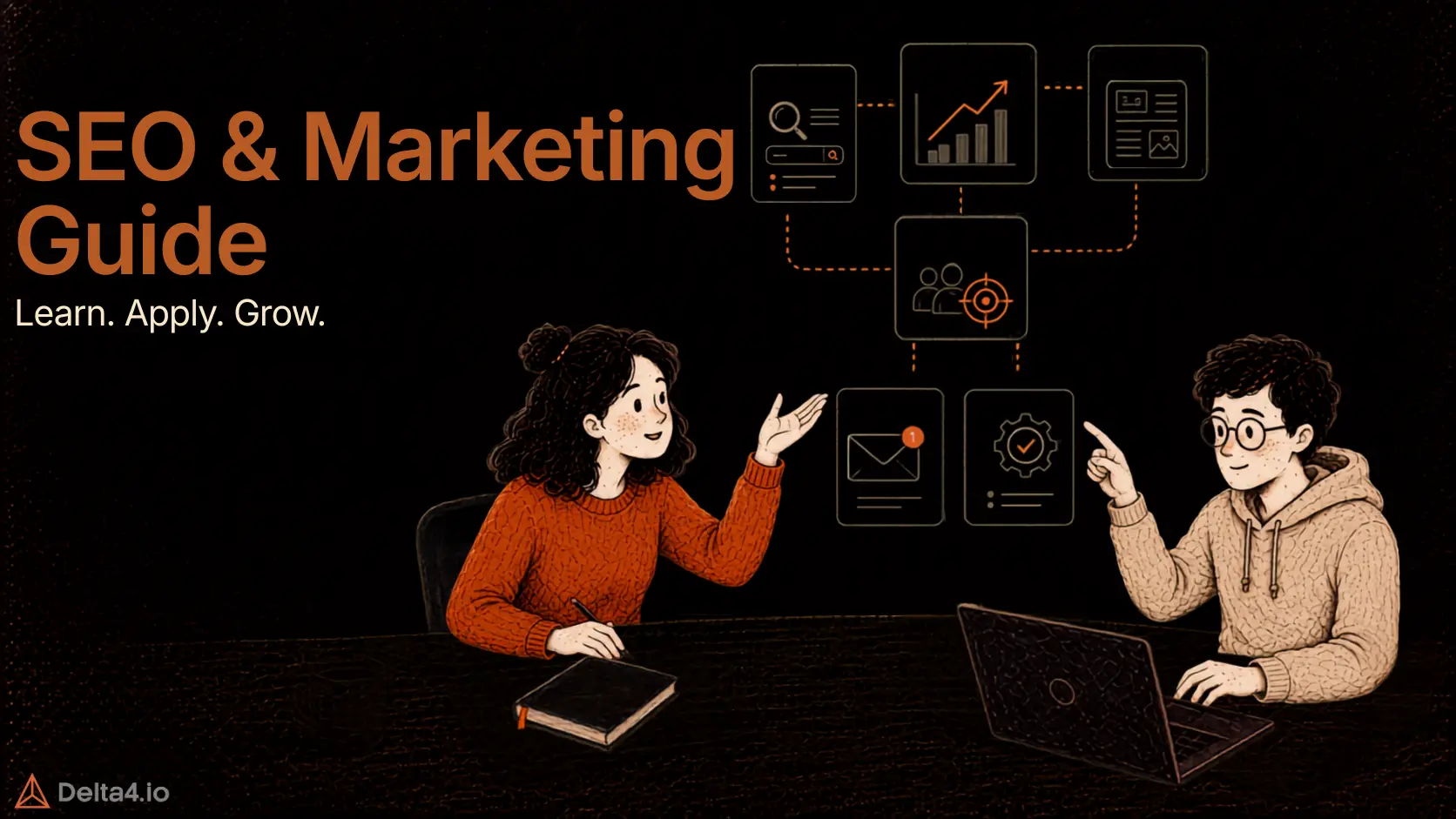
This guide will help you build a strong foundation in SEO and Digital Marketing. You’ll learn key skills, current trends, and best practices that businesses use to grow online. Whether you’re a new hire, an aspiring marketer, or a business owner, this will give you the knowledge you need to succeed.
Understanding SEO (Search Engine Optimization)
SEO is the process of improving a website’s visibility on search engines like Google, Bing & others. The goal isn’t just to rank higher—it’s to attract the right audience and convert them into customers, subscribers, or engaged users.
Effective SEO isn’t about stuffing keywords or chasing backlinks. It’s about matching search intent, optimizing content, and building authority in a way that search engines trust. This requires a combination of:
- On-Page SEO – Optimizing content, headings, and internal links for both users and search engines.
- Off-Page SEO – Earning backlinks and building credibility through mentions on reputable sites.
- Technical SEO – Ensuring fast load times, mobile-friendliness, and proper site structure.
With AI-generated content becoming widespread, search engines now prioritize expertise, originality, and user experience over outdated tactics. Understanding these principles is what separates effective SEO from random guesswork.
The Problem: Many SEO Experts Miss the Mark
A year or years of SEO experience looks good on a resume. But when it comes to delivering actual results, most candidates fall short.
Why? Because they don’t truly understand the offering they’re optimizing for.
SEO isn’t just about knowing the tools—it’s about applying them with purpose.
Too many candidates treat SEO like a checklist:
❌ Stuffing keywords without context
❌ Chasing backlinks without relevance
❌ Ignoring how search intent aligns with the product
❌ Fully AI Generated Content
What Separates Top SEO Professionals?
The best SEO professionals don’t guess. They focus on user intent, aim to provide value-driven content to readers, optimize content, use data for decision-making, and, most importantly practice retrospection.
Instead of blindly adding keywords, they create content that answers real questions. Instead of chasing backlinks, they build authority by earning them naturally.
Most importantly, they understand their offering and what they are presenting. They have a good understanding of their product, service, or solution.
They know that rankings alone mean nothing if the traffic doesn’t convert. That’s why they analyze search behavior, test different approaches, and refine strategies based on actual performance—not assumptions.
The Difference Between Stagnation and Growth
SEO is no longer about just executing tasks—it’s about thinking strategically. The difference between those who grow and those who stay stuck comes down to skill, not experience.
- Can’t analyze data in Google Analytics and Search Console? Measuring impact becomes impossible.
- Don’t know how to use Ahrefs, SEMrush, or Ubersuggest to find opportunities? Your strategy will always be weak.
- Using AI the wrong way? It will hurt more than it helps.
- No understanding of content marketing, user intent, or conversion optimization? Your SEO efforts won’t lead to real business growth.
The Skills You Need to Succeed
SEO in 2026 requires more than just knowing the basics. It demands critical thinking, adaptability, and a strong command of multiple skills along with basic SEO skills. Here’s a detailed breakdown of what’s needed to stay ahead.
1. Keyword Research & Search Intent Analysis
Finding the right keywords is no longer enough. Understanding why users search for them is what makes a strategy effective.
- Short-Tail vs. Long-Tail Keywords – Know when to target high-volume, competitive terms vs. low-competition, high-conversion phrases.
- Search Intent Classification – Every keyword has an intent—informational (learning), navigational (finding), transactional (buying), or commercial (researching before buying). Targeting the wrong intent leads to poor results.
- Competitor Analysis –Use Ahrefs, SEMrush, or Ubersuggest to find what’s already working for others and where they are missing opportunities.
- SERP Feature Optimization – Ranking #1 isn’t enough. Optimize for featured snippets, AI Overview, People Also Ask, image packs, and other search result features to maximize visibility.
2. Content Strategy & On-Page SEO
Search engines rank pages that provide value. If the content is weak, no amount of technical SEO will help.
- Content Optimization – Write clear, engaging, and search-friendly headlines, meta descriptions, and page content that match user intent.
- SEO Copywriting – Blend SEO best practices with persuasive writing naturally. Ranking is pointless if the content doesn’t convert.
- Internal Linking – A solid linking structure guides users and search engines to important pages, increasing time on site and improving rankings.
- Content Clusters & Topic Authority – Build authority by covering topics in-depth rather than relying on isolated blog posts and create interconnected content (Content Pillars) to establish authority in a subject.
- User Engagement Metrics – Monitor bounce rate, dwell time, and scroll depth to understand how users interact with content. If visitors don’t stay to your content your rankings drop.
3. Link Building & Digital PR
Backlinks remain one of the strongest ranking signals, but quality matters more than quantity. Knowing how to acquire links the right way is key.
- White-Hat Link Building – Earn links through guest posts, HARO responses, and partnerships with industry websites.
- Broken Link Building – Identify dead links on high-authority sites and offer your own relevant content as a replacement. This provides value while earning a backlink.
- Resource Page & Skyscraper Technique –Create content that is so valuable and in-depth that other websites naturally link to it. The skyscraper technique involves improving existing high-ranking content and pitching it to sites that linked to the original.
- Unlinked Brand Mentions – If websites mention your brand but don’t link back, reach out and request a backlink. This is one of the easiest ways to gain authoritative links.
- Avoiding Spammy Practices – Never buy links, participate in link farms, or use shady PBNs (Private Blog Networks). These tactics might work temporarily but lead to penalties that can destroy rankings.
4. Technical SEO – Build a Strong Foundation
Search engines favor websites that are fast, secure, and easy to crawl. Mastering technical SEO ensures your site performs well and is accessible to both users and search engines.
- Crawling & Indexing – Understand how search engines discover and store web pages. Use tools like Google Search Console to check indexing status and fix errors.
- Site Speed Optimization – Learn how to improve Core Web Vitals to boost rankings and user experience. Use tools like PageSpeed Insights and GTmetrix.
- Mobile-Friendliness – Ensure websites work seamlessly on all devices by using responsive design and mobile-first indexing techniques.
- Schema Markup – Implement structured data to help search engines understand and display content in rich results.
- URL Structure & Site Architecture – Maintain clean, logical site navigation that makes it easy for users and search engines to find content.
4. AI & Automation in SEO
AI is changing how SEO works. But blindly using AI-generated content leads to poor rankings. The key is knowing when and how to use AI while maintaining originality and strategic control.
- AI-Assisted Content Writing – Tools like ChatGPT, Claude can speed up content creation, but raw AI content won’t rank. Always edit, refine, and add unique insights to make content valuable and human-like.
- Automated Reporting – Use Google Looker Studio, Google Sheets, and APIs to automate SEO tracking, reducing manual work and allowing faster decision-making.
- Semantic Understanding & NLP – Google now interprets content based on meaning, relationships, and context rather than just keywords. Optimizing for semantic SEO, structured data, and natural language processing (NLP) is now critical for ranking.
AI is a tool, not a replacement for strategy. Those who use AI effectively will outperform those who rely on it blindly.
5. Data Analysis & SEO Reporting
SEO is not guesswork. Every decision should be backed by data. Without proper tracking and analysis, efforts can go to waste. Knowing how to collect, interpret, and act on SEO data is what separates top professionals from the rest.
- Google Analytics & Search Console – Track organic traffic, keyword rankings, and technical issues. Learn to analyze click-through rates (CTR), bounce rates, and conversion data to optimize performance.
- SEO Forecasting & Trends – Use historical data to predict future traffic trends. Identify which keywords and content types are gaining traction and plan accordingly.
- A/B Testing for SEO – Small changes can have a big impact. Test:
- Page titles & meta descriptions to improve CTR.
- Different content structures to increase engagement.
- Call-to-action (CTA) placements to boost conversions.
- Attribution Models – SEO doesn’t work in isolation. Learn how organic search interacts with paid ads, social media, and referrals to measure the true impact of SEO on overall traffic and conversions.
- Cohort Analysis & User Segmentation – Break down traffic by user behavior, location, and device type to refine targeting and personalize SEO strategies.
- Custom Dashboards & Automated Reports – Set up Google Looker Studio, Google Sheets, or API integrations to automate reporting and get real-time insights.
SEO professionals who understand and apply data effectively don’t just track rankings—they drive real business growth.
6. Video & Audio Marketing
Search is no longer just about text. Videos and podcasts attract massive engagement, but success depends on more than just being present. Quality content, optimized correctly, increases discoverability across platforms.
- YouTube SEO & Video Growth Strategies – YouTube is the second-largest search engine, but ranking requires more than uploads. Key factors:
- Watch time & retention – High-quality content keeps viewers engaged, signaling relevance to YouTube’s algorithm.
- Click-through rates (CTR) – Strong thumbnails, compelling titles, and engaging descriptions drive more clicks.
- Engagement signals – More comments, shares, and likes push videos higher in search results.
- Podcast Marketing & Audio SEO – Platforms like Spotify, Apple Podcasts, and YouTube Audio rely on their own search algorithms. To improve rankings:
- Use keyword-rich titles & descriptions aligned with listener intent.
- Add transcripts & show notes so search engines can index content.
- Cross-promote on blogs, social media, and YouTube to expand reach.
The more platforms you optimize for, the more discoverable you become—but only if the content is valuable. Weak content won’t rank, no matter how well it’s optimized.
7. Conversion Rate Optimization (CRO) & UX
Driving traffic is only half the battle. If visitors don’t take action, the effort is wasted. CRO (Conversion Rate Optimization) ensures that traffic converts into leads, sales, or engagement. A strong user experience (UX) supports this by making interactions seamless and intuitive.
- A/B Testing & Multivariate Testing – Small changes can make a big difference in conversions.
- Tools like Google Optimize, VWO, and Optimizely help test variations of headlines, CTAs, page layouts, and forms.
- A/B testing compares two versions of a page, while multivariate testing tweaks multiple elements simultaneously to find the best combination.
- Psychological Triggers in UX/UI – we humans make decisions based on emotions, not logic. Using proven behavioral psychology increases conversions.
- FOMO (Fear of Missing Out) – Limited-time offers and social proof create urgency.
- Loss Aversion – Highlighting what users might lose rather than what they gain makes actions feel more necessary.
- Urgency & Scarcity – Real-time stock indicators, countdown timers, and exclusive deals encourage faster decisions.
- Heatmap & Behavior Analytics – Understanding how users interact with a website allows for smarter optimizations.
- Tools like Posthog, Hotjar, Crazy Egg, and Mouseflow show where users click, scroll, or drop off.
- Session recordings reveal friction points, helping refine navigation, CTA placement, and content flow.
The goal isn’t just to attract visitors—it’s to guide them toward taking meaningful actions. Data-driven CRO combined with UX improvements ensures that every visitor has the best chance of converting.
Growth Hacking & Performance Marketing
Getting traffic is one thing. Turning that traffic into sustained growth is another. Growth hacking combines marketing, psychology, and automation to accelerate user acquisition and retention, while performance marketing ensures every ad dollar delivers measurable results.
1. Viral Marketing Strategies
Some content spreads naturally, but virality is rarely accidental. The right approach increases the chances of exponential reach.
- Network effects – Encourage user sharing by making content more valuable when more people engage (e.g., invite-only access, social challenges).
- Share triggers – Emotional, controversial, or highly useful content gets more shares.
- Built-in virality – Referral incentives, social proof (e.g., testimonials, case studies), and gamification increase credibility.
💡 Tip: People share what makes them look smart, funny, or helpful. Craft content that aligns with those motivations.
2. Referral & Retention Strategies
Acquiring customers is expensive. Keeping them is cheaper.
- Loyalty programs – Reward users for repeat purchases, engagement, or referrals.
- Advocate marketing – Turn satisfied customers into brand ambassadors through exclusive perks, user-generated content, and strong community engagement.
- Email & SMS retention – Timely, personalized messages keep users engaged and returning.
💡 Tip: The best referral programs make sharing effortless. Offer simple, one-click referral links with clear rewards.
3. Advanced PPC & Retargeting
Paid ads aren’t just about getting clicks—they should bring conversions at the lowest cost.
- Google Ads scripts – Automate bidding, keyword monitoring, and campaign adjustments.
- Facebook Custom Audiences – Retarget past visitors, upsell existing customers, and build lookalike audiences.
- AI-driven bidding strategies – Platforms like Google Ads and Meta use machine learning to adjust bids in real time for better ROI.
💡 Tip: Retarget users with some kind off action like a discount offer. It’s one of the easiest ways to recover lost sales.
Soft Skills That Matter
SEO is more than just technical expertise—it requires skills that help in execution and collaboration.
- Critical Thinking & Problem-Solving – The ability to troubleshoot in respective context is important in every field including SEO & marketing.
- Adaptability – Keeping up with industry changes and adjusting strategies accordingly.
- Communication – Explaining things to a non-technical stakeholders clearly and persuasively.
- Patience & Persistence – SEO takes time. Consistency is what leads to results.
USEFUL Resources
Complete SEO Resource Guide
Your comprehensive collection of SEO tools, guides, and learning resources to master search engine optimization.
Pro Tips for Growth Marketing Success
✔ 80/20 Rule: Focus on the 20% of efforts that bring 80% of results—double down on what works.
✔ Data Based Decisions: Don’t rely on opinions; track CAC (Customer Acquisition Cost) and LTV (Lifetime Value) to guide strategies.
✔ Speed Matters: Launch fast, optimize later—perfectionism kills momentum.
✔ Be Everywhere (But Strategically): More channels = more discoverability, but quality content always wins.
✔ Stay Updated: Algorithms change, and what worked last year might not work now. Keep testing and refining.
Conclusion
The digital marketing landscape is evolving fast, with AI playing a major role. To succeed in SEO & marketing in 2025-2026, you need a mix of technical skills, creativity, and adaptability.
✅ Stay updated with industry changes.
✅ Experiment with new tools and strategies.
✅ Focus on user experience and high-quality content.
Start implementing these skills today, and you’ll be on your way to mastering SEO & marketing! 🚀

Article by
Rohit Joshi