5 Trends Our AI Team Is Excited About in 2026

Written by
Himanshu
Reviewed by
Rohit Joshi
Last edited 22 July 2026
Expert Verified
These words sum up how AI is changing the way businesses work. It’s no longer just about prototype ideas; it’s actively solving real-world problems.
In 2026, AI is expected to become even more practical, offering smarter ways to handle everyday tasks.
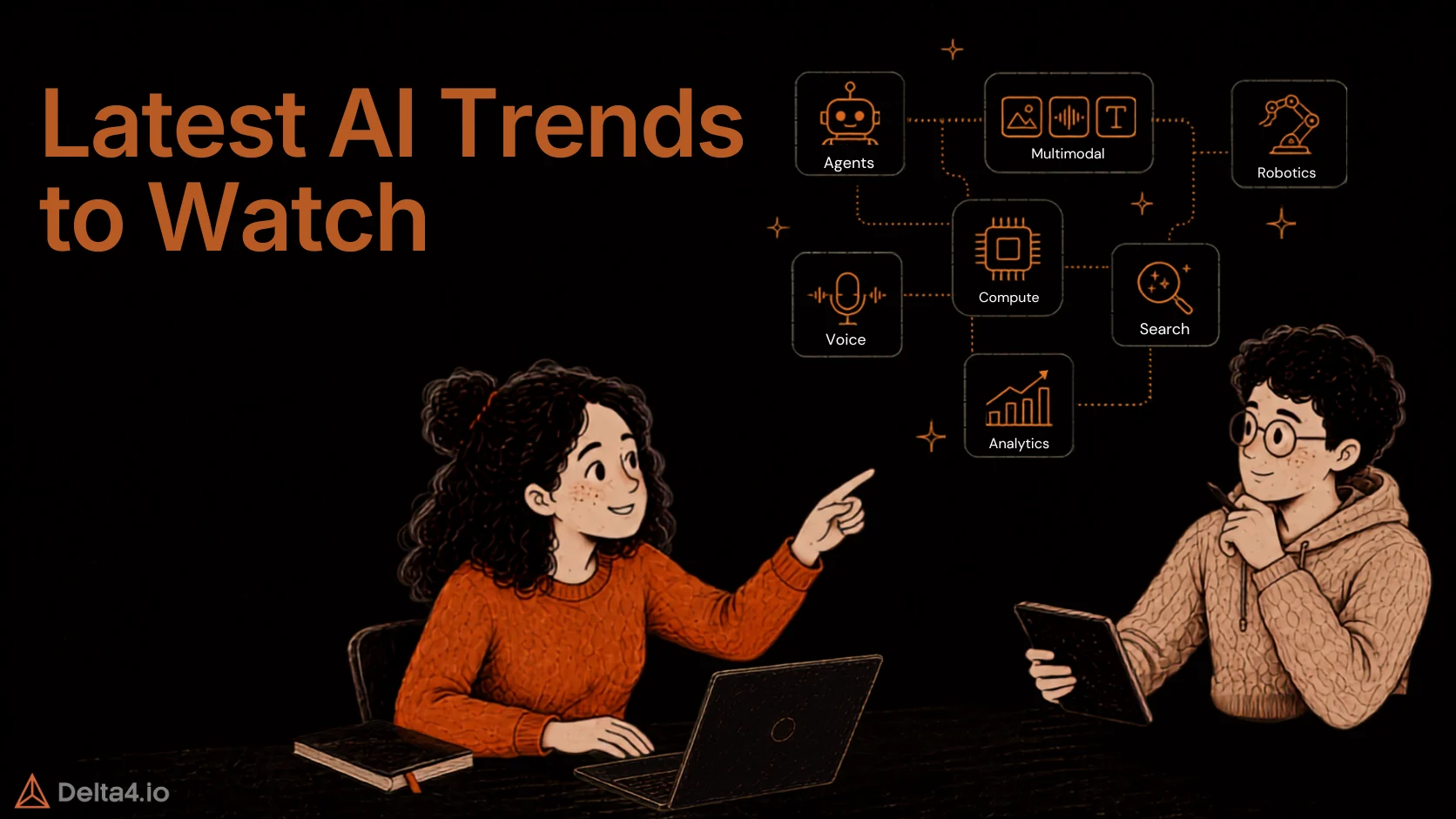
Below are five key trends we believe will shape the future of AI in meaningful ways.
1. Better Language Models with Practical Reasoning
OpenAI’s recently announced o3 model is a prime example of how language models will be in 2026 more advanced. This SOTA model introduces better reasoning capabilities, offering:
- Clear, step-by-step problem-solving skills, ideal for complex tasks like coding and mathematics.
- Enhanced adaptability to everyday business applications, such as generating detailed reports or answering intricate queries.
- Reliable performance in technical and real-world scenarios, making it a practical tool for diverse industries.
- Models will exceeding hundreds of trillions of parameters offer unmatched accuracy and advanced reasoning. Simultaneously, small language models provide efficient solutions for specific tasks, ensuring accessibility even in resource-limited settings.
These advancements are set to make decision-making faster and more precise, reducing the time spent on manual processes.
2. Improved Voice Capabilities
Realtime Voice technology continues to mature, offering practical benefits that directly impact businesses. Recent progress includes:
- Voice agents with advanced contextual understanding, providing more accurate responses and reduced latency & error.
- Reliable voice integration in customer support platforms and other domains.
These innovations ensure businesses can operate more efficiently while delivering better services to their customers.
3. Multimodal AI
Multimodal AI which processes and combines different data types will becoming increasingly relevant. Notable advancements include:
- Assistants capable of handling both visual and textual inputs, enabling richer interactions.
- Tools designed for different sectors where understanding multiple data formats is important.
This approach helps AI systems work with existing processes and simplify tasks.
4. Reliable Autonomous AI Systems
Autonomous AI systems will starting to show promising results across industries. By 2026, these systems are expected to:
- capable of managing repetitive tasks with greater accuracy and minimal supervision.
- a orchestrator agent that will proactively control other based on its own decision making, given permissions it have.
- Used in various other domains other than marketing and customer support.
Customer support, marketing, and sales sectors are already benefiting from these advancements. They are using automated agents to improve operations and productivity.
5. Context will Not an Issue
AI will quickly reaching a point where context limits won’t hold it back anymore. Current advancements are solving the issue of losing track in longer conversations or workflows but in 2026 it goes beyond todays:
- AI will handle long and complex discussions or tasks without forgetting earlier details.
- Responses will feel natural and accurate, even for multi-step processes.
- Teams will be able to rely on AI for managing detailed workflows and tackling challenging scenarios.
By 2026, better memory systems and smarter models will allow AI to maintain context over time. This will make it more reliable. It will also become capable of solving real-world problems without interruptions.
Why These Trends Matter
The AI industry in 2026 will see major advancements. Smarter language models, more safe aligned AI and improved voice technology will make tasks faster and more accurate.
Advancements in reasoning, voice technology, and multimodal systems are helping the industry deliver smarter solutions that work seamlessly. Automation and better context handling ensure workflows are faster and more efficient.
These trends are not just technological advancements; they will solve the real-world challenges.

Article by
HimanshuHead of Growth & Engineering
Himanshu is Head of Growth & Engineering at Delta4 Infotech, writing about AI agents, MCP, and no-code automation from a go-to-market view. He covers how teams evaluate, adopt, and get real value from AI tools, translating what the tech does into what it means for a business.